Archive for category The Bible
Moving toward the eschatological challenge
Posted by simon peter sutherland in Eschatology, Theology on August 18, 2020
 During the Coronavirus Pandemic, a lot of people, Christians and none believers, have been asking a lot of questions. Many Christian spokesmen, leaders and organisations have been expressing their views concerning Covid-19 and its relation to the Christian worldview.
As is common, some views I have agreed with others not. However, it appears that eschatology has become quite topical and many take the viewpoint that we are in the ‘end times’. And in some sense, I would agree.
However, the New Testament is clear that this world has been in the “Last days” (ages, aeons) since the time of Christ. This is stated very clearly in Hebrews 1: 1-2.
God, who at various times and in various ways spoke in time past to the fathers by the prophets, has in these last days spoken to us by His Son, who He has appointed heir of all things, through whom also He made the worlds.
The Epistle of Hebrews was written prior to the events of AD 70 and the destruction of the Jerusalem Temple by Titus. This means that the original author of Hebrews, understood the “last days” as an age that had already begun in his day. However, this right understanding is not always mentioned by dispensationalist thinkers. On the contrary, many Christians understand the “last days” as though it either specifically relates to now or our future, but rarely as a period that began 2000 years ago and could span thousands of years.
When I was a young Christian, the majority eschatological opinion, more often than not, conditioned that term ‘last days’ as expressively related to a time in the distant future when the antichrist would sign a peace treaty and a seven year tribulation would follow. This interpretation is taken from Daniel 9: 27.
But not everybody has subscribed to that interpretation.
When I was a young Christian and newly baptised, I was often presented with a then recent publication called ‘Approaching Hoofbeats’ by Billy Graham. The book was popular back then and the dramatic title intrigued me and although I never read it, I often left the Book of Revelation alone through some form of unease.
Well meaning Christians would say ‘We are in the last days’ and read passages to me relating to ‘antichrist’ and a ‘rapture’. “One will be taken, one will be left” (Matthew 24: 40-41) Yet no one ever referenced any other viewpoint, or mentioned the many contrasting interpretations of those passages.
Eager to read the Bible for myself, I grew up, and after reading the Bible from start to finish, I eventually reached an opposite view. I read the Gospel of Matthew in its original context and could not see any reason why our Lord Jesus Christ would warn, or inform, 1st century believers about events that would happen in Jerusalem thousands of years later when they would be no longer on earth.
This is also true of the Book of Revelation. I still see no reason why John would write to Seven Churches in Asia Minor about events that would happen thousands of years later after those original readers were all dead.
It was then that I realised that this common ‘end times’ theology radically took the original 1st century readers out of the equation.
To cut a long story short, I can now comfortable state that I reject Premillennial and Dispensational eschatology. I view this theological system as incredibly inconsistent with the original meaning of many Bible passages and what Scripture reveals Christ achieved during His Life, Death, Burial, Resurrection and Ascension.
Now days being in the Conservative Evangelical wing of the Church of England, I need not listen to ‘Premillennialism’ since the majority view, (if it is ever discussed) is ‘Amillennial’.
I have now reached a point in life where I am ready to engage in the eschatological debate and challenge this idea of ‘Premillennialism’ with Scriptural and historical facts.
Having said that, I accept that eschatology is in no way a salvation issue and I do not look down upon other Christians as half Christians for believing something different than I. But I have no doubts that many other Christians will not offer me the same in return.
William Salesbury’s Book of Common Prayer and Psalms
Posted by simon peter sutherland in Documentaries, The Welsh Bible, Theology on May 6, 2020
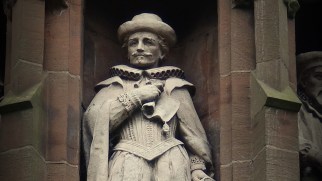
On May 6, over 450 years ago, William Salesbury published The Book of Common Prayer and Psalms, newly translated, into Welsh.
This 16th century prayer book had been previously written for use within the Church of England by Archbishop Thomas Cranmer. The Book of Common Prayer would become an important spiritual ingredient in the daily diet of Christians throughout England, and beyond, and continues to be used by Anglicans, even to this day.
The Book of Common Prayer and Psalms has been deeply revered within Christianity, and a majority of English Bibles were printed and bound with it from the 16th century up to the 19th century. It was that important.
Early 19th century editions published by the British and Foreign Bible Society are among some of the earliest Bibles to exclude the BCP. But earlier printed Bibles such as the Geneva Bible and King James Bibles, all contained Cranmer’s Prayer book.
In the year 1567, William Salesbury had translated his version into Welsh under the title; Lliver Gweddi Gyffredin. Back in those days Parliament was Biblically minded and Westminster had given Salesbury the deadline of 1 March 1567 (St David’s Day) to publish his translation. Sadly that deadline was missed. The Book of Common Prayer and Psalms into Welsh did not appear until May 6. But it was not without its opponents.
Anger had outburst by opponents of the Welsh tongue, and people had aggressively demanded that the translation be utterly abandoned. But such opposition was unfruitful. Salesbury did not give in.
Lliver Gweddi Gyffredin was published on 6 May 1567. But Salesbury was the translator, not the author.
Cranmer’s original Book of Common Prayer had been a work of absolute genius and Christian devotion. Rather than divide the Church, Cranmer sought to unify her through Scripture and Prayer.
Cranmer’s prayer book is a very special gift and people would always do well to read it. The Book of Common Prayer and Psalms is a monumental work that has echoed on through the centuries and has fed the Church of God with Scripture, through with Prayer.
It is not a book of ‘prayers’, it is a book of prayer. We need more of that today, perhaps more now than ever.
 Easter is a ‘Christian festival‘ that celebrates and remembers the resurrection of Jesus Christ. All around the world, Christians and religious persons gather to remember an event that has changed the face of the world we live in.
William Salesbury’s 500th Anniversary
Posted by simon peter sutherland in The Bible, The Welsh Bible on March 6, 2020
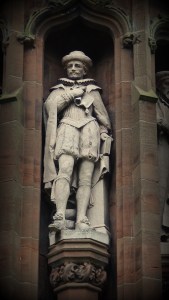 2020 marks the 400th anniversary of the Welsh Bible and the 500th anniversary of the traditional birthdate of Welsh New Testament translator William Salesbury.
According to tradition, William Salesbury was born in 1520 and died sometime around 1580 or 1584. He was from a small town in North Wales and became one of the greatest scholars and Christian hero’s Wales has ever known.
He became an Oxford scholar and withdrew into seclusion during the reign of Mary Tudor between 1553-1558. In 1567 he published a Welsh translation of the New Testament which became the foundation for the 1588 Welsh Bible by Bishop William Morgan.
2020 also marks the 400th anniversary of 1620 Revision of the Welsh Bible by Bishop Richard Parry and Dr John Davies and events around Wales will be held to commemorate this event.
My documentary “William Salesbury, The Man from Lllansannan” marks the dawn of my journey into the history of the Church in Wales and Welsh Christian history. This documentary is my contribution to the life and legacy of this most excellent and dedicated Christian man. Of whom Wales owes so much.
Throughout the Bible, people read, spoke and heard people speak in their own languages. Jesus read the Scriptures in Hebrew, one of His own languages (Luke 4: 16). At Pentecost, the people were confounded because they heard people speak in their own languages (Acts 2: 6). The Apostles and New Testament authors wrote in languages people could understand and the early Church translated them into the common tongue.
Let us remember those who were once in great need of reading the Scriptures in their own languages and remember those who gave their lives and dedication to seeing the most important Book in the world translated into the common tongue.
Ancient Kameiros, and the spread of early Christianity on Rhodes
Posted by simon peter sutherland in Christianity on September 24, 2019
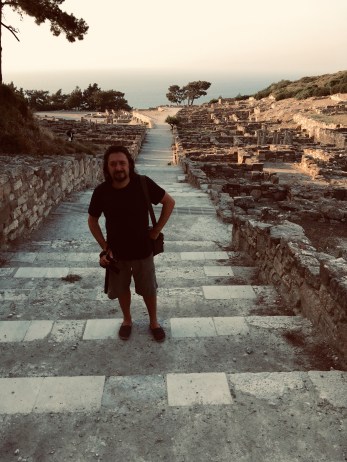
Kameiros, Rhodes © 2019 Simon Peter Sutherland
Recently I visited the ancient City of Kameiros on the Greek island of Rhodes. This is now an archaeological site.
In ancient times Kameiros was one of the three ancient cities of Rhodes and today has some evidences of the spread of early Christianity on the island. Here the city was built upon three levels. There was a Temple of Athena, a Stoa and an Acropolis. There was even a reservoir.
Here, hundreds of people once lived in terrace type houses. On my visit I greatly admired an area where these ancient houses once stood. Here, archaeologists affirm many early Christians once lived.
This is interesting because the first and only time Rhodes is mentioned in the Bible is in Acts 21: 1 and my documentary explores that passage of Scripture. However, it must be pointed out that before the time of Paul’s visit to Rhodes in the AD 50’s, there is no evidence for Christianity on the island. We can only imagine that Christianity must have spread from either Rhodes town or Lindos, after the Apostles visit.
Here in Kameiros early Christians would have had to live amongst pagan temples and the worship of other gods. However, in 142 AD an earthquake destroyed the city. Today it lies in ruins.
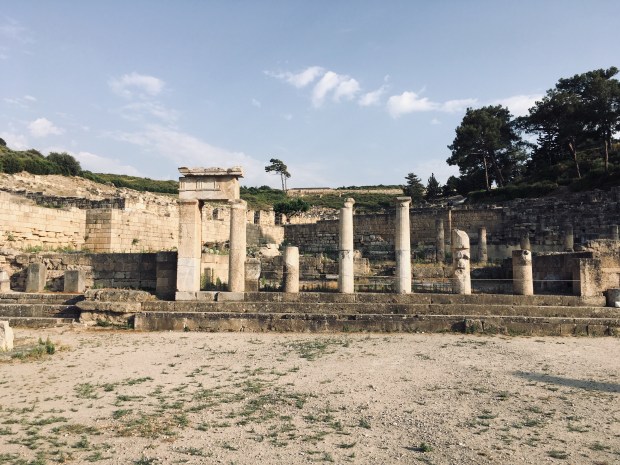
Kameiros, Rhodes © 2019 Simon Peter Sutherland
Much of ancient Kameiros is yet to be excavated, some of the finds are in the British Museum. But what I learned from this visit was that Christianity was present on Rhodes very early. This is interesting because clearly someone brought the Gospel to Rhodes in the early days of Christianity. I propose that archaeology and history affirms that Luke in Acts was correct and that he and Paul brought Christianity to Rhodes on Paul’s third missionary journey.
A 15th century image on St. Paul’s Gate, Rhodes
Posted by simon peter sutherland in Biblical archaeology, The Bible on June 18, 2019

Apostle Paul on Rhodes © 2019 Simon Peter Sutherland
While on the Greek island of Rhodes, I revisited the site of Acts 21: 1. This location is Rhodes Town, the site of the Colossus of Rhodes and St. Paul’s Gate. Here Paul and Luke landed in the 50’s AD.
It is quite easy to miss but within the walls surrounding the Gate of St. Paul, there is a 15th century image of the Apostle high up on the wall.
The image itself is faded and undefined. But it represents the familiar image of the Paul we know.
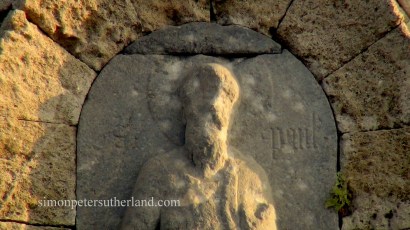
St. Paul, Rhodes Town © 2019 Simon Peter Sutherland
This is Paul the elderly and powerful. His left arm is raised. His right arm is carrying a sword. Representing the sword of the Spirit. His head is leaning to the left.
The Gate of St. Paul was constructed during the 15th century and fortifies an area of the harbour known as the Kolona Harbour. The locals of Rhodes town generally accept that this was the precise location where Paul and Luke landed. This location satisfies me as the site of Acts 21: 1.
Once again, as always, it was wonderful to stand in the places written about in the Bible. The message is clear, keep our eyes fixed upon the Apostles’ doctrine (Acts 2: 42).
Why I once believed in ‘Once Saved Always Saved’
Posted by simon peter sutherland in Limited Atonement, Once saved always saved, Theology on March 16, 2019
 Many years ago I read ‘The Sovereignty of God‘ by A. W Pink. This book is a well written work presenting the doctrine of the Sovereignty of God from the the Calvinistic perspective. It is well worth the read.
In this book the author affirmed the doctrine of ‘Once Saved Always Saved‘. Because of the sheer weight of Scriptures Pink presented, I believed the doctrine as very Scriptural.
A. W. Pink was from Nottingham and in my opinion, Pink was the most consistent Calvinist I have ever read. He was a brilliant man and an excellent Christian Theologian. He proclaimed the doctrines of Calvinism to the fullest with no weakness on his part. Obviously it is not difficult to realise that a man of such Scriptural knowledge would have his collisions with the Church of his day. His biography shows us examples of that. But most of it may relate to his Calvinism.
A. W. Pink should be admired, even by his Theological opponents, because he did not shy away from the proper logical conclusions to the clear teachings of Calvinism. These observations (in my opinion), separate him from the more common, inconsistent and unconvincing Calvinist revisionist preachers and writers of our day.
When I read Pink, it would not be long before I became persuaded by the doctrine of ‘Once Saved Always Saved’. Over time however, and through the clear lens of openly reading Scripture, the impact of Calvinism lost its flavour with me. I began to see too many Scriptures contradicting the system and Calvinistic apologists failing to explain the contrasts with proper exegesis or convincing argumentation.
In answer to my title, the reason I once believed in ‘OSAS’ was because of the selective Scriptures which Calvinists use to affirm their doctrine. I am convinced, if people simply read the Bible and never listened to Calvinistic preachers, they would see that eternal security is conditional and apostasy is possible for true believers. Christians have the duty to abide in Christ and no one can abide in Christ if they never were truly saved to begin with.
As a person who once believed the doctrine of ‘Once Saved Always Saved’, I understand it, not merely from knowledge, but from experience too. It is a very persuasive doctrine. However, over time I could see the natural progression of doctrinal bondage developing. Fear of departing from accepted doctrines and the teachings of popular preachers became easy to break when I digested and trusted the words of Christ “the Truth will set you free“.
The truth be told, people who believe in ‘Once Saved Always Saved’ very rarely arrive at that conclusion by simply reading Scripture alone, but by listening to their favourite preachers or their pastors, or biblically external books. For many people and preachers, the doctrine of ‘OSAS’ is Scripture itself and for an individual to deny it either makes a person a half Christian or simply not born again. These opinions however are absolute none sense. No one need accept such attitudes or permit themselves to be bullied into beliefs that contradict Scripture.
Obviously I would not regard those who teach the doctrine as false teachers, but I would say that without their rhetorical skills, the doctrine has little Scripture to authenticate it. The facts remain, as I have written in a previous article, the doctrine of ‘OSAS’ is a historical anomaly and was not taught in the church until the 16th century. John Calvin was probably the first person to have properly taught the doctrine. As I have previously argued in an earlier article, the doctrine likely has Gnostic origins rather than Scriptural foundations.
Over recent years I have repeatedly re-examined the doctrine and the more I read the New Testament from this perspective, and explored the contexts and the Greek, I saw an overwhelming amount of Scriptural evidences to claim the doctrine has little weight to it at all. In fact, there are so many Scriptures that contradict the position, many Calvinistic apologists and preachers are left scraping the barrel for argument, so much so that they are in danger of getting splinters under their finger nails.
The truth be told, there are over sixty or so verses in the New Testament which speak as warnings to Christians to remain loyal and in the faith and to abide in Christ.
It seems quite clear that the Calvinist claim that any believer who departs from the faith, was never truly saved in the first place, may well have some accurate Scriptural examples, but the majority of the doctrine is a violation of the plain reading of Scripture.
Is “rebaptism” by immersion Biblical?
Posted by simon peter sutherland in Baptism, Christianity, Theology on February 12, 2019
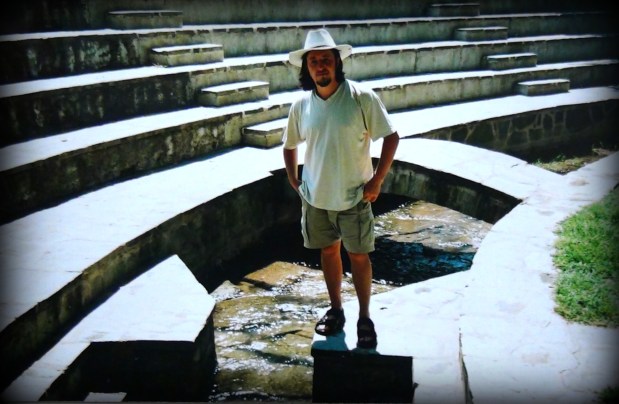
Simon Peter Sutherland @ Lydia’s river, Philippi © 2020 Simon Peter Sutherland
Over recent times I have been made aware of the ever growing trend of “rebaptism”. For some, “rebaptism” by immersion is baptism, nothing else. Modern ‘rebaptisers’ claim that there is only “one baptism” and the reason they baptise someone for a second time, is because the first baptism was not legitimate at all.
As always with all my beliefs and Christian practices, I claim that I do not believe or affirm anything in the name of Christianity, if it is not in the Bible. But these days almost all Christians claim that. Some ‘Christians’ claim they hold to ‘Scripture alone’, yet their doctrines are so broad, and unorthodox that it is difficult for me to read or hear them with a straight face. Others have so many variant doctrines, that I have absolutely no idea where their beliefs come from? All I know is they do not come from the Bible.
One of these ideas is the growing trend of ‘rebaptism’ by immersion. An unorthodox practice that is largely associated with ‘Oneness Pentecostals’ and ‘Southern Baptists’ and ‘youth groups’. This ‘baptism’ by definition is a baptism of a person who has been previously baptised, but some denominations or individuals do not accept previous baptisms as valid, because they were done in other churches. The common claim is that the person who has been previously baptised, did not actually fully believe in Jesus when the previous baptism occurred. The proposal is that the person must be “rebaptised” or simply “baptised”.
This trend of ‘rebaptism’ is absolute none sense! The facts remain that there is not a single reference in the entire New Testament for anyone to be ‘rebaptised’ or baptised more than once in the Name of the Father, Son and Holy Spirit. Thus the answer to the rhetorical title: “Is “rebaptism” by immersion Biblical?” the answer is a direct no. ‘Rebaptism’ simply denies Colossians 2: 12 and the power of God to raise a person up from being dead in sin unto new life, regardless of where that person was spiritually when the baptism occurred.
The harsh and real truth is, baptism by immersion is irrevocable. If someone is foolish enough to get baptised, and yet that person did not truly believe, then that person should take responsibility for their unbelief and actions and seek God for forgiveness. A minister should not allow his congregation to move beyond the realm of Scripture and orthodoxy because a false convert or persons in his congregation have previously made a foolish mistake of being baptised while they have an evil heart of unbelief.
Likewise, a person who goes into a new church and is pressured into being ‘rebaptised’ because the minister or teacher has convinced them they are not really saved, should search the entire Bible first. All people who experience this pressure should ask their pastors why there are no rebaptisms or repeated baptisms, or two baptisms in the Name of the Father, Son and Holy Spirit in the Bible.
Likewise people should ask why there are no denominational rebaptisms in the Bible? Is a single baptism in the Name of the Father, Son and Holy Spirit insufficient?
Likewise, the idea of rebaptising false converts is also destroyed by the Bible. In Acts 8 when the sorcerer was baptised, and after ward tried to purchase the Holy Spirit with money, Peter told that person “your money perish with you” (Acts 8: 20). Peter told the man to repent and seek God for forgiveness, in the hope that God may forgive him (Acts 8: 22). Peter did not mention anything about a rebaptism and neither did Luke the author of the Book of Acts.
What is clear is that the modern unorthodox revisionist and emotionally charged practice of ‘rebaptism’ by full immersion in the Name of the Father, Son and Holy Spirit, is nothing less than fiction.
Discerning Biblical truth from fiction…
Posted by simon peter sutherland in Biblical Scholarship, Theology on November 8, 2018

The term Biblical truth does not always mean what the individual person considers the term to mean. Each person has a definition of every word. What is Biblical truth to one man is heretical to another and vice versa. The Bible has a habit of contradicting many of our ideologies and theologies. But for me, when something is clearly stated in scripture and plainly referred to, the ideas and opinions of men mean little to me. Where the truth is concerned, what does it matter what men may think?
It is a fact that the many spurious gospels employed by modern secular critical scholars when dealing with the historical and spiritual life of Christ were written much later than the canonical Gospels and letters. It is not difficult to conclude that many of these writings are fictional fabrications and interpretations of real events and real people. Since many apocryphal texts are not conclusive in terms of dating due to the lack of historical reference in the texts they cannot all be deemed as truth but rather fictionalised truth.
I bring to attention the “Acts of Paul” which Tertullian claimed was a forgery by a Presbyter who wrote it out of his “love for Paul” 1. These texts, though interesting, are not as good as the biblical texts. They have very little majestic quality to them and I conclude the reason why so many were not included in the Biblical canon, is because they were not authoritative. Some of them contain stories that are so fictional, they appear unbelievable. Yet they come in useful to help us understand the minds of the ancients. If they are a record of beliefs and myths and factual traditions from the early Christians era’s, they can be useful. The problems happen when modern critical secular scholars use those texts in relation to Jesus in their attempts to disprove the New Testament. Too often they make out many of these books are modern discoveries and that the New Testament contains blatant errors. Yet scholars have been debating textual issues from the earliest days of the church. The arguments when presented today are merely part of a much larger soup of recycled argument. Re-packaged, re-marketed and re-developed for a modern audience.
EXCERPT FROM UPCOMING BOOK BY SIMON PETER SUTHERLAND
© 2018 Simon Peter Sutherland
-
You are currently browsing the archives for the The Bible category.
Simon Peter Sutherland
-

 Simon Peter Sutherland