Archive for April, 2026
New Shroud of Turin “research” article and how it “ties in with the Bible”
Posted by simon peter sutherland in The Roman Catholic Church, The Shroud of Turin on April 30, 2026
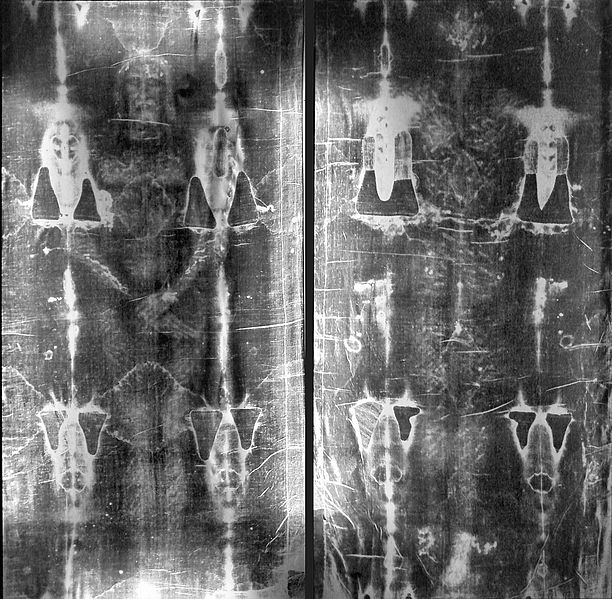
I’ve been reading an article lately about a latest theory on the Shroud of Turin. The article claims the “Christ-like image” may have been caused by “a massive earthquake.”
It goes on to say that the severe earthquake mentioned in Matthew 27: 50-52 was “powerful enough to release radiation that could have imprinted the image of Christ on the shroud.”
The article expresses the opinion that God used “natural means” to form the image, which is not beyond the realm of His character. He rules the winds and the waves, He governs the earth, there is none like Him.
It is possible there may have been multi layers to the purpose of God bringing about an earth quake in the first place.
The article also states “The man of the shroud was not buried in the material for more than a few days”.
I think the image on the Shroud would certainly help prove the resurrection of Christ, if it is genuine, because there is no evidence of a rotting corpse on the cloth. The Shroud shows the image of a man who had recently died when the image was formed, yet if the body had continued to be wrapped within that cloth, it would have decayed and left evidence of the rotting corpse. Which is doesn’t.
This is consistent with Messianic prophesy from Psalm 16: 10, “You will not leave my soul in Sheol, Nor will you allow Your Holy One to see corruption.” (NKJ)
In St Peter’s sermon in Acts 2: 30-32 the apostle says that Jesus fulfilled that prophecy by His resurrection.
I have also seen claims that the Name of Jesus has left an imprint on the cloth which came from an identity label that would have been attached to it after the body was wrapped.
But let’s not say that because it is possible that the Shroud of Turin may well be the burial cloth of Jesus Christ that means the Roman Catholic Church (who possess the artefact) is the true Church of Jesus Christ because it is not. There are plenty of establishments that own and display Biblical artefacts, from museums to libraries, many who are not even remotely Christian.
There is not a shred of evidence for papal authority in the New Testament. Outside of Matthew 16: 13-20, which they twist, Peter himself never mentions himself as a bishop of Rome or a pope. In 1 Peter 1: 1 Peter simply refers to himself as “an apostle”. In 2 Peter 1: 1 he refers to himself as “a bondservant”. If Peter was a pope, he would have mentioned papal authority which he does not. Neither does James, the half brother of Jesus who was a leader of the church in Jerusalem. When the Jerusalem council met it was run by James, Peter and John, not Peter alone (Acts 15: 6-29). Papal authority is not in the Bible. Mark doesn’t mention it, Luke doesn’t mention it, John doesn’t mention it, Paul doesn’t mention it, the author of Hebrews doesn’t mention it.
Scripture is clear that Christ is the rock of His church, not Peter. And if any church is not built on that rock it is not the Church of Jesus Christ, but a house built on sand.
Let us not forget that now is the time to get what we believe right and proper. It’s too late when we die.
Let us not forget that death not something that we should avoid thinking about, is just a sad reality of life. “We are all mortal.” But the man on the Shroud, if he is indeed the Christ, is immortal, because Christ came back to life. Let us follow Jesus Christ not man made religions.
Christian man burned alive in England
Posted by simon peter sutherland in Church of England, Martyr George Marsh, The Roman Catholic Church on April 24, 2026
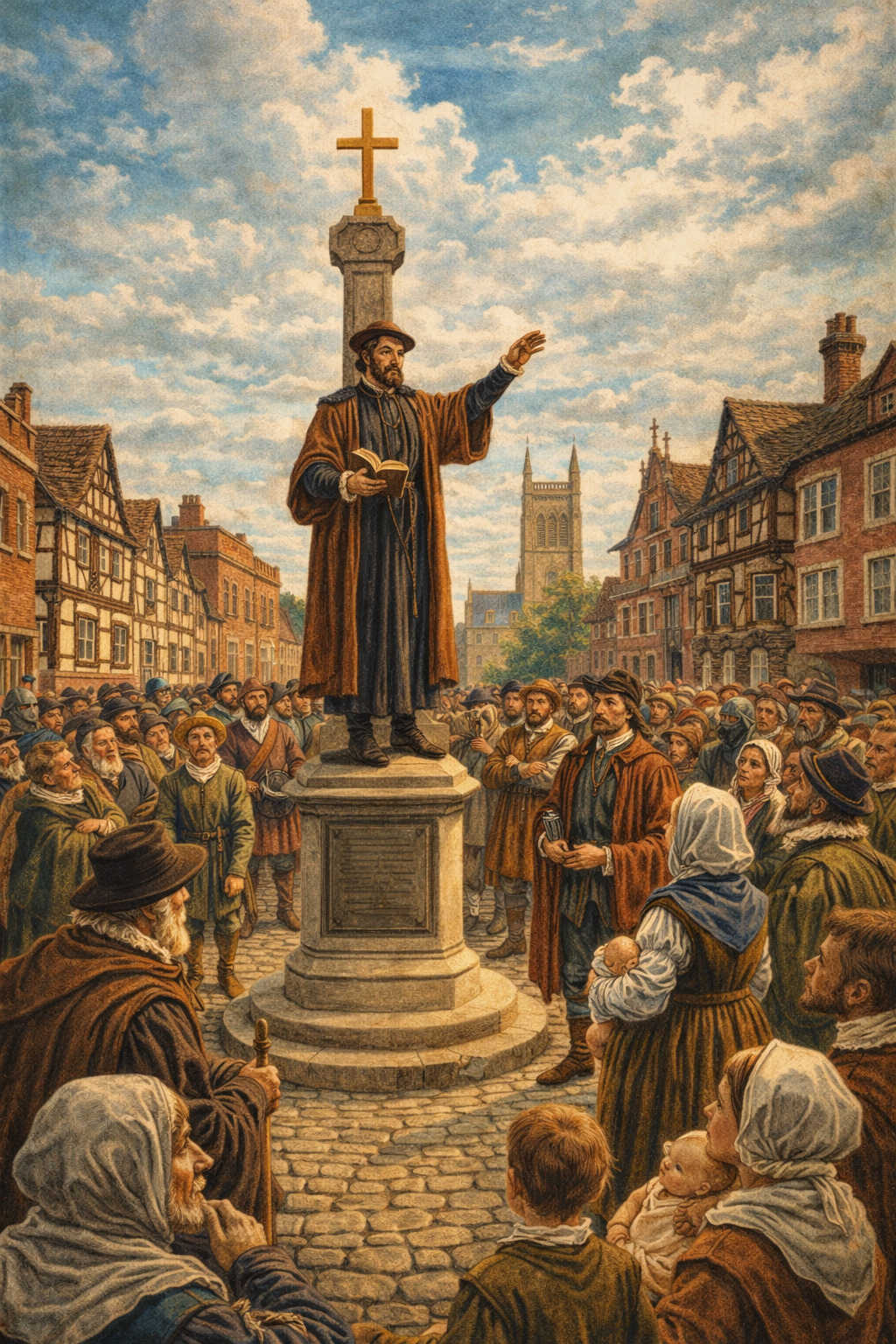
It is true, alarming isn’t it. That one man could be set fire to for preaching and believing something. Well, that is exactly what happened.
On this day, April 24, 1555, George, a farmer from Bolton, was burned alive for believing something different to the Roman Catholic authorities of that time. He had a family too, several children, yet still. They killed him. And for what? Because he preached without a licence and because he refused to submit to the authority of the pope and didn’t believe that Jesus’ flesh and blood could be remade at the mass and eaten like food and drunk like ale.
It’s a sad story and it’s backstory is even sadder. George lost the love of his life, his beloved wife died leaving him lost and alone. Marsh left for Cambridge and there he experienced a new way of life and he became a curate and taught a school. But then, when the monarch died, George was left to face a changing political tide. The dangerous Mary Tudor came to the throne and Marsh was one of many Christians who were hunted down for refusing to submit to her regime and Roman Catholicism.
George revisited his kids in Bolton and a warrant was put out for his arrest and he was taken to Lancaster Castle, and eventually to Chester where he would be burned alive in Boughton, about a mile or so outside the city.
Today his descendants live on and there are a number of memorials to him scattered around the north. In Bolton there is a memorial in the grounds of Deane Church, a memory of him in Smithills Hall, and Lancaster Castle still exists. In Chester there is a plaque to him in St Johns Cathedral and a memorial to him, near his execution site in Boughton. This is near the consecrated ground where his execution took place. A little further on there is a plaque on a wall where his remains were scattered by fellow believers after George was burned.
May this legacy live on.
Is Simon Peter really the rock of the Roman Catholic Church?
Posted by simon peter sutherland in Biblical Scholarship, England issues, The Roman Catholic Church on April 10, 2026
Throughout my youth, my mother always said that I was never deliberately named after St Peter, the apostle of Christ. Although at times I think I was. My mother originally got saved in 1972 after seeing a cross in a window, and when she went home she always said that Jesus appeared to her in the room of the house where my parents lived.
My father became a Christian the following year, in 1973. I was born that very same year.
Over recent years and months I have revisited the locations where these events happened and they have a very close affinity with me and my family. My mother was a very dedicated Christian who spent all of her life testifying about Jesus and singing about Him wherever she could. My dad on the other hand was a preacher, and a fishmonger.
I think some of these influences have impacted me throughout my life.
Like St Peter, I too like to go fishing. Like St Peter, I too believe Jesus Christ is the only way to heaven. Like Peter, I too follow Christ.
For me, I don’t like it when the very true apostle of Christ, who bears the same name as I, is slanderously claimed to be the founder of the singularly most apostate religion to have ever claimed the Name of Christ.
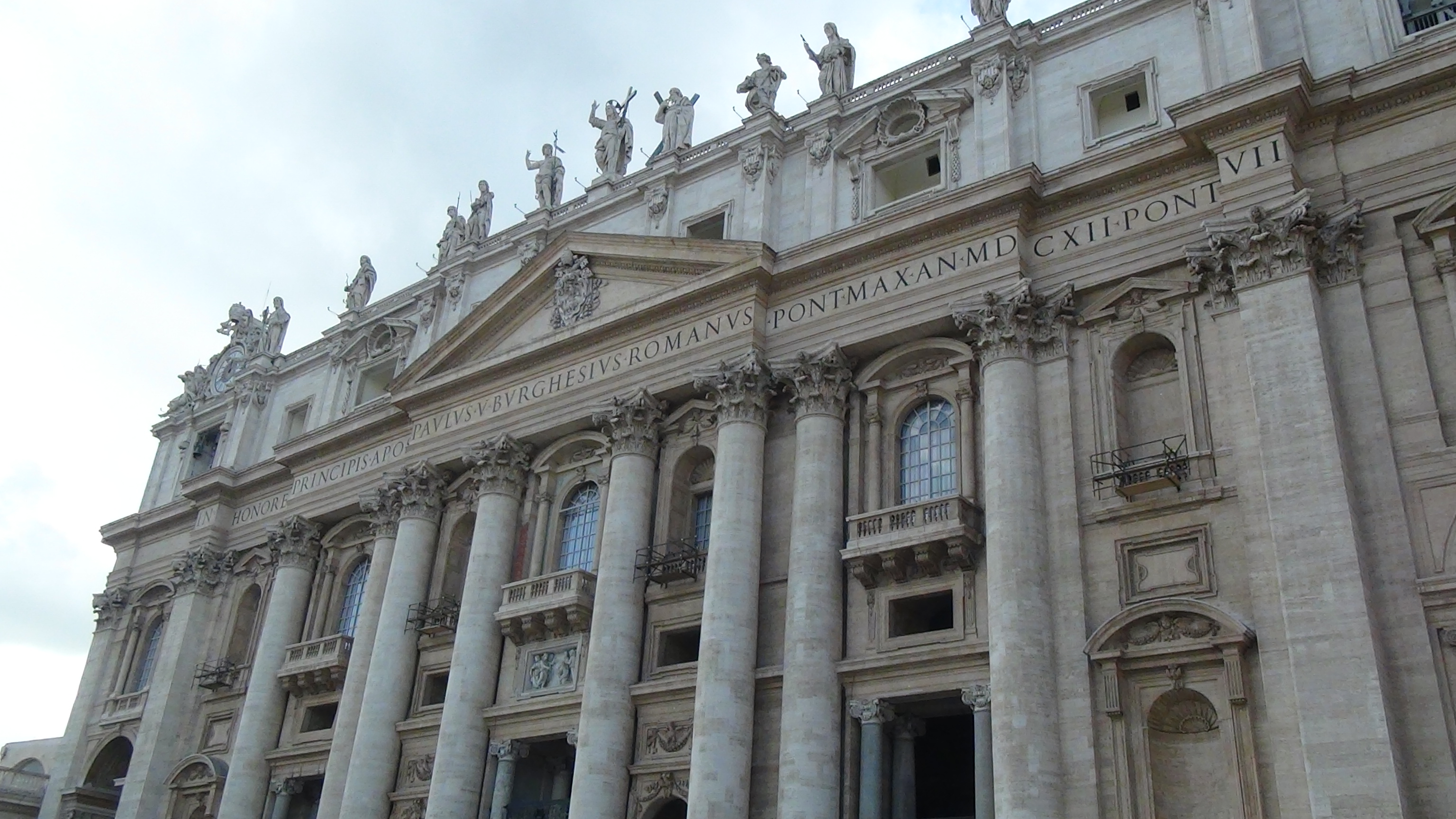
I am speaking of course about the Roman Catholic Church. An establishment that claims Peter was its first pope. This claim of course is absolute nonsense. The Roman Catholic church as it stands today was not even formulated unto 1054 A.D at the Great East West Schism. The facts remain that the early 1st century bishops of Rome had nothing whatsoever to do with modern church of Rome. Today the Vatican is an empire, a political power, a religion that affirms many acts that the Bible speaks against.
But let us look at this claim of St Peter being the rock of the Roman Catholic Church.
The claim itself comes from Matthew 16: 18 where Jesus says to Peter, “I also say to you that you are Peter, and upon this rock I will build My church, and the gates of hell shall not prevail against it.” (NKJV)
Let us imagine for a moment that Peter was the rock that Christ chose to build His church upon, would that mean that church was the Roman Catholic Church? If it were, would that exclude all other churches? Would that mean that Peter was only the rock of Rome, or only those churches the pope has jurisdiction over? Would that exclude the Greeks? Would that exclude the churches that St Paul founded? Or the Church of Jerusalem that was run by James? Would it exclude the church run by Titus on Crete?
The Greek word that Matthew uses to communicate “rock” is Petra, which means “a (mass of) rock, (literally and figuratively): – rock”. (Strongs G4073)
This word can be found in Matthew 7: 24-25, where Jesus says a wise man builds his house upon the rock. Was Jesus talking about Peter here? Was Jesus saying that a wise man builds his house upon St Peter? I don’t think so. When the wise man Jesus is speaking about built his house upon the rock Jesus was talking about the wise man building his faith upon Jesus Christ.
It is more consistent to say that Jesus was building His church upon Peter’s declaration of faith which came from the Father (Matthew 16: 17).
When Jesus says “you are Peter,” (Matthew 16: 18) He is acknowledging Peter as one of His disciples and when He says “and upon this rock I will build My church,” He was saying that like the wise man built His house upon the rock, so also Peter built his house of faith upon a solid foundation, which is the true confession of faith.
This confession of faith has lasted for 2000 years since Jesus said those words and Christ’s church has never gone away.
The reality is that if the Roman Catholic church views Peter as the rock that the church has built itself upon, then it is a house built upon sand and not upon the rock.
Roman Catholic’s may well view Peter as the rock of the Roman Catholic church, but he is not the rock of the body of Christ. Jesus Christ is the rock of the body of Christ, not Peter.
-
You are currently browsing the archives for April, 2026
Simon Peter Sutherland
-


