Archive for category Christianity
“The Divine Saviour in the Dark Light of Modern Critical and Sceptical Scholarship” coming soon
Posted by simon peter sutherland in Biblical archaeology, Biblical Scholarship, Theology on March 21, 2026
“Over the last two thousand years or so, the Christian faith has had more than its fair share of enemies.” I write “When Jesus was born, whatever date that may have been, Herod sought to have the Christ-child put to death. In the Gospels, the authors record how many attempts were made on Jesus’ life, only one was granted. All Four Gospels agree that Jesus was crucified and died. From the human perspective, Jesus had been executed for proclaiming Himself King. All other accusations against Him failed. In Jerusalem, at an ancient execution site outside the city walls, Jesus of Nazareth was nailed to a cross and died. This is historical fact.
To all intents and purposes, the story should have ended there, but it didn’t. The Gospels claim that Jesus came alive again and remained on earth for a period of forty days.”
The above words are a quote from my new upcoming book “The Divine Saviour in the Dark Light of Modern Critical and Sceptical Scholarship” a book that objects to the many speculative criticisms made by sceptical scholars over recent years. For those who do not know, sceptical and critical scholars are those who doubt the authenticity of the Bible and are often very vocal about it.
In my book I explore the history of the Bible and offer proofs in defence of the historicity of the Scriptures and I believe the work can be a valuable resource for many Christians who believe in the infallibility of the divine word.
Now that I have completed my documentary series on St Paul and the Greek Islands, “The Divine Saviour in the Dark Light of Modern Critical and Sceptical Scholarship” will be available soon.
The second coming of the King of kings, Advent reflections with J C Ryle and Matthew 24: 29-35
Posted by simon peter sutherland in Christianity, Christmas, Eschatology, Theology on December 1, 2025

I have begun the reading of a book “The Coming King” – 25 Readings For Advent with J. C. Ryle.
Ryle was Bishop of Liverpool between 1880 and 1900 and the readings are taken from his Expository Thoughts on the Gospels, some of the best commentaries available today.
In this part he deals with “our Lord’s prophecy” from Matthew 24: 29-35 where Christ describes His own second coming. In this passage we are told that Jesus will return with great power and glory quite different to His first appearing. During His incarnation Jesus was a man of sorrows (Isaiah 53: 3) He was not some ordinary joker Man who talked a lot, and blended in, He was a quiet Man and when He spoke He spoke with power and authority. If He did speak all the time, His words would not carry the same weight, yet His words were like no other, they had weight and strength. No one ever spoke like this Man. Even the authorities could hardly refute Him, even though they tried. He was the King of kings and Lord of lords, and no one had authority over Him unless it was granted by the Father.
When He was born, He was born humbly, among the lambs reared to be offered in the temple sacrifices. As He grew, He grew in favour with both God and man, yet He took on the form of a servant, rejected by mankind. Betrayed by his friend and condemned to death of a cross. Yet it did not end there, if it did, faith would be worthless and in vain. No, Christ rose from the dead and ascended into heaven where He reigns forever more. We do not need to wait for His return to know that He reigns, He is reigning now from heaven. We do not need to wait for some futuristic kingdom to take place on earth when He returns to Jerusalem, He is reigning now from heaven on the throne of David. And one fine day He will return and men will receive the fulness of eternal life or the sentence of eternal death.
Remember this, lest you live a pointless and meaningless life. There will be no escape from anything when He returns. There will be no opportunity for people to change their minds and believe once He returns. It will be the end. No thousand year reign. No second chance. No scoffing at Him. He will return to this earth when you least expect and no one will escape Him. He will not be the same as He was at His first coming, He will not be the Jesus people mock and blaspheme, and think they can walk all over, He will be returning with all His power and glory in the clouds of heaven, and no eye will be able to escape from Him. No ear will be unable to listen to Him. No sin will be left uncovered. No one will be able to escape. It will be the end.
What a terrible day that will be.
I wonder where you will be on that day? Will you be preaching, only to find yourself lost without salvation? Will you be drinking, only to find yourself thirsty? Will you be walking only to find yourself on your knees? It doesn’t have to be that way, you can pray. You can receive Christ at any moment of the day. You don’t need a priest, He is our priest. You don’t need a pastor, prophet, or pope or mediator, Jesus is our Mediator. All you need to do is pray and receive Him and you too will be given the gift of eternal life in the arms of our Lord and Saviour Jesus Christ.
Examine yourself whether you are in the faith (2 Corinthians 13: 5) Evaluate your beliefs. Consider your actions, and see if they line up with the gospel. Test your faith and yourselves, and keep awake, so that when Christ returns, He will not find you sleeping.
Is AMiE a better option than the CofE
Posted by simon peter sutherland in Christianity, Church of England, Reform on November 13, 2025

It is quite evident to most Christians now that the Church of England has fallen headlong into apostacy. A large percentage of ministers and bishops are in favour of practices and re-interpretations of Scripture which any Bible believer cannot accept.
It has been a long and tiring debate and conservative evangelical ministers are doing the best they can to uphold the church’s teaching on sexual ethics and Scriptural doctrines while at the same time holding the blanket concerning their future careers.
There are serious problems happening with the establishment and you know there is an even deeper issue on the horizon when the King prays with the pope for the first time in 500 years and now they have a very liberal catholic female archbishop about to be seated on the chair of St Augustine. An act for which Archbishop Thomas Cranmer would be turning in his grave.
The question is what to do about it?
Roman Catholic’s are being sneaky right now and are chasing in on this cradle of insecurity by trying to woo Anglicans back into their lair of popery. What’s wrong with that, people might say? Well, there is a great deal wrong with that. For a start off Roman Catholicism is not Christianity it’s Roman Catholicism. It is a religion that prays to the dead, worships a goddess, rejects justification by faith alone, condemns reformed theology and believes that the Eucharist is literally the body and blood of Jesus Christ, which is cannibalism and vampirism. On top of all they they quite literally believe that the pope is Christ’s vicar on earth, which means to be in place of Christ.
Not to mention the fact that they worship apparitions of a demon masquerading as the virgin Mary.
We live in very dangerous religious times and for this reason Paul wrote, “Take heed to yourself and to the doctrine. Continue in them, for in doing this you will save both yourself and those who hear you.” (1 Timothy 4: 16) Just because a religion claims to be Christian, does not make it so. Each one of us needs to examine claims and doctrines and do it closely with the Bible in hand. There is no need for a bishop to guide you in this, you can research and decide for yourself.
As you can tell I am a nonconformist at heart, I don’t believe things just because people preach them. I need proof.
That being said I am not the type of person who tells people what to do. Each of us must make our own choices in this life and everyone must decide for him or herself what each one of us must do. But I am going to recommend to you that if you are going to leave the Church of England, either now or in the future, do not go running off to Roman Catholicism. It is a corrupt religion with a rotten past and a future reliant upon it’s claim that the pope is a direct successor to St Peter. Such a claim in itself is useless since in Revelation 3: 16 Jesus warns a lukewarm church that He will vomit them out of His mouth unless they repent and that church in Laodicea knew John and St Paul, so if you can understand my perspective, it makes no difference if a church in history knew St Peter or John or Paul, Jesus can still remove them from His body if they apostatise like the Roman Catholic Church has done.
I assure you, there are better options for people who may be thinking of leaving the CofE, don’t go crawling off to the Roman Catholic Church, go to an independent church or why not give AMiE a try?
AMiE stands for the Anglican Mission in England and is not a state run church, it has no female bishops, no women vicars, no heresies, just basic Christianity and in the Anglican tradition.
Were Aquila and Priscilla joint church leaders?
Posted by simon peter sutherland in Christianity, Church of England, Is Female Leadership Biblical?, The Bible on September 8, 2025
Continuing on with my previous article on Priscilla, and my continued articles on Junia and Phoebe and we come to a passage of Scripture again used by liberal revisionists to usurp the unbiblical position of women leadership. This time we are looking at 1 Corinthians 16: 19.
Paul writes,
“The churches of Asia greet you. Aquila and Priscilla greet you heartily in the Lord, with the church that is in their house.” (1 Corinthians 16: 19. NKJV)
Revisionists liberals use this passage to claim that women can be leaders in the Christian church. But the passage doesn’t say very much does it. It certainly does not say that a woman can be an archbishop, rector or pastor. In fact all it says is that a 1st century Christian couple sent their greetings to other believers in Corinth.
So what is all the fuss about?
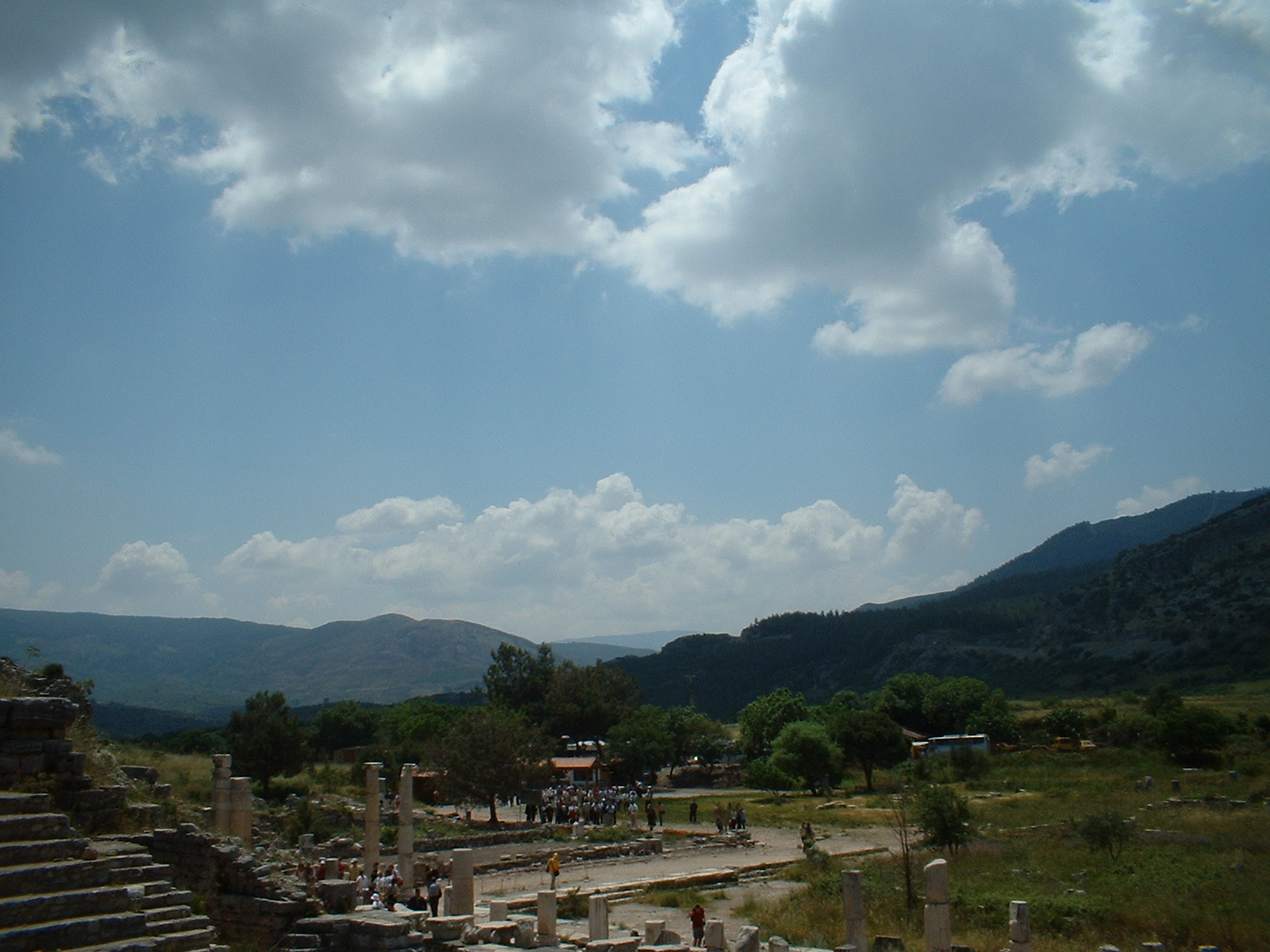
The answer is, there isn’t any fuss. The passage says nothing about joint leadership as the modern revisionist liberals claim. Paul was simply writing to an early 1st century church and says, “The churches of Asia greet you”. That is the churches that existed in the 1st century in Asia Minor, on the western shore, now modern Turkey. Paul writes, “Aquila and Priscilla greet you heartily in the Lord” by which he offers a warm greetings along with “the church that is in their house.”. This was a congregation that met in the house of this Christian couple and the apostle is being courteous to them. Paul is not writing about a state church or an institution or denomination. There were no chapels at that time. No church buildings. No cathedrals. No paid clergy. No archbishops earning a salary of £85,000 per year. These good 1st century Christians opened up their family homes for assembly’s of fellow Christians to worship together in.
Perhaps when this is considered we can understand why Paul is mentioning this Godly married couple. They were clearly wonderful Christians and perhaps that is how we should view this passage. Paul is just being very courteous to a couple who have been of great service to him in his missionary purpose.
Aquila and Priscilla were tentmakers by trade who had been expelled from Rome (Acts 18: 2) and accompanied Paul from Corinth to Ephesus (Acts 18: 18) They played a significant role in bringing Apollos to faith in Christ (Acts 18: 26) as my previous article demonstrates. In Romans 16: 3 Paul refers to them as “fellow workers”. There is no mention of preaching or teaching and certainly no hint whatsoever that any woman could be a bishop, archbishop or pastor. and the greek word translated workers does not denote ministry. Thus, I see nothing in these passages of Scripture to cause me to agree that women should be ministers in the Christian church.
Paul mentions Aquila and Priscilla (or Priscilla and Aquilla) together in six passages, and in 1 Timothy 4: 19, John Gill argues the Latin Vulgate adds “with whom also I lodge“. Thus demonstrating the generosity of the Godly couple.
Thus, if we look at 1 Corinthians 16: 19 in an open light we see there is nothing in this passage to cause any of us to believe Aquila and Priscilla were joint church leaders. Paul was simply informing his 1st century readers that a growing congregation was meeting at that time in their home and since Paul mentions Aquila first, we should assume he was the leader of this house group.
If you doubt what I am saying and have been persuaded by corrupted church leaders and revisionist liberals, ask yourself a question: wouldn’t you have the courtesy to mention the names of a married couple who let you have a house group or church meeting in their home?
If the answer is yes, then perhaps you can see why Paul mentions them.
Does Acts 18:24-26 say Priscilla was a preacher?
Posted by simon peter sutherland in Biblical archaeology, Church of England, Is Female Leadership Biblical? on September 3, 2025
In my previous articles on Phoebe (Romans 19: 9) and Junia (Romans 16: 7), I demonstrate my reasons for rejecting the modern revisionist claims that women can be leaders in the Christian church.
In this post I will be discussing another Scripture used by revisionists who argue in favour of female leadership. Revisionists like to claim that Luke in Acts mentions a woman named Priscilla as though she was a woman of Christian leadership. Yet nothing could be further from the truth. Let me show you why.
In Acts 18: 24-26 St. Luke mentions a man named Apollos who met a Christian couple in Ephesus by the names of Priscilla and Aquila and at that time Luke claims that Apollos only knew the baptism of John the baptist.
Luke writes,
“Now a certain Jew named Apollos, born at Alexandria, an eloquent man and mighty in the scriptures, came to Ephesus. This man was instructed in the way of the Lord; and being fervent in the spirit, he spoke and taught accurately the things of the Lord, though he knew only the baptism of John.
So he began to speak boldly in the synagogue. When Aquila and Priscilla heard him, they took him aside and explained to him the way of God more accurately.” (Acts 18: 24-26. NKJV)
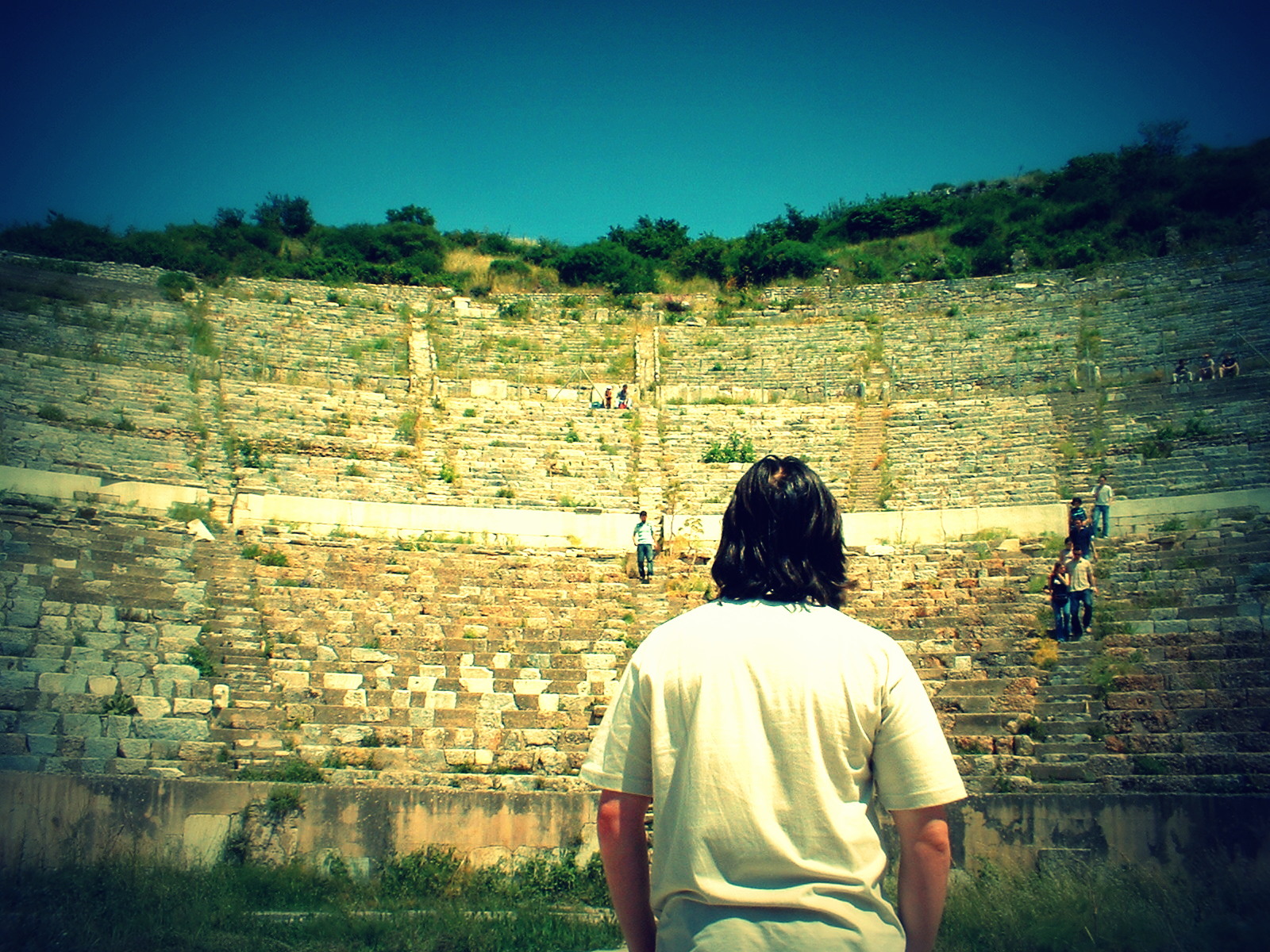
Ancient Ephesus is no longer part of civilization, it’s a historical landmark and an archaeological site. My wife and I visited Ephesus many years ago and walked the streets where this event happened. At that time I was involved in a great deal of church work. People knew my wife and I as a Christian couple and we had many discussions with people about the Bible and what it all means. Often times we would have discussions with believers who were not seeing Scripture rightly and engaging conversations would happen to show Christ more clearly. Yet neither of us believe in women leadership.
That is what I see going on here in this passage. Luke communicates how the man named Apollos was in Ephesus and he was very knowledgeable but didn’t yet know all he needed to know about Christ. Apollos only knew the baptism of John the baptist and had been teaching in the synagogue at Ephesus. The very fact that Luke states he taught in the synagogues and only knew the baptism of John sets this whole passage in its proper context. This is what happened.
When Aquila and Priscilla heard about him and how he was Jewish man who didn’t know about Christ, they delivered the truth to him about the Messiah. Some years earlier Apollos had likely returned to Alexandria after receiving the baptism of John and never fully knew that Jesus had fully come and had been crucified, risen and ascended. So the Christian couple explained what had happened and Apollos believed and received this truth.
Luke is communicating that Aquila and Priscilla evangelised to Apollos which they did in the ancient city of Ephesus. Please do not let modern revisionists distort the meaning of this two thousand year old text. Luke does not say that Priscilla was in any kind of church leadership, he merely communicates that the godly couple witnessed about Christ in the context of evangelism.
In short, all that happened in this passage of Scripture is that a married Christian couple witnessed Jesus Christ to a Jewish man from Alexandria. That’s all.
“From Obedience To Freedom” free book offer
Posted by simon peter sutherland in Christianity, The Bible, Theology on August 7, 2025
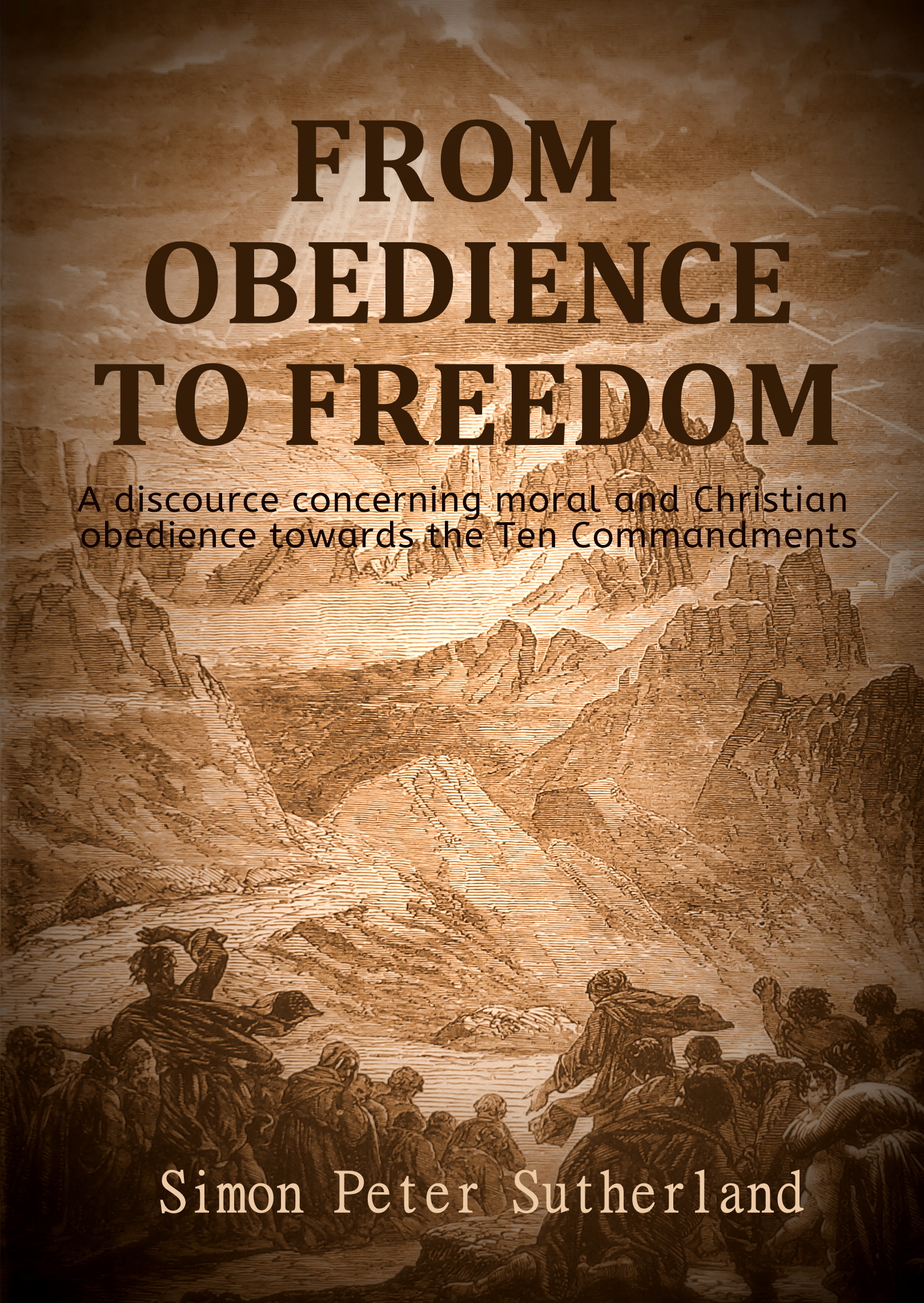
In May I published my first book “From Obedience To Freedom” A discourse concerning moral and Christian obedience towards the Ten Commandments.
In this book I discuss the Christian’s voluntary service towards Christ and His commandments. The book has taken me many years to write and in it I discuss a variety of opinions and I also present the historical views of reformers and other persons and use the King James Version. I discuss how voluntary obedience to the Ten Commandments is not a works based gospel, and how Paul delighted in the commandments and how they contain the very heart of Christ and the New Testament.
I also give brief expositions on each of the Ten Commandments.
From tomorrow I have made my book available for free for a limited time on Amazon. So please get yourselves a copy and share it with your friends and on social media outlets.
Martyr George Marsh 510th anniversary 2025
Posted by simon peter sutherland in Christianity, Martyr George Marsh, Reformation 2017 on June 26, 2025

2025 marks the 510th anniversary of the birth of Martyr George Marsh.
Marsh was born in Bolton, in 1515 into a family of farmers. He attended Deane Church and had a great zeal for Biblical faith and following the tragic death of his wife he became a curate in the Church of England. Serving under the reign of Edward V1 his ministry was grounded to a holt when the boy king died and Mary Tudor ascended to the throne.
Christians and leaders were hunted down and executed and on April 24th 1555 Marsh was burned alive in Boughton, Chester and his ashes were collected and laid to rest in a nearby leper colony.
His story was collected by John Foxe and included in the Foxe’s Book of Martyrs and his martyrdom became widely known for many centuries.
His story remains of significant importance since it continually reminds us of the evils of bad religion and extremism. Yet Christian’s are still persecuted around the world so mankind hasn’t properly learned the lesson yet. It is for this reason that we must never forget our own history and we must always be aware that religion in the wrong hands can be very dangerous, especially when people get hurt.
George Marsh was a good man, and the Church of England failed to protect and preserve him. They should have embraced his zeal and passion for the truth instead of falling headlong into the bondage of the Roman Catholic Church.
Contrary to popular beliefs Britain has gained an enormous benefit from the cause of the reformation, and I have covered these points in a previous article.
So let us remember George Marsh and the martyrs who gave their lives in the cause of truth.
Today a number of dedicated memorials can be found in his memory in Deane Church grounds, Smithills Hall, St John’s Cathedral and at the site of his execution in Boughton, Chester.
May the memory and legacy of Martyr George Marsh live long.
My new book on the Ten Commandments
Posted by simon peter sutherland in Christianity, The Bible, Theology on May 10, 2025
For many years I have been writing a number of books and wanting to release them. Books can take a long time to put together and they won’t write or publish themselves, so I have decided it is now time to put them out there.
As a Christian I have very deep convictions about holy living and obedience to Scripture and I am constantly writing about them. Some of these writings are reflections and others are yet to be published. One of these books includes my present discourse on the Ten Commandments and their relationship to the Christian life. This work began many years ago and I have rewritten and revised it many times. When I first wrote it, the book began as a somewhat puritanical discourse and over time, I have improved the book while remaining true to the original concept.
In “From Obedience To Freedom” I have used the King James Version and I argue there is a place of freedom in obeying the Ten Commandments in simplicity and in faith.
In our world we are caught up in society and day to day life, in doing the law of man. Our culture is constantly trying to remove us further and further away from Christ and closer to the world. Sin is forever trying to cause the Christian to obey it. But no Christian is obliged to obey the laws of sin and for this reason the Ten Commandments are very helpful in bringing us closer to God. I argue there is much more to the Ten Commandments than mere rules and regulations, there is a place of inner freedom where the human soul can find liberty in law and within ourselves.
In Christ and His commandments we can be free from this world and that freedom can be found in obedience to our Lord. This is what my book is essentially about and I have now released it through Amazon and I hope my readers find it helpful.
Was Saint Paul shipwrecked on Kefalonia?
Posted by simon peter sutherland in Bible translation, Biblical archaeology, Documentaries on August 9, 2024

In my new documentary I close the episode with a reference to the shipwreck of Paul on the island of Melite. The central theme of the documentary focuses upon the life and ministry of Saint Titus on Crete and concludes with a reference to the epic journey of Paul who was shipwrecked on his way to Rome. It’s a passionate and dynamic narrative to say the least.
I refer to the island as Melite for a distinct reason, this is the greek word Luke uses in Acts 28: 1.
Most English Bibles translate Melite as “Malta“, however for textual and geographical reasons I do not believe the translations are correct here. Malta is way off the map for the actual island Luke was writing about and is not in the Adriatic sea as Luke clearly states it was in Acts 27: 27.
However many people believe Malta is the island where Paul was shipwrecked and I have visited St Paul’s Bay myself and the little church is one of my favourite places on earth. However, over recent years and after studying old maps I have come to conclude that Malta is not the location of Acts 28 and have narrowed down two or three possible locations where the shipwreck could have taken place.
In a recent article published by Eric Metaxas it is claimed that “Paul was shipwrecked on Kefalonia, not Malta” and evidences are given to support that claim. I am familiar with the opinions that are expressed in the article and locals on Kefalonia claim Paul was shipwrecked at Pessada. This is the location in the closing scene of my film and in the photo above. It should be noted there are archaeological remains present at that place which cannot be denied.
But is it true? Was Saint Paul shipwrecked on Kefalonia? It would be great if it is true, it’s a beautiful island with a wealth of Christian history. However, it should be pointed out that if it is true and Paul was not shipwrecked on Malta, serious concerns are raised regarding the accuracy of English Bibles.
But did it really happen this way? Was Paul really shipwrecked on Cephalonia, or someplace else?
This theme has been a long endeavour for me since I first visited Malta in 2005 and I hope to explore this topic in greater detail in the future. Having visited the location of Pessada, Kefalonia, the argument is extremely stimulating and I am continuing my research.
“In Search of Saint Titus and Paul on Crete”
Posted by simon peter sutherland in Biblical archaeology, Documentaries on June 26, 2024
Great news, my long awaited documentary “In Search of Saint Titus and Paul on Crete” is now available on YouTube.
In this documentary I explore Paul’s Epistle to Titus and its connections to passages in Acts of the Apostles. I visit Fair Havens, Gortyna, and Heraklion and a few other places, all in search of Saint Titus and Paul.
This documentary marks my ten year quest to uncover St Paul’s associations with the Greek Islands and I hope it is a blessing to you.
-
You are currently browsing the archives for the Christianity category.
Simon Peter Sutherland
-

 Simon Peter Sutherland