Archive for category My books
Papyrus fragment in John Rylands Library proves the Bible
Posted by simon peter sutherland in Bible Manuscripts, Historical Manchester, My books on August 3, 2026

Simon Peter Sutherland writes,
“Popular thinking has it that the Bible is unreliable and the manuscripts differ widely. It is often thought that the manuscripts contain large amounts of copying errors. But a tiny fragment found in Egypt, challenges this view. In The John Rylands Research Institute and Library, Manchester UK, there is the oldest fragment of the New Testament to date. This fragment was acquired in Egypt in 1920. In 1934 the text was translated into English and it was found to be a fragment of the Gospel of John. This manuscript fragment is known as ‘P52’ and contains the words of Jesus and the words of Pontius Pilate. Some claim the fragment dates to 125 – 150 AD, others think an earlier date of writing is possible.
I visit and view P52 often. It is about 9 cm and written in Greek and is at present on public view. There are few greater pleasures for me than to view this fragment. Often after a long day of voluntary Theological research, it brings my focus back to the Biblical text. For me, it is a breath of fresh air, that during an age of modern critical scholarship and its heavy denial of Biblical texts, we have a great testimony in direct contrast to many critical claims of modern textual scholars.
In contrast to the persuasions of many modern critical and sceptical scholars who deny the authenticity and early composition dates of the Gospels, P52 stands as a testimony against the claims that the New Testament accounts were written much later than they actually were. When I see this fragment as I do on a regular basis, its surviving words never cease to amaze me as it could for all who trust in Jesus Christ. These words are a pure testimony to the reality of the absolute identity of Jesus Christ, son of God, who was and is, and is to come, “the Truth”. Not truth, but ‘The Truth’.
The Greek fragment, of John 18: 31-33, on the recto reads as follows:
“the Jews, “For us it is not permitted to kill anyone,” so that the word of Jesus might be fulfilled, which he spoke signifying what kind of death he was going to die. Entered therefore again into the Praetorium Pilate and summoned Jesus and he said to him, “Thou art king of the Jews?”
The Greek fragment of John 18: 37-38, on the verso reads as follows,
“a King I am. For this I have been born and (for this) I have come into the world so that I would testify to the truth. Everyone who is of the truth hears of me my voice.” Said to him Pilate, “What is truth?” and this having said, again he went out unto the Jews and said to them, “I find not one fault in him.”
Is it not amazing that the oldest fragment in the world of the New Testament, dated possibly earlier than 100 AD and no later than 150 AD, speaks of such a great testimony to the word of God. Jesus said, “Heaven and earth shall pass away, but my words shall not pass away.” Matthew 24: 35.”
Book excerpt: “The Divine Saviour In The Dark Light Of Modern Critical and Sceptical Scholarship” by Simon Peter Sutherland is available now in paperback from Amazon
Some recent discoveries that prove the Bible true!
Posted by simon peter sutherland in Biblical archaeology, Biblical Scholarship, My books, The Bible on July 25, 2026
Simon Peter Sutherland writes,
“Biblical archaeology has taken a significant turn over the past few years and today it is not so easy to dismiss the Bible as historically accurate as many modern critical and sceptical scholars have attempted to do. I have highlighted a few of these discoveries below so the reader can research further.
Battle ground of David and Goliath
In 2106 it was announced that archaeologists have found an ancient city where they believe the battle between David and Goliath took place. The site sits in the Elah valley between Sokho and Ezekah, about the border of Philistia and Judah. Western and Southern gates were discovered and olive pits, all perfectly matching to the Biblical account. The city is referenced in 1 Samuel 17: 1-2, 1 Chronicles 4: 31 and Joshua 15: 36.
The City of David found
It has been an archaeological mystery to locate the ancient City of David in Jerusalem. For the last 150 years or so, researchers have been working hard to discover the long lost Biblical city. Recent discoveries however have unveiled important new evidences and brought to light the exact location of the city of David in Jerusalem. But it is highly controversial and politically wrapped up in the Israeli-Palestinian conflict.
2,700 year old inscription
In 2013, archaeological excavations just outside the Capital of the ancient city of David in Jerusalem discovered a ceramic bowl with a Hebrew inscription. This pottery fragment dates to the first Temple period between the 8th and 7th centuries BC. The name on the 348 inscription is similar to the name of Zechariah, 2 Chronicles 20: 14. Confirming once again the historic reliability of the Biblical texts.
2,700 year old seal of the governor
In 2018, archaeologists revealed an ancient clay seal of the governors of Biblical Jerusalem. 1 Kings 10: 15 and 2 Chronicles 9: 14 refer to the ‘governors of the country’. This find was discovered near the Western wall in Jerusalem and archaeologists have agree these claims back up the Biblical accounts that there were governors of the city of Jerusalem.
Temple sifting project
In 2005 an archaeological program began known as the Temple Sifting Project. The program was dedicated to the recovery of artifacts taken from truck loads of top soil taken from the Temple Mount area in Jerusalem, and dumped into the Kidron Valley. Hundreds of artifacts have been sifted out within this program and have been publicly announced. Some of the finds include a Roman arrowhead from the siege of Jerusalem in AD 70 and a 2,600 year old priestly seal from the first Temple period. There is also the only known floor tile from the second Temple.
Locating the Jerusalem temple
It is a common assumption to accept the Temple mount in Jerusalem as the actual historic location for the first and second Temple’s. Yet Jesus said ‘not one stone would be left standing upon another’ (Matthew 24: 2) Yet the Western wall is connected to the Temple mount. The present discussion claims that the Temple mount area is the site of the Roman Antonia Fortress, a military barracks from the New Testament era. The site would later be used for the Temple of Domini from the Crusaders time, which Muslims under Saladin took it and made it into a Mosque. The majority of the walls overlooking the mount of olives date to the Ottoman Empire (1520-1566) with some earlier foundations. The problem being that the original locations were lost because the Jewish people were gone from Jerusalem for a thousand years, they didn’t know the location for the City of David until around 1900. Locals in Jerusalem often think it is a political claim that Temple mount is the actual location of Solomon and Herod’s Temple. Another location has been proposed, which many claim is better, and more consistent with the historic information. A 10th century BC 20 feet tall and 230 feet long wall has been found between the Temple mount and the ancient City of David. Thus, giving a basis for an actual historical framework to be developed for the quest to locate the actual site of the first and second Temple.
Childhood home of Jesus, Nazareth
In 2006, excavation work began underneath the sisters of Nazareth Convent in Nazareth. These excavations revealed a first-century courtyard, tombs and a cistern. The finds are consistent with claims written about in historical documents and the site is now being discussed and reviewed as the possible childhood home of Jesus.
The Nazareth inscription
One very important archaeological testament not so often presented by the so-called ‘academic elite’ is what is known as ‘The Nazareth Inscription’ or ‘The Nazareth Decree’. The tablet itself dates to the 1st century and was written in Koine Greek (The language of the New Testament) and was acquired in the 19th century from Nazareth, the 350 home town of Jesus. This inscription is made of marble and contains a Greek edict from a Caesar. This is what it says;
Edict of Caesar
“It is my decision [concerning] graves and tombs—whoever has made them for the religious observances of parents, or children, or household members—that these remain undisturbed forever. But if anyone legally charges that another person has destroyed, or has in any manner extracted those who have been buried, or has moved with wicked intent those who have been buried to other places, committing a crime against them, or has moved sepulchre-sealing stones, against such a person, I order that a judicial tribunal be created, just as [is done] concerning the gods in human religious observances, even more so will it be obligatory to treat with honour those who have been entombed. You are absolutely not to allow anyone to move [those who have been entombed]. But if [someone does], I wish that [violator] to suffer capital punishment under the title of tomb-breaker.” 584. When this edict is linked up with Matthew 28: 12-13, they match up perfectly.”
Book excerpt: “The Divine Saviour In The Dark Light Of Modern Critical and Sceptical Scholarship” by Simon Peter Sutherland is available now in paperback from Amazon
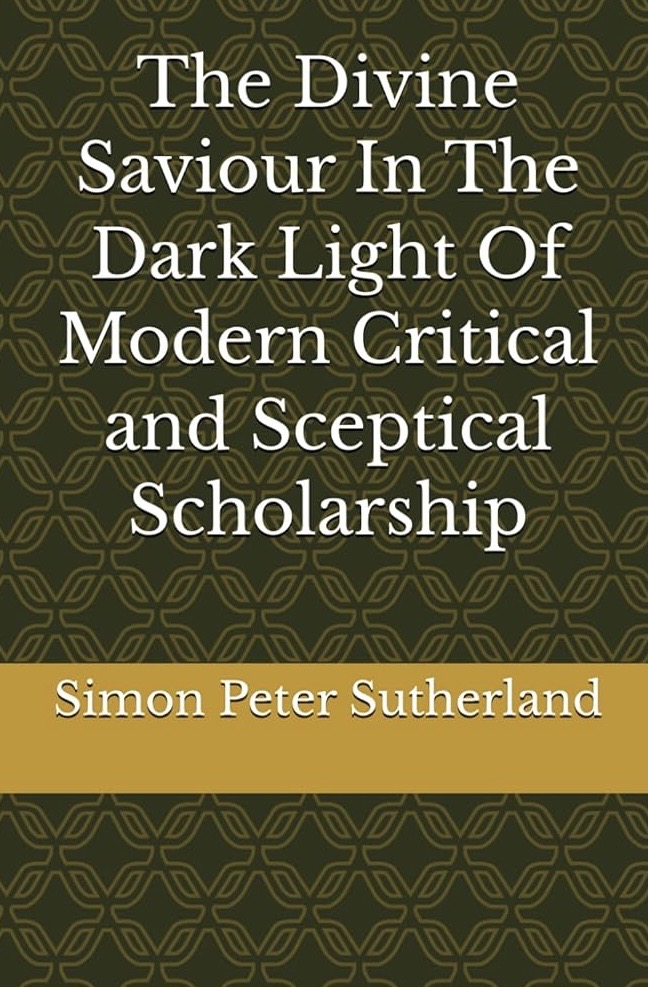
“The Divine Saviour In The Dark Light Of Modern Critical and Sceptical Scholarship” paperback book excerpt
Posted by simon peter sutherland in The Bible, Theology, Biblical archaeology, Documentaries, My books on June 7, 2026
“In 2012 I made the long desired step of making my first Biblically inspired documentary. I had begun a website where I was sharing my views and then we went to Paphos, Cyprus. There I was struck yet again at how historically accurate the Bible was. Here, in these places, the Bible is part of the history and culture of the land. St Paul walked here. My documentary was called “The Apostles at Paphos” and in it I explore the events of Acts 13. This documentary contained my first verbally public criticism of modern critical scholarship and shows why the events of Acts 13 can be verified by archaeological remains in Paphos. My wife and I had already visited Cyprus and my research was entirely independent and self motivated. While others were at the coffee shop, I was visiting an old church and archaeological grounds, and I loved every minute of it. I made notes, recorded details, read the Bible and explored. It was a far cry away from the little boy who was raised up on a council estate who had saved up to buy himself a Bible. O yes, I did it. In 1986, and I still have that Bible and I read from it until the covers came off. As life progressed on I often found myself at loggerheads with wrong concepts and misinterpretations of the Bible in churches. I tried to remain faithful to what is written in Scripture but there is such a thing as false teachers and they don’t care what the Scriptures say. I have preached and taught many times in churches and on more than one occasion I have had to walk away. These circumstances often leave a person feeling drained and anxious, and feelings of despair can try and crush a man when his faith is harassed. I have faced this reality many times and it is a cost of choosing to be loyal to Scripture. There I was with a Bible in one hand and a guitar in the other. O yes, I’m a musician and I made my first official solo album while I was studying for my theology degree. Even while I was trekking through Greek islands like Rhodes and Kos (Acts 21: 1), and Crete (Acts 27: 7-12) in search of St Paul and Titus (Titus 1: 5). I was creating music back in England while editing documentaries I had filmed. It had been a hard creative road and all the while, this book has had rewrite after rewrite, revision upon revision. I have carried it with me at all times, waiting for that final day when I will be happy to release it and see it in print. But as time went on, things began to change. Public awareness began to grow and a certain claim I had made came to pass. In my thesis in 2010 I had claimed that one day Biblical discoveries would be made that confirm the Biblical truth and since then the City of David in Jerusalem has been unearthed. Solomon’s kingdom has been proven. No end of Biblical discoveries have been made. Likewise, public perception and knowledge of the Bible has improved. People are raising public awareness of historical facts and places associated with the Bible. No longer are critical and sceptical university scholars and media barons ruling the roost. It’s Hollywood in your pocket, the days of media outlets and film companies controlling the narrative are over. People can freely watch YouTube videos and read articles that at one time would never have been published or made. We have witnessed the decline of Christianity in Britain, now we are seeing some changes. There is a renewed interest in the faith and Bible sales have increased. So I hope this book inspires and challenges its readers and helps people to have a renewed confidence in the authority and historicity of the Bible. To look beyond ourselves and to the lands in which it was written. Because the most important Book in the world (the Bible) is either entirely true or it is entirely false. In this book I want to communicate that these critical and sceptical scholars are the ones the British media has given rise to since the late 1990’s and early to mid 2000’s. But the battle has been happening a long time before then. The movement goes all the way back to the 18th century. It began quite moderate but, in modern times these scholars have shredded the historicity of the Bible in the minds of many people.”
“The Divine Saviour In The Dark Light Of Modern Critical and Sceptical Scholarship” is available now in paperback from Amazon
My new book is a criticism of sceptical and critical scholarship, and I’ve published it with Amazon.
Posted by simon peter sutherland in Bible Manuscripts, Bible translation, Biblical Scholarship, My books on May 20, 2026
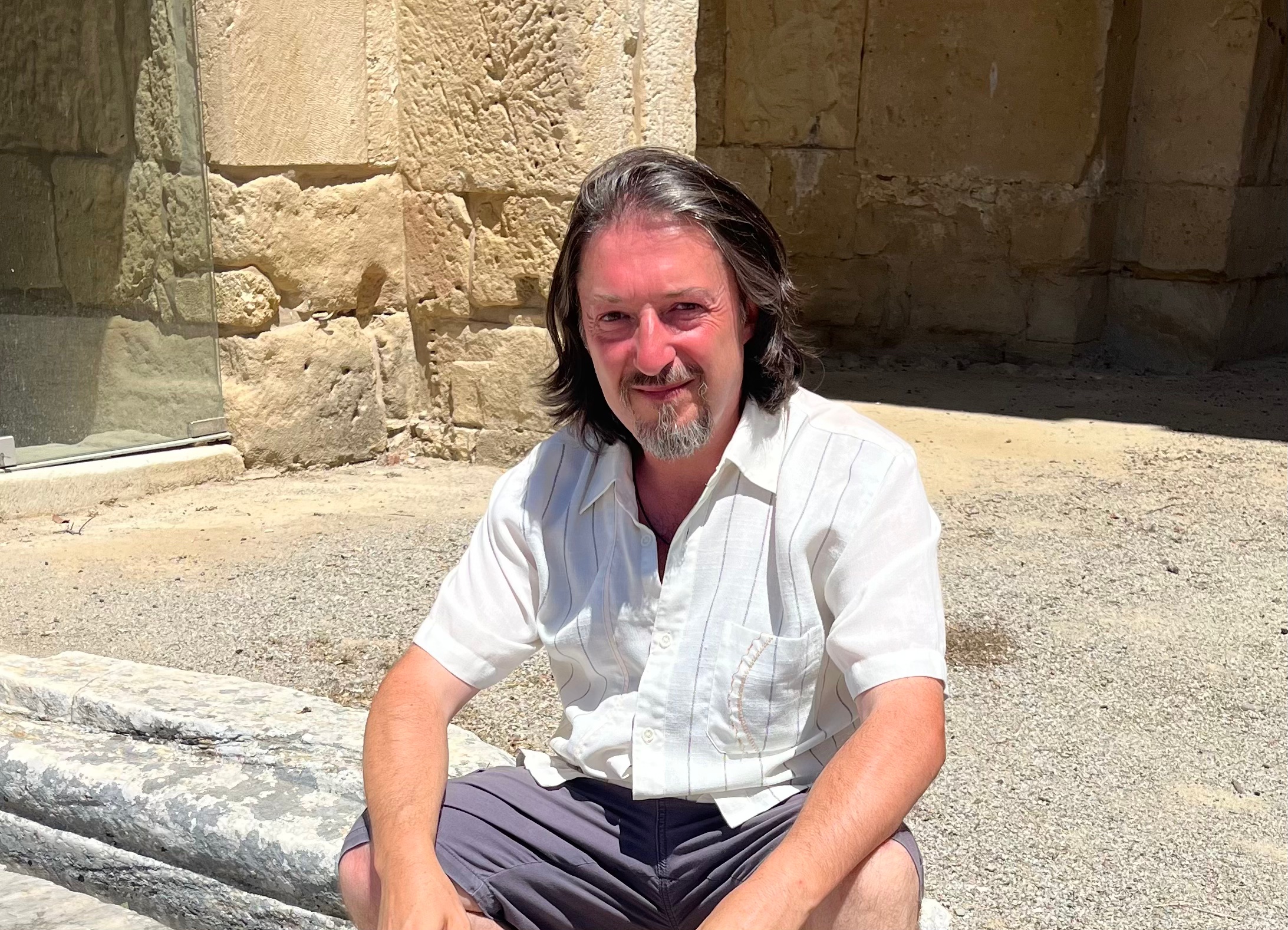
Over the course of many years, over 15 to be exact, I have been sporadically writing and rewriting a book called “The Divine Saviour in the Dark Light of Modern Scholarship”. It began in 2008 as a partial fulfilment thesis while I was studying theology at a Bible college.
Years went by and the work was shelved.
At that time I was attending lectures at the Manchester Theological Society in Manchester Cathedral and I was busy recording an album and making documentaries on St Paul and also the English and Welsh reformation. So I wrote and rewrote the book as I went along. Eventually I revised it, and shelved it and then worked some more on its pages. Eventually I arrived at a happy conclusion where I had completed my documentary series on St Paul, the Greek Islands and Cyprus, and I decided it was time to finish what I started.
The book is essentially a very topical work that centralises upon the theme of Biblical criticism and how its affects can damage the reputation of the Bible to the general public. It all began back in the 1990’s when I watched documentaries produced by the British media which often maligned the historicity of the Bible and when I began to do street evangelism, I heard the same at arguments used in these films to refute the claims I made.
So I decided I’d had enough so I wrote a book about it and that journey continued. I didn’t expect it to take as long as it did for me to complete it and make it publishable.
After a reshuffle with the title, and repetitive revisions, I’ve published the book with Amazon and at the moment its only available in hard copies. I’ve avoided sensationalism and fancy covers and I’m wanting to reach serious people who are serious about reading and any quest they may have to know if the Bible is true or false.
I certainly believe the Bible is absolutely true and historically accurate and for that reason I’ve published my book under the title of “The Divine Saviour In The Dark Light Of Modern Critical and Sceptical Scholarship“.
-
You are currently browsing the archives for the My books category.
Simon Peter Sutherland
-


