An open letter to Archbishop Justin Welby
Posted by simon peter sutherland in Reformation 2017 on November 5, 2017
Dear Archbishop Justin Welby,
Earlier this year I read with interest your “Statement from the Archbishops of Canterbury and York” concerning your prayer for unity and the call on Christians to repent for the Reformation split. I have repeatedly delayed myself from giving any response, because I have sought to understand properly the things that have been said.
Firstly, I would like to point out that any call for persons alive today to repent of the past, is a logical fallacy. A living person cannot repent for something he or she never did. A person is only responsible for what he or she has done and what they will do in the future.
Secondly, a Scriptural definition of the word “repent” means to ‘change ones mind‘ and sometimes refers to ‘expressing sorrow’ of wickedness and turning away from it.
With these two points in mind, I seek to ask you what it is that you would like Christians like myself to repent of? and how can any Christian repent of something that might not be a sin in the first place? Is the primary focus on how we deal with divisions within Christianity or on the divisions themselves? Or is the primary focus upon the larger agenda to reunite the Church of England with the Roman Catholic Church?
I think the answer may well be both, but with a primary emphasis upon the latter!
May I remind you that during the 16th century German Reformation, it was Rome which excommunicated Luther and not Luther Rome. If Christians have common ground with Roman Catholicism, then what was it about the doctrines of Faith alone and Scripture alone that Rome despised so much? The positions seem quite Biblical to me!
I am reminded of Paul’s warning to Timothy “Take heed unto thyself, and unto the doctrine; continue in them: for in doing this thou shalt both save thyself, and them that hear thee.” (1 Timothy 4: 16) These words when translated in the KJV give a distinct warning, not concerning love, but doctrine.
In the statement it is worded; “We therefore call on all Christians to seek to be renewed and united in the truth of the gospel of Christ through our participation in the Reformation Anniversary, to repent of divisions, and, held together in Him, to be a blessing to the world in obedience to Jesus Christ.” Thus, while I do not disagree with the entire statement, I cannot agree with all of it when the context is measured with Scripture, because a Christian who holds to Scripture cannot repent of divisions that are caused by those who deny the Bible.
A true united Church can only be united to the truth of the Gospel when the Gospel is not denied by those who claim to represent it. But when establishments such as the Pope’s church deny the Scripture, how can those who love the Truth be at one with those who don’t? Can light mix with darkness?
Archbishop, though you may or may not see it, and I’m sure you have, close examinations have been done concerning the doctrines and practices of the Roman Catholic Church, and studies show the Pope’s church is little more than an apostate works based religion. Thus in the face of Scripture, it becomes clear that the Pope’s church does not believe the true Gospel of grace alone.
In the preface of a 19th century copy of of ‘Foxe’s Book of Martyrs’ there is a distinct warning. It reads like so;
“Rome is labouring, with redoubled effort, for the subjection of Britain. She attacks us openly from without, while there are traitors ready to open our gates from within. And the people have forgotten that she is a siren who enchants but to destroy. It is time that the mask should be torn from her face, and that she should be recognised once more as “Mystery, Babylon the Great, the Mother of Harlots and abominations of the Earth” (Rev. XV11. 5)“
Thus, I ask you; why should Christians repent of the divisions made by the Pope’s establishment and the stance the Reformers held that the true character of Rome’s tyrannical apostasy was something that the people of Britain and Europe had been so mercifully rescued from during the Reformation? Is the blood of the martyrs not enough to show that the true face of Pope’s church was shown by her own acts? Is a tree not to be measured according to its fruits?
Sir, I believed you to be a true Christian and I hope to warn you that religion is something that rarely changes, and there are good reasons why the Holy Spirit has warned us in the New Testament concerning deception in the church perhaps more than any other topic.
Please think it possible, that while your intentions may have been well meaning, you may also be mistaken.
Simon Peter Sutherland
November 5, 2017
(Amended 13 July 2024)
What has the Reformation given us?
Posted by simon peter sutherland in 500th Anniversaries, Reformation 2017 on November 3, 2017
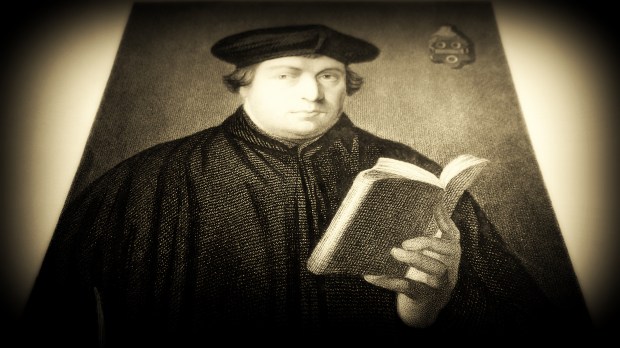
Martin Luther © 2017 Simon Peter Sutherland
On the evening of the anniversary of the Reformation, I attended an exhibition, debate and discussion at John Rylands Library.
The night began appropriately with the printing of indulgences (on an antique printing press) accompanied with music and an exhibition of artefacts and books from the reformation era. These artefacts included original handwritten and printed indulgences. A Tyndale New Testament and The practice of prelates and Luther on Galatians.
A summery toward the end of the evening focused upon what the reformation has given us today. Where would our world be if not for the Reformation?
This question is a good one and one that could possibly provide a never ending list. However, I have listed a few of the things I think are the direct results the Reformation has given the people of Britain and things inspired by the Reformation and the Theology and principles. These are things that we can be thankful for;
- The New Testament published in the original Greek
- The Bible in English
- The Apocrypha in English
- Chapters and verses of the New Testament
- The old and modern English language
- The Bible in multiple languages
- The freedom to read the Bible for ourselves
- The freedom to interpret the Bible
- The liberty to believe
- Hymnbooks
- Music
- Independent Churches & Congregations
- Seats in Churches
- The priesthood of all believers
- Religious liberty
- Freedom of speech
- Puritan history
- Democracy
- Free education
- The bank of England
- The Wesleyan revivals
- Novels
- The abolition of the slave trade
- Chetham’s Library, Manchester
- John Rylands Library
- Ongoing Bible translation
The list could go on…
An open letter to John Piper
Posted by simon peter sutherland in Limited Atonement, Reformation 2017 on October 31, 2017
 Dear Pastor John Piper,
I am writing this letter to you because I know you are familiar with open letters.
All I ask of you is that you read it, test it, to see if it be of true. If it is true, I pray you will embrace it.
May the Lord be with us both as we remember this day.
Grace and peace
Simon Peter Sutherland
Calvin’s cafes
Posted by simon peter sutherland in 500th Anniversaries, Reformation 2017 on October 27, 2017

John Calvin and his council © 2017 Simon Peter Sutherland
During our celebration of the 500th anniversary of the Reformation, #Reformation500, it is good to remember the events from a number of perspectives.
It is easy to look at the Reformation as one singular event and neglect the series of happenings throughout Europe.
The ancient city of Geneva was a place uniquely driven by the reforms and ideas of John Calvin and his major contributions to the Reformation took place in Geneva between the years 1541-1549.
By 1541 Geneva was undergoing a political and religious war, and some sought peace by wanting to return to Roman Catholicism. But Calvin was strong enough to hold onto his conviction that all things, be they religious or civil, should be done according to the Bible.
Some of the controversial reforms the Genevan council of 60 implemented was the closing of taverns. A 16th century tavern, being a place where locals and travellers drank alcohol and eat food. Calvin had them replaced with Cafe’s where people would pray before every meal, and the Bible was always present. People were not permitted to sing in them either.
But the plan failed and it drove people away, so the taverns were reopened.
A lesson to be learned is that no Christian should ever try to force believers or none believers to do anything. People have to decide for themselves. Implementing Christian or none Christian ideals and morals on the public fails to do anything but drive people away.
William Tyndale: The man who kick started the English Reformation
Posted by simon peter sutherland in 500th Anniversaries, Reformation 2017, Theology on October 25, 2017
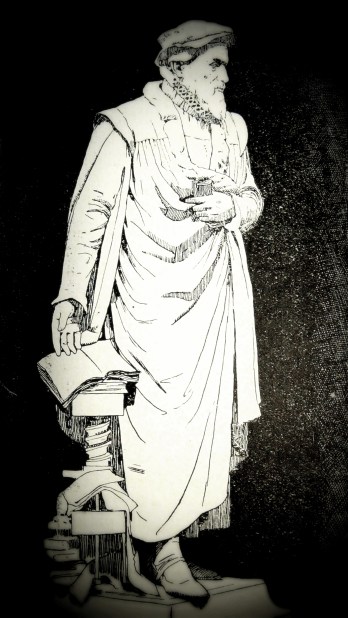 In 1523, a man named William Tyndale visited the city of London to gain permission to translate the Greek New Testament into English. He visited a Bishop by the name of Cuthbert Tunstall and requested help, but Tyndale was rejected.
It wouldn’t be long before Tyndale self exiled out of England and headed for Europe and onto Germany. Tyndale was a Lutheran, and there he likely met with Reformer Martin Luther who had recently published his own translation of the New Testament into German.
It was at Wittenberg, Germany where Tyndale probably began to expertly translate the New Testament, from Greek into English. By 1525 Tyndale had published his translation using the printing press at Cologne.
He did not have a licence, and his burden lay for his own people and so he was forced to smuggle the New Testament back into England by ship, along the River Thames.
By 1529 Tyndale had been publicly declared a heretic and his books publically burned outside St.Paul’s Cathedral. By 1535 a Judas by the name of Henry Phillips had befriended and betrayed Tyndale and he was captured, imprisioned, condemned, strangled and burned at the stake in 1536.
But it was not the end of Tyndale. That same year his translated work was lifted and used in the very first complete English Bible by Miles Coverdale. Likewise, the translation work was later incorporated into the Geneva Bible and eventually the King James Bible.
Some say as much as 84-90% of the King James New Testament, was the work of William Tyndale.
Most historians today say the English Reformation began with Henry V111’s quest for a male heir, but that is not quite true. The 16th century English Reformation began when Tyndale spread out the Scriptures openly before the people.
But it was never any man who reformed the Church, it was the Holy Spirit who brought about the change. The Lord used honest men to do it, just as He can use honest and God-fearing men today, to do His will.
Was the Reformation exclusive to Calvinism?
Posted by simon peter sutherland in 500th Anniversaries, Limited Atonement, Reformation 2017 on October 24, 2017
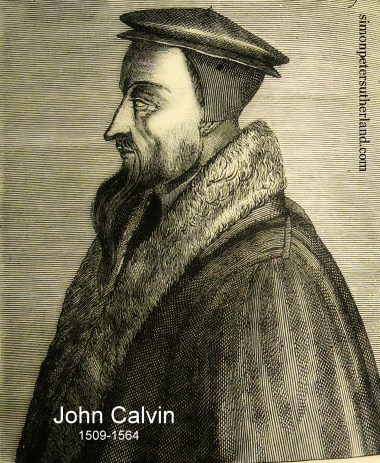
John Calvin © 2017 Simon Peter Sutherland
In only a few days now the actual 500th anniversary of the Reformation will be upon us.
31 October for me is a time that can inspire things to be straightened out. A time that inspires misconceptions to be challenged and for the voices of the people to be heard.
At this time of such a momentous anniversary, there is a common misunderstanding today that I have noticed for sometime, where popular preachers from America often associate the labelling of ‘reformed Theology’ as somewhat exclusive to Calvinism.
There are a lot of brothers in America who claim ‘reformed Theology’ is little more than Calvinism in a nutshell.
Calvinism they say, is nothing more than the pure Gospel.
These claims however are highly speculative and cannot be verified beyond doubt in the face of history and Scripture.
The facts remain that reformed theology can be divided into about four branches or positions.
- Lutheran
- Calvinist
- Anglican
- Hussite
The facts remain that when Luther nailed his 95 theses to the Castle Church door in Wittenberg in 1517, John Calvin was only eight years old.
Calvin was born 10 July 1509 in Noyon, France, which is nearly 600 miles from Wittenberg. When Luther stood at the Diet of Worms in 1521 and the outbreak of the Reformation spread, Calvin was an 11 year old boy who went on to study Philosophy in Paris. He went on to study and pursue a career in law and would not experience a conversion to Christ until 1533 when he was about 24 years old.
By that time Luther had already been excommunicated, translated the New Testament into German and his complete German translation of the Bible was close to being published. The following year Tyndale’s New Testament was in its final revision and the majority of key reformation books had been published and distributed.
By 1536 Calvin was working hard to reform the Church in Geneva and his publication of ‘the Institutes of the Christian Religion’ was in its 1st edition. And through his preaching and influence in Geneva, Calvin’s branch of the reformation spread throughout Geneva and the reformation reached its peak by 1545 and by influence continued on till about 1620. By 1545, many publications had been published and the majority position of the Reformation was Lutheran. Calvinism mainly taking root in France, Netherlands, and Scotland and remaining until after the counter reformation of 1648.
From the mid 16th century – the mid 17th century, Calvinism had taken root in England, Scotland, Greece, and Wales during the Puritan era, while Lutheranism held a majority throughout Europe, even making its way back to Rome itself. Thus, the simple facts remain that although Calvin’s influence had branches within the Reformation, it was probably not referred to as Calvinism until the 18th or 19th centuries, the majority of Calvinistic thought process at that time being the development and spread of the doctrines proclaimed in 1618 at the Synod of Dort and the Puritans who left England during the 17th century for America.
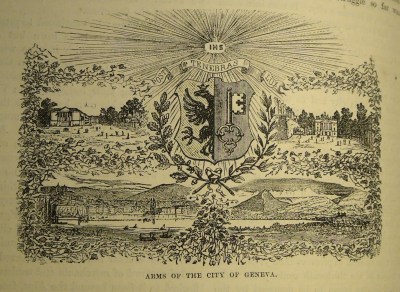
Geneva arms © 2017 Simon Peter Sutherland
John Calvin’s steadfast work and devotion to the faith is to be admired and admonished, and I value his contribution to the reformation. I regard Calvin’s commentaries on Scripture among the best available. But, I am less favourable concerning the common claims that reformed theology is nothing more than Calvinism. On the contrary, the claim is little more than a fictitious propagation of this centuries favourite American Calvinist preachers, who because of their position on believers baptism, would probably have been either imprisoned or drowned by the very same people they claim to revere.
Surely it is time now for this fallacious claim to be amended!
William Salesbury Welsh Bible documentary interview
Posted by simon peter sutherland in Documentaries, The Welsh Bible on September 26, 2017
John Rylands Library reformation exhibition
Posted by simon peter sutherland in 500th Anniversaries, Reformation 2017, Theology on September 17, 2017
 In my previous post I wrote about an upcoming exhibition at John Rylands Library on the Reformation. The exhibition, now open, marks the 500th anniversary for a happening that would become one of the most significant events in Church history.
Yesterday I visited the exhibition for the second time.
On arrival I was faced with an original handwritten letter by Martin Luther dated 1 January 1528. Written in German, the letter is very Christ centred. It shows a man who’s life was heavily under threat, unable to save himself and looking to Christ who remains the life and justification of the those who believe and trust in Him.
A translation is available and presents a very humble and spiritual man. It is a very touching letter.
Moving through the exhibition it is clear that the representatives of Rylands have portrayed the reformation properly. There is a 1539 ‘Great Bible’ and for the most part, the exhibition Focuses on the writings, influence and controversies of the following three distinct persons;
- Tyndale “Radical“
- Henry V111 “Rogue“
- Martin Luther “Renegade“
Here is a list of some of the displayed items and books.
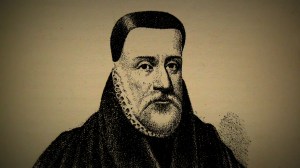
William Tyndale © 2017
William Tyndale features prominently and there is a Tyndale New Testament, printed in Antwerp, 1536. There is a copy of ‘The Obedience of a Christian Man and how Christian rulers ought to govern’ (Antwerp, 1528)
There is also an intriguing book “The Testament of Master William Tracie esquier expounded both by William Tyndal and John Frith’ (London, 1535)
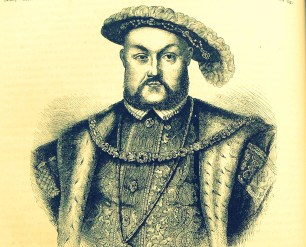
Henry V111 © 2017
Henry V111 rightly features and there is a fine decorated copy of a ‘Defense of the seven sacraments against Martin Luther” (London, 1521) and “The confutacyon of Tyndale’s answere” by Thomas More (London, 1533)
Also on display is a fine copy of “The Bible in Englishe“, known as the Great Bible (London, 1539)
This work was the first English Bible approved of by King Henry V111 and the New Testament contains the majority of Tyndale’s translation.
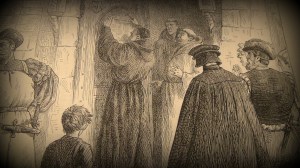
Martin Luther © 2017
Martin Luther is very prominent with an original 15th century ‘indulgence‘ printed by Gutenberg at Mainz between 1454-1455. Luther’s reaction to this is displayed in his bold “Disputation on the power of indulgences” (Basel, 1517)
Other Luther books include ‘A treatise touching the liberty of a Christian‘ (1579 print) “On the Babylonian captivity of the Church” (Strasboug, 1520) and a Luther New Testament in German (Wittenberg, 1522) with an image of the ‘whore of Babylon‘ wearing the Pope’s Papal Tiara.
I like that one a lot!
John Rylands Library “The Reformation” exhibition!
Posted by simon peter sutherland in Reformation 2017 on September 1, 2017
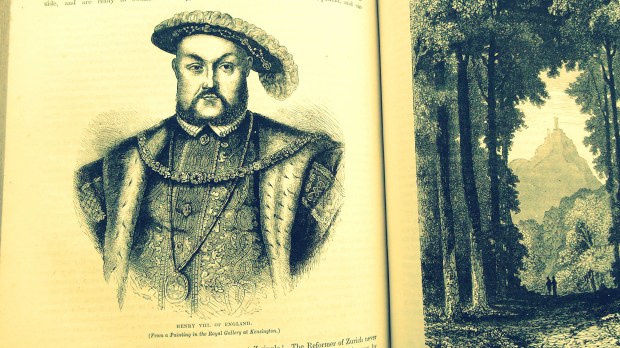
Henry V111 © 2017 by Simon Peter Sutherland
October 31st 20017 marks the 500th anniversary of the Reformation. Christians and people from all around the world are making ready to celebrate and remember this major turning point in the history of the Church.
In my opinion, John Rylands Library, Manchester has the greatest Biblical archive in Britain and holds some of the finest examples of 16th century printed Bibles anywhere in the world. As a contribution to this momentous and unique anniversary, Rylands library, Deansgate is holding an autumn Reformation exhibition starting on 7th September 2017 through to 4th March 2018.
According to the John Rylands website, the Reformation exhibition will focus upon central persons of the Reformation, Martin Luther, Henry V111 and William Tyndale and “will explore the early years of the upheaval and the roles of these three men, considering the war in print which had a lasting effect on the history of Europe through propaganda, words and ideas.”
Today, an awakening is happening, people all over are talking about reformation. Yet there are a number of false new reformations taking place, and the Church of England is jumping back into bed again with Rome, but there is also a true Reformation. Thus, I look unto Christ, in anticipation and expectation of what God is going to do and is doing in the future history of His people.
The exhibition is free and I will certainly be attending and no doubt re-attending.
It is upon us. It is ongoing. Now is the time!
Dearly beloved, let us “agree to disagree”
Posted by simon peter sutherland in Theology on August 4, 2017
Today, Christianity has become very troubling. In fact, it has become so troubling that it is a difficult thing to claim one is simply a ‘Christian’.
Theological divisions and historic splits have split the wood of Christianity into many branches. It is because of this that denominations have developed the habit of sticking a title or nickname before them. Baptists, Calvinists, Methodists, Congregationalists, Presbyterian, and so forth. Most of them holding onto a doctrine or a set of doctrines which have caused them to separate themselves or be excommunicated, or dispersed from the Churches they once were part of.
History shows there are many Godly people who have been forced out of Churches because their fellowships have fallen into error or apostasy.
I cast my mind back to the “Great Ejection” of 1662 when the Church of England formed “The Act of Uniformity” which in effect caused the likes of Puritan Richard Baxter, John Flavel, Thomas Watson and over 2000 Godly ministers to be ejected out of the Church. It was clearly a mistake that the ‘Church of England’ has never recovered from to this day.
In 1770 John Wesley gave a sermon upon the death of George Whitfield in which he spoke concerning their disagreements by saying, “There are many doctrines of a less essential nature … In these we may think and let think; we may ‘agree to disagree.’ But, meantime, let us hold fast the essentials…”.
Whitfield famously chose to speak against Wesley because the two did not agree on definitions of ‘grace’ and ‘predestination’. Whitfield held to a Calvinistic interpretation of those doctrines while Wesley believed ‘Calvinistic predestination’ was a “monstrous doctrine”.
But it is the term ‘agree to disagree’ which is clearly something that many Christians have failed to do. Rather than do see the truth of what Wesley said “let us hold fast to the essentials…” too many Christians choose to make a ‘false teacher’ or an ‘unbeliever’ out of anyone who questions or does not believe their beliefs.
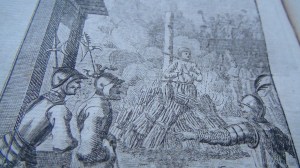 After all, is it not a historical fact that it was the Bishops and priests who had Christians burned at the stake for believing the Bible? Is it not a Biblical fact that it was the men in the pulpits who denied the Christ and were partially responsible for the execution of some of the Apostles and disciples? Is it not also true that the majority of problems within Christianity today are caused from leaders and pastors who deny the truth yet accuse others of things they themselves are guilty of?
I think too many leaders need to take the plank out of their own eyes!
Today there are too many dogmatic ‘preachers’ who will simply not move one iota from what they believe and at times mentally bully other believers hoping they conform to their requirements, not considering for a moment that their requirements are wrong. Thus if the believers in question do not comply, the preachers often misrepresent them or label them as ‘rebels’ or ‘not saved’ or accuse them of simply ‘denying scripture’.
This however, is quite simply not always the case!
Christianity today has perhaps more denominations than any other ‘religion’ and much of this has come as a direct result of the problems created by the leaders themselves. Some have claimed there are as many as 43,000 denominations of Christianity worldwide. Many of them claiming to be Christian and merely believing and teaching what Scripture says, yet when tested, contain a great deal of error.
Indeed, cults claim they too hold to scripture. Last week I was in discussion with a Mormon gentleman and he too claimed to believe ‘just what Scripture says’. This week, I was in discussion with a gentleman representative from the Jehovah’s Witnesses and he too claimed to believe ‘just what Scripture says’.
Obviously I do not believe ‘Mormon’ or ‘Jehovah Witness’ teaching to be true to the Bible. On the contrary, I do not believe either of those two religions to be part of the body of Christ, but even we, despite our major doctrine divides, still managed to ‘agree to disagree‘.
 What troubles me today however in true Christianity, is how so many Christians and Pastors, Priests, Bishops and leaders refuse to consider anything that contradicts what they believe, even if those beliefs are not “essentials” or ‘salvation issues’ but merely Biblically questionable.
In closing I will say this, I think Christians desperately need to cease from contesting one another on none essential differences and creating more division by locking themselves away behind the doors or their own beliefs.
May believers not be like the ‘Jehovah witness’ who, when presented with Scripture, merely replied, ‘that’s not what I believe’.
Simon Peter Sutherland
-

 Simon Peter Sutherland