Archive for category Theology
Calvinistic Determinism Refuted
Posted by simon peter sutherland in "Calvinism", Theology on April 29, 2025
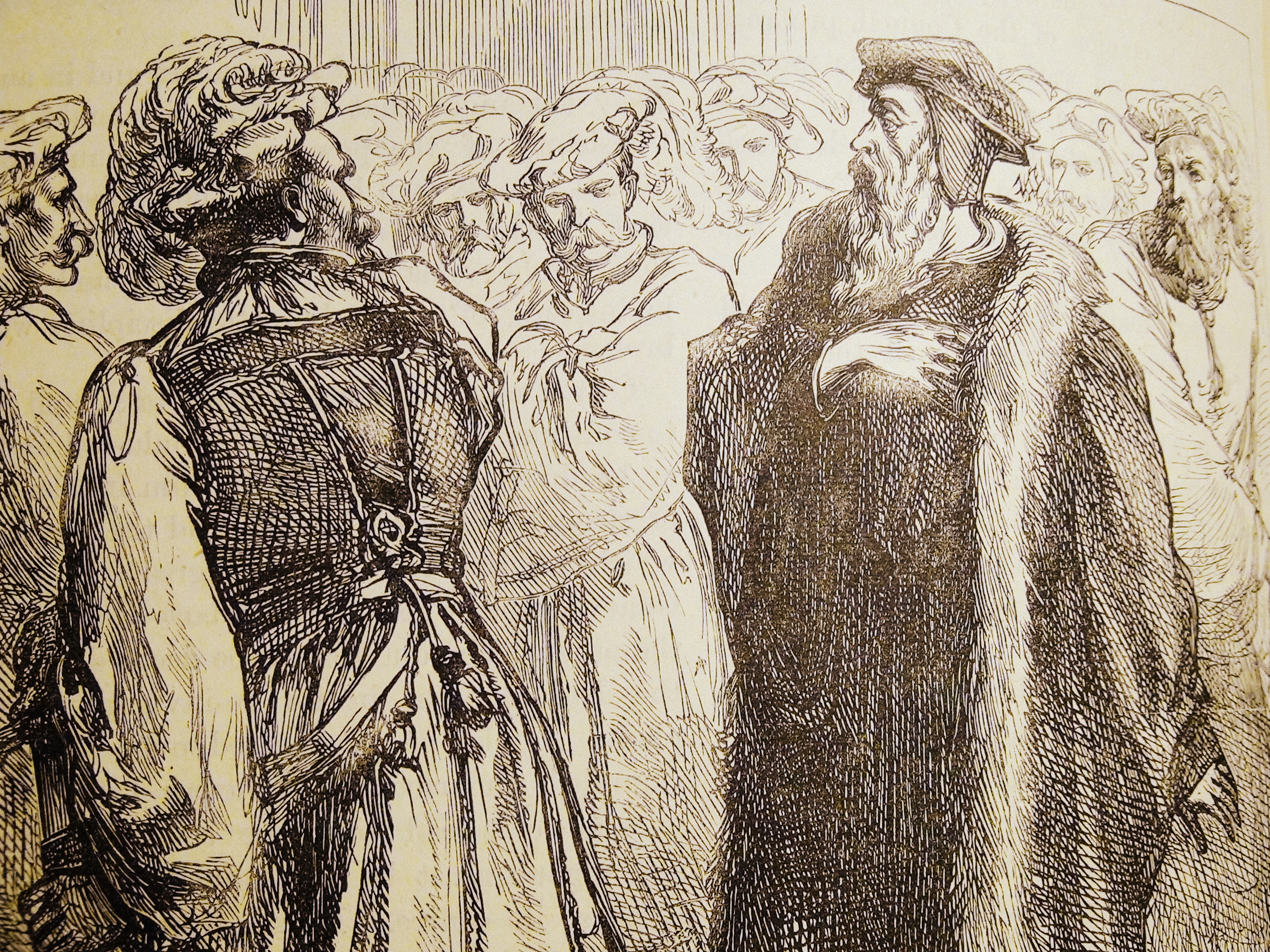
There is a doctrine gaining popularity today, known as ‘Calvinistic determinism’ or ‘theological determinism’. This concept claims that every event in the universe is predetermined by a divine will, suggesting that human actions and decisions are ultimately guided by God’s divine plan. It is often cloaked or hidden within the beliefs of many famous reformed preachers, who may emphasize God’s sovereignty and control over the universe without explicitly acknowledging the implications of their doctrine. At other times, it is plainly stated, leading to profound discussions among theologians and laypeople alike about free will, predestination, and the nature of divine foreknowledge, which raises questions about human responsibility and moral accountability in a world governed by such determinism.
In short, for those who do not know, determinism is a doctrine that claims that all human acts, both good and evil are pre-determined by God before the world began. God’s will is always done. Everything people do, be it good or bad, is all pre-determined and predestined by God before He made the world. It’s not a belief that says God knows everything you do, it’s a belief that says God determines, decrees and wills everything you do. In other words, He writes them.
It’s crazy!
But where did this doctrine come from and why are people so eager to believe it?
Well, basically, people do not always like the truth and some people are gullible and others are skilled at indoctrinating them. Some people are easily influenced by people they follow. They listen to their favourite preachers and their skilled rhetoric causes listeners to feed their views into the Bible. People assume that because a preacher strongly believes something, it makes it true. As a result, people assume the preachers beliefs are very Biblical, when in actual fact they are the exact opposite.
But are these deterministic ideas Biblical?
Well, the answer is yes and no. Yes in the sense that some Biblical events were determined by God, no in the sense that the events of Jeremiah 7: 31, 19: 5: 32: 35 and Isaiah 30: 1 and Galatians 5: 7-8 were not determined or decreed, or willed by God. In fact, in Jeremiah 18: 10 God reconsidered the good He intended to do, because Israel did not obey Him.
In order for God to determine everything that happens in this world He must decree, will and determine apostasy, the persecution and murder of Christians in Africa, false teaching, and some of the most evil acts of mankind can do, (evil acts I do not even want to mention) and then judge people for doing things that He has already determined them to do. If Calvinistic determinism were true God would be self contradictory. He would be determining people to break the commandments He has commanded them not to break.
But where do these ideas come from?
The answer is early examples originate in Augustine of Hippo, John Calvin and Jonathan Edwards. Augustine introduced theological determinism into Christianity in 412 AD and Calvin re-introduced them in the 16th century. Before that time determinism was a Gnostic and Stoic concept originated by Greek philosophers in the 7th and 6th century BC. Early Christian writers did not teach theological determinism. However, when Calvin re-introduced determinism into western Christianity (and adopted his ideas from St Augustine), his influence spread to puritans in the 17th century and Jonathan Edwards took this concept to another level, and when Banner of Truth republished a lot of old puritan books, preachers in America re-introduced their love of Jonathan Edwards and puritans to a new audience, and the so-called ‘reformed’ preachers in America began to influence a whole new generation of eager restless and reformed Christians.
Obviously not all Calvinists believe this level of determinism, but the original source is St Augustine and Calvin quotes Augustine more than any other theologian.
The reality is, it’s that same old thing again, influence. As Calvin adopted his deterministic logic from the writings of St Augustine, preachers today adopt their logic from the works of Calvin, Jonathan Edwards and their favourite preachers via podcasts, books, YouTube videos and so on.
But let us take a step further, if Calvinistic determinism were true God would not only determine everything that happens, He would have to decree and will everything that happens including these winds of doctrine. God would not only have to determine every good and evil act of mankind, but He would have to determine the podcasts and the books.
Preachers who oppose abortion would need to be opposing God because in reality God would not only be the one who wills and decrees the deaths of unborn babies who die in the womb and in infancy but He would be the one who determines them.
Do yourselves a favour and search up how many murders happen in America every year. In order for determinism to be true, God would need to have decreed, determined, and willed those horrific acts to take place down to the very number.
The Bible however does not affirm these repulsive beliefs.
In Jeremiah 32: 35 the abominations men did didn’t even enter God’s mind, so how could He determine them?
In 1 Corinthians 14: 33 Paul states that God is not the author of confusion so how could God determine and decree and will everything that happens? God would not only be the determiner of every human act but He would be the author of confusion, which is contrary to what the apostle claims.
Does that make sense?
In short, I am not even remotely interested in debating or discussing these forgone conclusions with theologians, pastors or preachers who advocate these repugnant doctrines. They are making the God I serve and love to be the author of evil and the determiner of the most disgusting and evil acts this world has ever known.
In short, I want to reach out to you, the general public, average Christians who find themselves confused and influenced by these preachers and do not know what to make of these filthy claims.
I want you to know that the God of the Bible has nothing whatsoever to do with the evil acts that men do. He gave His Ten Commandments and the commandments of Christ for people to obey not disobey. He gave us Christ to save us from our sins not determine them. He cares for you and He serves you in your times of great strife and upset and wants you to know that we live in a fallen world and in the midst of that fallen world God has given us His spirit to minister to the souls of men. Therefore, comfort each other with these words.
If you are influenced by these confused preachers who repeatedly contradict themselves and don’t know what they are talking about, do yourselves a favour, switch off from them and go and read your Bible.
19th century English hymn discovered
Posted by simon peter sutherland in Hymns, Music, Theology on January 16, 2025

The tradition of composing Christian hymns goes back centuries and back in times of antiquity ministers of local churches actually wrote their own hymns for their own congregations. For example, John Newton wrote Amazing Grace while he was minister at Olney and that hymn was first sung in that place.
Such is the case with an original handwritten hymn I have discovered.
The hymn is written in English on a small piece of paper and dates to 1842 and likely originated in Wales. Written by a minister for Sunday school teachers the author based this hymn on John 21: 17 and 1 Corinthians 9: 27. The word “castaway” is used repeatedly in the hymn and is likely based upon the King James Version of Paul’s letter. In this Scripture the apostle advocates a strict subjection of his own body, lest after preaching to others he himself “should be a castaway”.
The sad reality is that this passage of Scripture has been abused. But such is not the case with this hymn. It is a sad reflection and is written out of deep concern, by a minister, for his Sunday school teachers. The Wesleyan interpretation of Scripture implies the hymn most likely has its origins in that denomination and it is not found in any Wesleyan hymn books. So it appears to have never been published. The hymn does not have a tune, which is normal since many hymns in those days did not have accompanying melodies. Many congregations used the popular tunes of the day to sing the words. Such would have been the case with this hymn.
I’ll post more about it as time goes on and research continues, but in the meantime, if anyone knows of any hymns from this era that contain references to 1 Corinthians 9: 27, please feel free to get in touch.
The Promise of God for all mankind
Posted by simon peter sutherland in Census of Luke, Christmas, Christmas or Nisan, Documentaries, Eschatology, Theology on December 18, 2024

Many years ago, when I was a boy, I was asked what my favourite New Testament Gospel was, and I replied “Luke’s Gospel”. For me, I think that claim still stands. The Gospel According to St. Luke is still my favourite of the four Gospels.
Luke’s Gospel gives us the greatest account of Christ’s birth. I say this because I believe chapters 1 & 2 contain the actual words of Mary herself given to St Luke. Luke’s Gospel gives us the reference to the census of Quirinus. I have discussed this census in a previous article showing that it may have been referenced in the Mausoleum of Augustus on the funerary Res Gestae Divi Augusti in Rome.
Luke was a very reliable historian as my documentaries have shown. In Kos and the Gospel According to St. Luke I demonstrate elements of his accuracy by visiting the Greek island of Kos and discuss how he interviewed surviving witnesses to the life of Jesus Christ. Luke references his accuracy himself in Luke 1: 1-4 and Luke’s desire was for the Roman official (Theophilus) “to “know the certainty of those things in which you were instructed.”
Luke follows up his Gospel with part two (Acts of the Apostles) and those who know it are assured of the certainty of the events that happened.
As previously mentioned “I believe chapters 1 & 2” of Luke’s Gospel “contain the actual words of Mary herself given to Luke.” The nativity account contains elements of feminine Greek and in Mary’s account of the angelic announcement of Christ’s birth the angel says to Mary “behold you will conceive in your womb and bring forth a Son, and shall call His name Jesus. He shall be great, and will be called the Son of the Highest; and the Lord God will give Him the throne of His father David. And He will reign over the house of Jacob forever, and of His kingdom there will be no end.” (Luke 1: 31-32. NKJV)
This statement concerning the kingdom of Christ and Him being given the throne of David was not some reference to a futuristic kingdom that Jesus sets up when He returns to earth at the second coming. Luke tells us that this kingdom was established during the life, death, resurrection and ascension of Jesus Christ and was revealed to the people of Judea and Jerusalem by St Peter in his sermon contained in Acts 2: 14-39.
In Acts 2: 30-31 Peter says “Therefore, being a prophet, and knowing that God had sword with an oath to him that of the fruit of his body, according to the flesh, He would raise up the Christ to sit on his throne, he forseeing this, spoke concerning the resurrection of the Christ, that His soul was not left in Hades, nor did His flesh see corruption” and in verse 32 Peter states that the things which they saw when the Holy Spirit came on the Day of Pentecost (Acts 2: 1) is what they “now see and hear.”
The important point to note here is that the promise made to Mary in Luke 1: 32-33 has been fulfilled for all mankind. God in Christ Jesus has set up His kingdom and it has no end and as Peter stated to the people in Judea and Jerusalem, “the promise is to you and to your children, and to all who are afar off, as many as the Lord our God will call.” (Acts 2: 39)
This Christmas remember what Christ has done for us and for all mankind. Let us turn our backs upon the things of this world and whatever you do keep your eyes upon Christ, and know that He is our Saviour, and our God, if we believe in Him and receive forgiveness for our sins and make Him Lord of our lives.
Amyraldism calmly considered
Posted by simon peter sutherland in "Calvinism", Theology on October 25, 2024

Over the years I have expressed my deepest concerns relating to a doctrine known as ‘Limited Atonement’. This 5 Point Calvinist theory claims that Jesus Christ did not die for all mankind but only for the elect. If Christ died for all mankind (they say) then no one should be in hell for whom Christ died, thus He didn’t die for all, He died only for those whom the Father had given Him. Believing that Christ died for all (they say) is universalism.
I disagree with these claims entirely. There is no Scriptural proof that the sacrificial offering of Jesus Christ on the cross automatically saves anyone. No one is saved by the cross of Christ alone since believers are saved by grace alone through faith (Ephesians 2: 8) so faith is the means by which we are saved and there is no Scriptural evidence that Jesus purchased our faith at the cross.
A person can argue that faith or salvation is a gift of God (ibid) and I wouldn’t disagree but there is no suggestion that faith or salvation (as a gift) is limited only to those whom God has predestined and chosen. For me, this claim is more systematic than Scriptural and retains some serious Biblical inconsistencies. For me, and for J. C. Ryle, the doctrine of Limited Atonement is inconsistent with the Bible and some theologians who propagate it are more systematic than the Bible they represent. Yet many proponents of the ‘Calvinist’ teaching actually reverse the truth by claiming that those who don’t believe in the 5 Point Calvinist interpretation of ‘Limited Atonement’ are the ones who are inconsistent. This is untrue. For me, and for many Christians, the New Testament is extremely clear that Christ died for all mankind and to deny that fact can be dangerous. The reason I say this is because a person is putting argumentation above Scripture, thus leaving room for any persuasive argument to be believed, even if it contradicts Scripture. Yet many 5 Point Calvinists claim that their beliefs are the pure teachings of Scripture and they wait patiently for others to catch up and be persuaded.
Obviously I’m not one of those who have been persuaded and if a doctrine cannot be consistently proven by all Scripture, I’m not obligated to believe it. So for me, I have reached an opposite conclusion to the 5 Points of Calvinism. For me, I am actually very uncertain if 5 Point Calvinism is even accurate to the teachings of the man it is named after. There are times when I find it very doubtful that Calvin ever taught the same version of limited atonement that modern 5 point Calvinists teach? I haven’t found the majority of 16th century reformers affirming it either.
For me, Calvinism (as it is nicknamed today) is little more than Owenism. By “Owenism” I am referring to puritan John Owen (1616-1683). A man who, in 1648 published a book called “The Death of Death in the Death of Christ”. In this book Owen affirms the doctrine of Limited Atonement in no uncertain terms. The book blends in perfectly with the doctrines affirmed in England during the times of the Westminster Confession of Faith. Like the Westminster Confession, Owens theology offers no salvation for the none elect, they are utterly doomed. Born to be damned and to enter hell for disbelief in a Saviour who did not die for them to begin with.
It is an awfully distasteful doctrine and one that should be spat out.
Having read Calvin, and studied many other 16th reformers, I have been (over the past few years) somewhat pleasantly surprised to learn of the 17th century man named Moses Amyraut (1596-1664) a French reformed theologian who noticed the inconsistencies of Calvinist theology and propagated moderations. Like Richard Baxter, John Bunyan and Richard Horne, the believer can be blessed by the challenges presented by Moses Amyraut who find themselves troubled when ‘Calvinists’ deny the exceedingly clear Biblical statements that Christ died for the sins of the whole world.
Amyraut challenged Calvinians and presented a view that is much more conceivable than Limited Atonement and taught that Christ did in fact die for the whole world but God in His foreknowledge knew those who would believe in Jesus Christ and elected them based upon that foreknowledge. This is entirely consistent with Romans 8: 29 “For whom He foreknew, He also predestined to be conformed to the image of His Son,”. Note that St Paul presents foreknowledge prior to predestination. Thus preserving the doctrine of unconditional election while not excluding anyone from receiving Christ.
For me, if Christ died only for the elect the great commission is null and void and the gospel should not be preached or offered to “every creature” (Mark 16: 15) and Acts 17: 30-31 makes no sense. Why would God command all men to repent (as Paul proclaimed in Athens) if man was incapable of doing so because he is not elect? Why would the great commission be offered to every creature if salvation was not available for every creature?
The logical conclusion is that salvation is offered to all because it is available for all and I am very pleased to know that reformed theology does not exclusively belong to the limited atoners. Lutherans, Calvinists, Anglicans, Arminians, all fit into this broad theology labelled ‘Reformed’.
I remain convinced that if any person merely read the Bible for itself, without feeling pressured to read other books and listen to preachers rhetoric, no one would ever discover such a harsh and uncaring doctrine as Limited Atonement.
Did Martin Luther believe in Limited Atonement?
Posted by simon peter sutherland in Reform, Theology on October 15, 2024
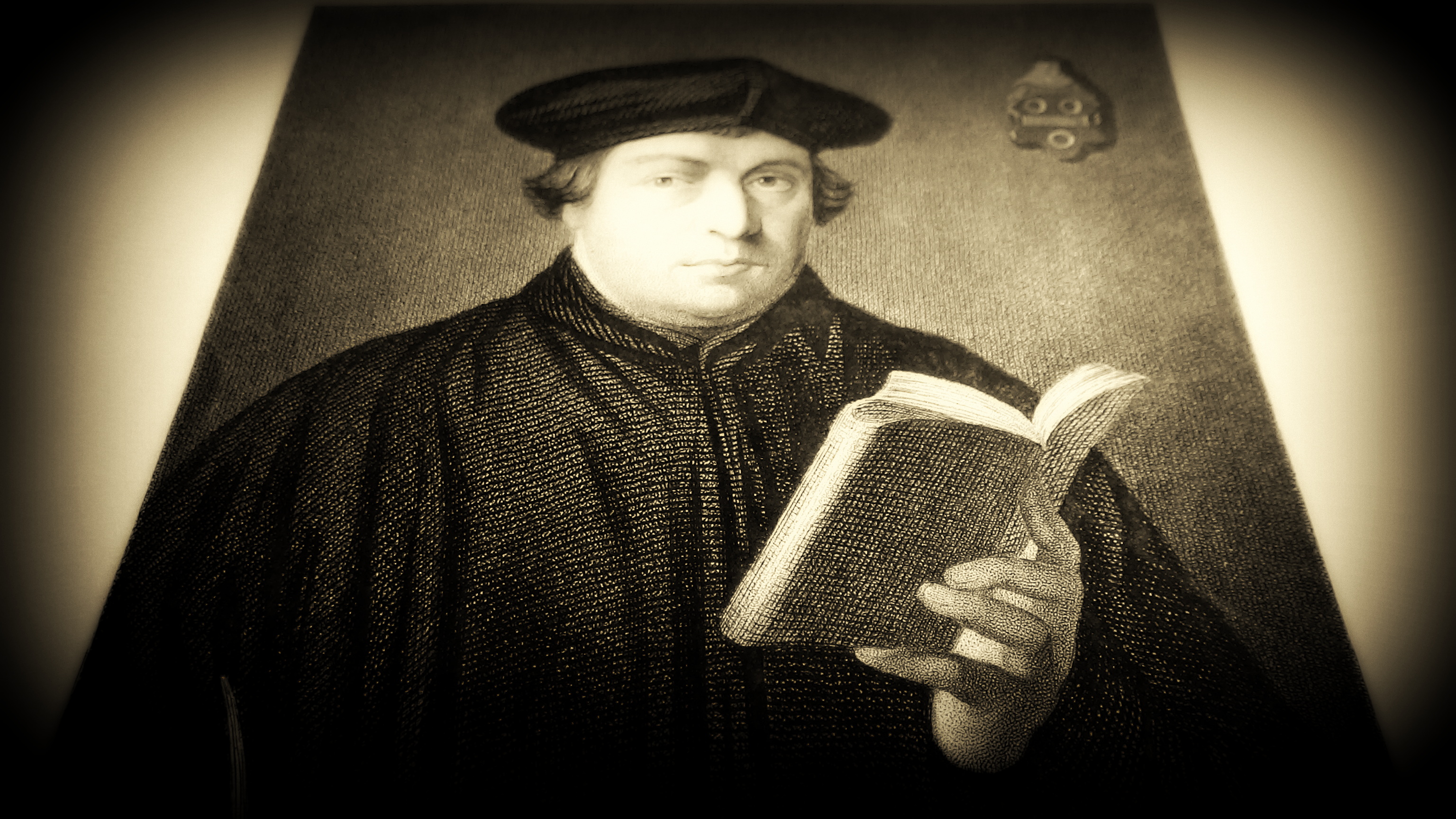
On 31st October 2024, it will be Reformation Day. This event is a public holiday in 5 states in Germany but in the UK Reformation Day is largely forgotten and replaced with Halloween. With this in mind I’m minded to write something about it.
For those who may not know Reformation Day is an anniversary of the day (October 31, 1517) when Martin Luther (1483-1546) nailed his ninety five thesis to the church door in Wittenberg. Back then the church was like our church is today, apostate and in desperate need of reform. Priests and Popes were corrupting the church and few had the nerve to stand up to them. But Luther, God bless him, stood strong and famously nailed his thesis to the church door and the sound of his hammer echoed through the chambers of the establishment.
Recently I watched the 2003 film Luther starring Joseph Fiennes and it has brought back a lot of fond memories for me. That film was very influential when I first began studying Luther and reading his books and autobiographies about him. I’d recommend people view that film and read his books rather than waste their time with all that Halloween nonsense.
But as the saying goes ‘nobody’s perfect’ and the same can be said for Luther. For me Martin was far from perfect, and that’s the point. Reformers do not need to be perfect humans they just need to have faith and believe the Bible. There are times when I really agree with Luther and think that he has been misrepresented by many people. For me, a great deal of these misunderstandings stem from cherry picking sections of Luther quotes without really considering the possibility that he might have changed his mind later on.
While in discussion recently it came up of how Luther and Calvin would have agreed with each other over doctrine and this brings me to the main point of this article. My discussion was in response to the Calvinistic interpretation of Predestination which logically affirms the doctrine of Limited Atonement. As always I make my point that there are differences of opinion concerning the meaning of Predestination and the 16th century reformers didn’t all agree with the Calvinism of that century. For me, Calvin is a little like Luther sometimes in that he might have changed his mind at times. For me, Calvin reads as though he did believe in Limited Atonement and certainly Predestination, while other times he appears to believe that Christ died for all mankind. These views can be found in Calvin’s Commentaries.
Yet there are times, (certainly in Luther’s books) where Martin appears to believe that Christ died for all, yet other times he implies all means the elect? This would imply that he didn’t believe Christ died for all, so there’s certainly conflict in understanding his position. This brings me to the answer of my own title: Did Martin Luther believe in Limited Atonement? Well, the answer is yes and no, I don’t think he did and other times I’m not so sure, here’s why.
While at Wittenburg in 1515, Martin Luther began to lecture from the New Testament and from Paul’s epistle to the Romans. It was during Luther’s studies for these lectures that he famously found that salvation is by grace alone and through faith.
In the popular modern versions of Luther’s commentary on Romans, such as J. Theodore Mueller’s translation, certain beliefs and passages have been omitted from the publications to avoid confusion with Luther’s actual beliefs. For, his beliefs often changed and improved with his knowledge of scripture. In his lectures on Romans and 9: 20-21 Luther says this:
“God will have all men to be saved” (1 Timothy 2: 4), and he gave his Son for us men, and he created man for the sake of eternal life. And likewise: Everything is there for man’s sake and he is there for God’s sake in order that he may enjoy him, etc. But this objection {to God’s sovereignty in salvation} and others like it can be just as easily be refuted as the first one: because all these sayings must be understood only with respect to the elect, as the apostle says in 2 Timothy 2: 10, “All for the elect.” Christ did not die for absolutely all, for he says: “This is my blood which is shed for you” (Luke 22: 20) and “for many” (Mark 14: 24) – he did not say: for all- “to the remission of sins” (Matthew 26: 28) (Martin Luther, Lectures on Romans, translated and edited by Wilhelm Pauck. Philadelphia: The Westminster Press, 1961. P 252)
The question remains for my readers: Did Luther believe in Limited Atonement or did he believe Jesus died for all mankind? Decide for yourselves. I think he may have originally believed in Limited Atonement (in 1515) and changed his mind later on.
Hymn stories: All Hail the Power of Jesus’ Name
Posted by simon peter sutherland in Hymns, Theology on October 3, 2024

Way back in 1838 a railway man James Ellor (1819-1899) brought his local choir a tune. This was called “Diadem” and he had written the tune to be sung with the Edward Perronet hymn “All Hail the Power of Jesus’ Name”.
James Ellor was born in a place called Droylsden in Manchester and was choirmaster at his local Methodist Wesleyan Chapel and is also said to have worked in the hat industry.
Over the last few months I have been fascinated by this great old hymn and have sought to find the location where the hymn tune of this great hymn was first sung. Lo and behold I have found it. After looking through old maps and studying the location and all the related churches in the area I have narrowed the original location down to a site on Market St, Droylsden.
Today the original building is long gone but back in the 1830’s a chapel stood near and in between the location where a Co-operative Hall Wharf (dating to 1876) and an industrial building (dating to 1911) now stand. Thankfully, a local church meet very close to precise location so someone is still doing the Lords work there and there’s a tram stop near should anyone wish to visit. After all it is a very special hymn and should never be forgotten.
Today a number of versions of the hymn continue to be sung, and especially in America. This seems very fitting since James Ellor emigrated to America in 1843 where he returned to his trade a hat maker. So let us remember the words of this great hymn from the Methodist Hymn Book,
”Let every tribe and every tongue before Him prostrate fall, And shout in universal song The crowned Lord of all.
O that with yonder sacred throng We at His feet may fall, Join in the everlasting song, And crown Him Lord of all!”
I think all Christians everywhere, can agree with those great words. I know I can.
I have written my first hymn
Posted by simon peter sutherland in Hymns, Music, Theology on July 30, 2024

For many years I have been a great lover of wonderful old hymns. Guide Me O, Thou Great Jehovah, The Day Thou Gavest, Lord, is ended and How Great Thou Art. All of these hymns have inspired me greatly throughout my life and I have been a worship leader a number of times and sung many great Christian worship songs.
Last year I read Keith and Kristyn Getty’s book “Sing” and it’s all about Christian music and the value of hymn writing. I was very motivated by this and while revisiting the Greek Island of Kos I wrote my first hymn.
Kos is very important to me as a Christian and I’ve made documentaries about it and explored St. Paul’s connection to the island (Acts 21: 1). It has been a long journey and this has contributed to my writing this song.
The hymn is not presently released but my wife and I have sung it. Jenny has been very instrumental in helping me make my documentaries and I’m very thankful to her and I have faith to believe that the Lord has given me this song as a nice gift and He will use it to His own glory and praise.
I believe the hymn will one day be a blessing to Christian’s everywhere, regardless of denomination or circumstances.
My quest to find the lost Bible of George Marsh
Posted by simon peter sutherland in Martyr George Marsh, Theology, William Tyndale on May 3, 2024
In my previous article concerning my quest to uncover the home and Bible of George Marsh I mention his Bible in passing. I mention how I have examined a Marsh family Bible in Bolton Library and how an old newspaper article suggests his Bible was seen in Bolton in the 1850’s.
My research revealed the Marsh family Bible in Bolton cannot be the Bible that once belonged to George Marsh (1515-1555) since it outdates him by 11 years. A Bible that belonged to him would need to have been printed prior to his imprisonment in 1554 and his execution in 1555. In my opinion he would have likely used the Tyndale New Testament for his own personal reading and (as a matter of fact) a reformed Church of England cleric would have used the Great Bible for ministry at that time.
I have examined the Scripture quotes in the pastoral letters of George Marsh and in the book of Martyrs and they appear to be influenced by both Tyndale and Great Bible translations. This is an immensely important observation.
I believe any Tyndale New Testament that once belonged to George Marsh would have been burned with him in Boughton, Chester in 1555. In those days condemned reformers who used the Tyndale New Testament were paraded around a city with Tyndale’s New Testament hung about their necks. In the Book of Martyrs the last reference to George Marsh having his Bible was when he held it up before being burned. Foxe writes how Marsh was offered a pardon and he refused it on the condition that it would “pluck him from God”.
This New Testament I believe was burned with him.
However, the Bible I believe he used in his public ministry was not taken with him so it may have been left at the last place he ministered before his arrest. This would imply his Bible remained in and around the areas of Bolton and Bury in Lancashire.
The question is, has this Bible been found? Or is there something more?
As I have previously stated, my quest to uncover his Bible began after I made my documentary about him. I believe it is possible that the Bible people believed (in the 19th century) to have been his may have been identified? However I also believe it is possible the Marsh family Bible in Bolton library may also be the Bible people thought was his?
I am also aware that reformers and puritans once gathered in the area of Rivington Pike to read George Marsh’s letters. This could also be an important factor in the quest. But where all this will lead, only time will tell.
Either way, a Bible that once belonged to this great man, would be of enormous spiritual significance in our time.
Uncovering the location for the Manchester dwelling house of Thomas Charles
Posted by simon peter sutherland in Historical Manchester, Mary Jones, The Welsh Bible, Theology on April 27, 2024

Finding forgotten locations or places of historic significance is no easy task in our modern world.
Redevelopment, regeneration and expansion comes at a cost as archaeological remains lie beneath the surface.
One of those is a street in Manchester where the “dwelling house” of Thomas Charles once stood.
For those who may not know, Thomas Charles (1755-1814) was a Welsh Calvinistic Methodist from south Wales who spent a lot of his life living and ministering in Bala, North Wales. Thomas Charles was once a Church of England minister who was let down by that denomination and eventually found a home in Bala where he could minister among the Calvinistic Methodists who lived there.
Thomas Charles is the man famously responsible for giving a young Welsh girl called Mary Jones a Bible in 1800. Mary was a poor girl who worked and saved 6 years to purchase her beloved Welsh Bible and walked 26 miles or so, barefoot to buy it. Arriving at the home of Thomas Charles in Bala, Mary would eventually attain her Bible and two others as a gift. Thomas Charles was the man who gave her those Bibles.
Thomas Charles was very inspired by the story of Mary Jones and in 1804 he founded the British and Foreign Bible Society with William Wilberforce. His life and work is a testimony to the grace of God and known throughout the world.
Mr Charles had been gravely ill for many years and a prayer was offered up for him that he might live another 15 years. That prayer was answered. Charles died in 1814 and in his last Will and testament he writes that he is the owner of three properties, two in Bala and one on Hope Street, Manchester.
In his will Mr Charles wrote “I am the owner of the Inheritance of three messauges or dwelling houses with their appurtenances two of them situate in Bala aforesaid and the other in Hope Street in the town of Manchester in the County of Lancaster” (The World of Mary Jones. By Sara Eade. P. 33)

Back then the area of Oldham Street was very important to the Methodist movement and nearby is a place called Hope Street. This is actually the location of one of three houses owned by Thomas Charles.
Hope Street is also very near to where John Wesley preached.
I have located the site of that property and have examined a map dating to 1819. There is however no blue plaque to his memory or any acknowledgement of this great man’s connection to Manchester.
Yet there are plenty of other plaques scattered around the city.
In St Anne’s Square there is a blue plaque to Robert Owen (1771-1858) a Welsh entrepreneur and social reformer who lived in Manchester for 12 years.
On Bow Lane there is a blue plaque to Ernest Jones (1819-1868) who practiced a law chamber here between c 1863 – 1869.
There is a plaque to Elizabeth Raffald (1733-1781) outside Marks and Spencers who established a cookery school, shop and domestic service agency near the site.
Indeed, there are different colour plaques scattered all around the city and as a native I have visited these places for myself and once realised it isn’t difficult to find yourself lost in the history of this city.
Manchester is the birthplace of poet John Byrom, the author of the classic hymn “Christians Awake”. The city has a very significant Wesleyan history. Oldham Street has a blue plaque which tells of how Wesley opened a chapel here in 1781.
It is clearly a city packed with history and sure enough there had been a Welsh settlement in Manchester since the 16th century.
We have a great deal here, from a Roman settlement to the location of an ancient castle. A historic Cathedral. The oldest public library in the English speaking world. Significant Tudor and Christian history also plays an important role in Manchester’s history, including the life of Protestant martyr John Bradford (1510-1555).
Surely it is time to honour this great man and have a commemorative plaque put up on Hope Street.
Christ died for all mankind, even Judas!
Posted by simon peter sutherland in "Calvinism", Limited Atonement, Theology on March 28, 2024

Over the last 20 years I have been in a continuous and sporadic confrontation with the 5 Point Calvinist view of Limited Atonement. I have read books, articles, listened to sermons, debates and had many conversations with a number of believers who hold to the the view that Christ did not die for the whole world but only for His elect.
I reject that viewpoint.
In the Bible there many verses that state that Jesus Christ died for all, yet according to many 5 Point Calvinists, this word all, does not always mean all. Fair point, there are times when all does not mean all. Does that observation however mean that Jesus Christ did not die for the whole of mankind? No, it does not.
At this stage, there is little point my listing the considerable amount of New Testament verses which are believed to affirm that Jesus died for all mankind, since 5 Point Calvinists differ to the plain interpretation of these passages. So I will focus upon one passage and work my way from there.
In Matthew 26: 17-30 Jesus celebrates the Passover with His disciples and institutes the Lord’s supper. Those who were present were the 12 disciples. This includes, Peter, James, John, Andrew, Philip, Judas Iscariot, Judas Thaddeus, Matthew, Thomas, James (son of Alpheus), Bartholomew, and Simon the zealot.
The feast took place on the evening of the first day of the feast of Unleavened Bread (Matthew 26: 17). Verse 20 says “When evening had come, He sat down with the twelve.” Then Jesus refers to the one who will betray Him (verse 21) and the disciples are exceedingly sorrowful and they ask the question “Lord, is it I?” (verse 22) Then Jesus responds by saying “He who dipped his hand with Me in the dish will betray Me.” (verse 23) He then goes on to say “woe to that man by whom the Son of Man is betrayed! It would have been good for that man if he had not been born.” (verse 24)
Then Jesus takes the bread, blesses and breaks it and gives it to His disciples saying “Take, eat; this is My body.” (verse 26) We assume all 12 disciples ate the bread at this point. Then in verses 27-28 Jesus takes the cup and says “Drink from it, all of you. For this is My blood of the new covenant, which is shed for many for the remission of sins.“
This word translated many is is described by Greek scholars as meaning what it says on the tin, a large number. There is basically no limitation to that word. The word “shed” describes a pouring out in a sacrificial sense and is steeped in Old Testament knowledge. He means that without this shedding of blood there is no remission of sin or sins.
When you consider the unmoveable fact that Judas was present when Jesus said that and when He offered all 12 disciples to eat and drink this Passover, we cannot but assume that He said this to all 12 disciples including Judas.
Thus, if Limited Atonement were true as is stated in the 5 Points of Calvinism, then Christ only died for His elect who would believe in Him and be saved. This would exclude Judas. Yet here in Matthew 26: 17-30 we see the exact opposite. We see Jesus offering Himself to all 12 disciples, including Judas, yet Judas betrayed Him.
It is my belief that had Judas repented, He may have been saved? But he did not. This however does not mean that Christ did not die for him or for the rest of mankind, it merely means that all do not receive Him.
Dwell upon these thoughts this Easter as we remember what Christ has done for us and all who believe in Him and keep His commandments.
-
You are currently browsing the archives for the Theology category.
Simon Peter Sutherland
-

 Simon Peter Sutherland