Archive for category Christianity
Jesus out of focus and Christmas with Christ
Posted by simon peter sutherland in Christianity, Issues with Christianity in England today on December 23, 2014

Cross out of focus © 2014 Simon Peter Sutherland
I greatly admire Christmas and it is at this season of the rolling year that I have a few traditions of my own. One such tradition I have is my reading of ‘A Christmas Carol’ by Charles Dickens.
First published in 1843 after a visit to Manchester, Dickens clearly wrote the book with the aim of reforming the festival that was starting to fade. I think he did a good job of it. His term “humbug” was a masterly description. The problem is, Scrooge was in fact correct, Christmas was a “humbug”. A 19th century definition means ‘fraud’.
In the 21st century, Christmas is in fact a time for paying bills, acquiring heavy debts and a time where people indulge in constant spending, socialising, gluttony and alcoholism in an industrious commercial institution that focuses upon materialism and not the person of Jesus Christ. In that context Scrooge was correct; ‘Christmas sir is a humbug’.
But for me and many Christians, Christmas is not merely a time for gaining material or spending, and I certainly do not drink alcohol or indulge in gluttony. Christmas for me, is a time for remembering the birth of the Lord Jesus Christ and in that, Christmas is with me 365 days a year.
However, despite the fact that a secular Christmas has little to do with Jesus Christ, there is little doubt in my mind that many people today, Religious and none Religious would seek to abolish Christmas, and replace it with something else or nothing. In many ways, secularist culture has done just that, it has abolished the true historical meaning of Christmas.
Likewise, the use of the abbreviation “X” rather than “Christ” can be argued that the secularists have used a historic meaning. The letter “X” is from the Greek “Χριστός” which means Christ. The problem is that the majority of people, especially the secularists or average soul, has little or no knowledge of the Greek language, so “X” to them is just a letter.
Secularism has turned Christmas away from a festival where people celebrate and remember the birth of Jesus and turned it into a time of worldliness and sin and selfish gain. People are celebrating the sins that Jesus came to set us free from.

St Paul Outside the walls, Rome, Out of Focus © 2014 Simon Peter Sutherland
In the year 1647, the Puritan government in England banned Christmas and regarded it as little more than a snare of “Antichrist” and “Popery”. But today in the 21st century it is difficult to connect Christmas with the Roman Catholic Church or even as a Religious festival. We all know that for many people in the West, particularly in Britain, Christmas has little to do with the Lord Jesus Christ.
But for me as a Christian, the season is very much related to our Lord Jesus. He is everything! And even though we do not know the exact date or year when Jesus was born, we do know that the early Church made the decision to celebrate His birth at this time of year.
Because of a 4th century reference to Christmas in the calendar of 354 AD, we know that early Christians at Rome regarded the Nativity to have taken place on 25th December. However, Christians in the East celebrated the Messiahs birth on January 6th.
Moving forward in history toward the Protestant Reformation, I would think that no accurate case can be established to claim the 16th century Reformers denied Christmas. It is true that governmental 17th century English Puritans banned Christmas, but such was not the case with the 16th century Reformers. The facts remain that 16th century Lutheran, and Church of England Reformers continued to celebrate Christmas: that point is clear from history and the Book of Common Prayer.
Christmas reminds me in many ways of the Jewish season of Hanukkah, recorded by Jewish historian Josephus as “The festival of lights” (Antiquities X11) In this festival the Jewish people commemorate the establishing or rededication of the Holy Temple, and is an eight day holiday which starts on the 25th day of kislev. This can occur from late November to late December. Concluding for many on what we call ‘Christmas eve’.
It is clear to me that the things which Jewish people celebrate in Hanukkah were fulfilled in the life, death, burial and resurrection of Jesus Christ. I see that in and through Jesus, Judaism is made whole. Without Him I see little conclusion or fulfilment of the Torah and the Prophets. Not only is Jesus the “Light of the world” and not only has did He fulfil the prophecies but He has rededicated the Temple and purified it in His people. And if one desires to see Jesus in this, a good place to start would be throughout the Gospel of John, where Jesus is at the Feast of dedication during winter (John 10: 22-23) and also the book of Hebrews.
I think Christmas has been hijacked by secular culture and I think that unless peoples hearts and minds are won over to the Truth, there is little that can be done about that. Christmas for secularists merely implies faith, hope and gluttony:
- Faith in “Evolution”.
- Hope in “Science”.
- Indulgence in the flesh.
A person cannot honestly take Christ out of Christmas and continue to celebrate the festival as though He never was who He said He was, it is intellectually dishonest. And as for the mess that the world makes of Christmas, should we really expect anything else? The world would turn every celebration into a hotchpotch of drunkenness and fleshly pursuits, and entertainment. So what more can we expect? It is up to each one of us to be different, because we are different. We are not of this world, if we belong to Christ. Thus, it is up to us to know and understand what we believe and it is up to us to show the people of the world the historic Truth behind the Christmas many know and love.
Many Christians are speaking out for the Truth, but far too many Christians in Britain desperately need to start speaking out!
Visit to Rome: The Mamertine Prison
Posted by simon peter sutherland in Biblical archaeology on December 1, 2014
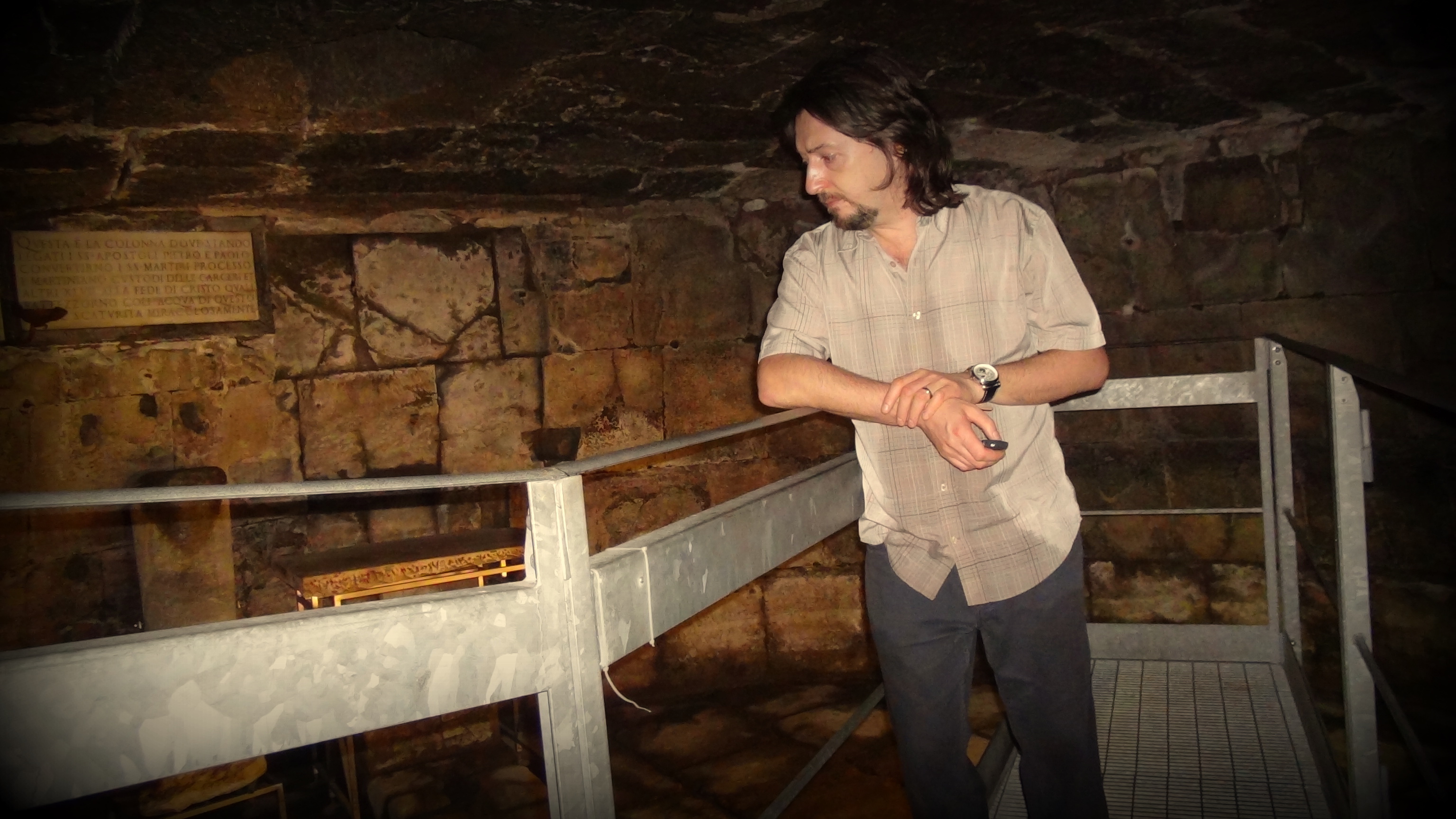
Simon Peter Sutherland at the Mamertine Prison, Rome © 2014
Visiting ancient Biblical sites in the Mediterranean is always an experience for me and is something I find second to none. Although I like some of the wonders of modernity, I regard our present world as unappealing, noisy and somewhat shallow. Because of that, I prefer history rather than the present
Last month, I travelled to Rome, the ancient and modern city known for being somewhat of an open air museum. Being a history fanatic myself and absolutely intrigued by the Bible, as always I was in inner rapture.
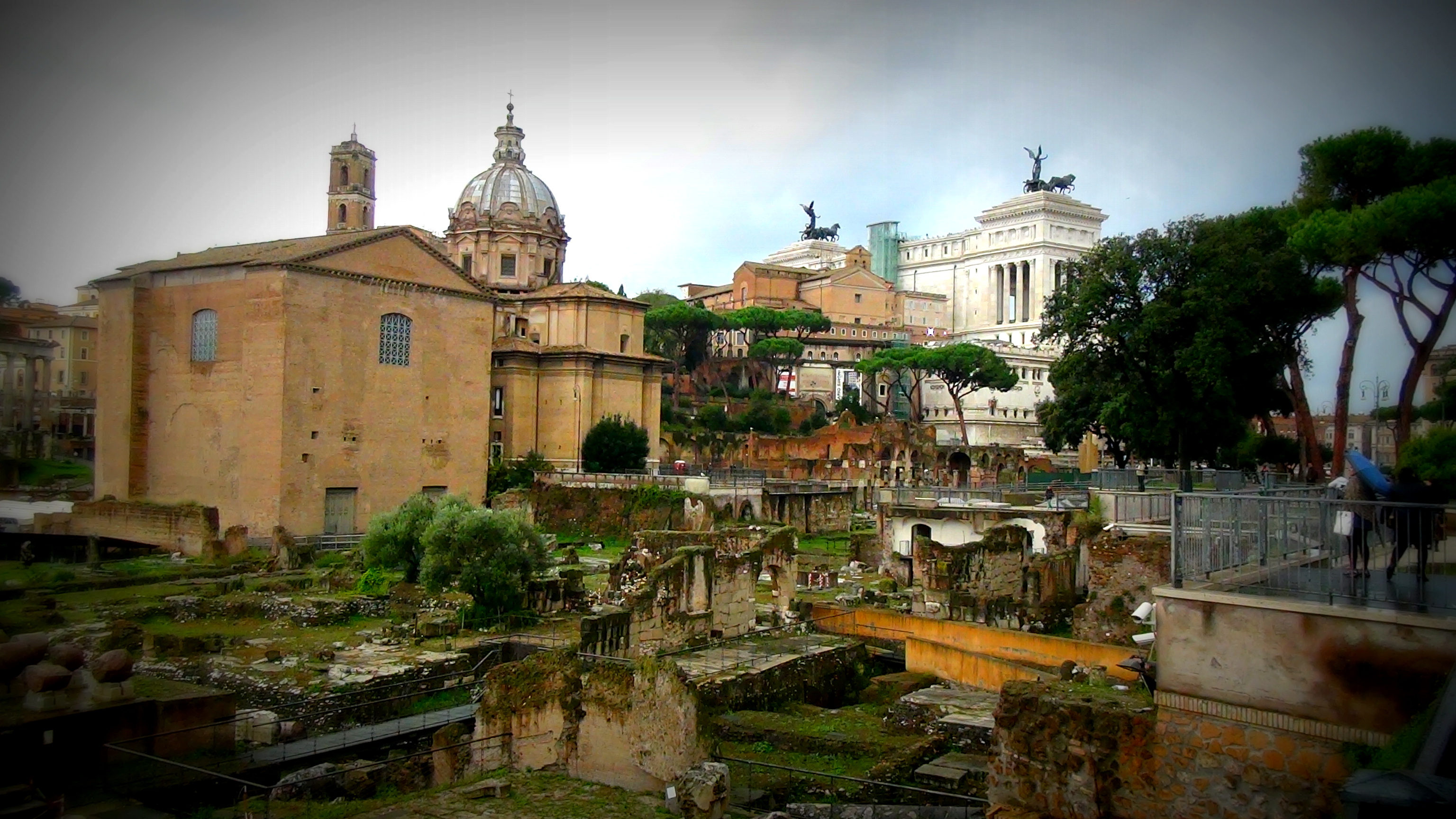
Forum, Rome © 2014 Simon Peter Sutherland
During the afternoon of the first day I visited the ancient area of the Forum leading to a place known as “Mamertinum”or the Mamertine Prison. This ancient prison is within a stones throw of the ancient forum, a Comitium which once felt the feet of the Apostles Peter and Paul and also of Luke and of Aquila and Priscilla.
The Gospel of Luke and Acts of the Apostles were probably written while Luke was in Rome. We also know that Luke was with Paul during his time in prison. This is understood from 2 Timothy 4: 11.
The Mamertine prison, known historically as the “Tullianum”, was probably constructed between 640-616 BC and was likely a cistern. The amazing thing for me was that scripture was written from this damp dark cell.
In 2 Timothy 1: 16 Paul referred to his “chain” this chain now resides at ‘St Paul outside the walls’ which was build on his ancient tomb. Writing from the Mamertine, in 2 Timothy 2: 7-9 Paul wrote: “Consider what I say; and the Lord give thee understanding in all things. Remember that Jesus Christ of the seed of David was raised from the dead according to my gospel: Wherein I suffer trouble, as an evil doer, even unto bonds; but the word of God is not bound.”
On entry down the stairs to the upper level of the complex, I saw ancient Frescos. These can be found on the walls and show Christians depicted with the arms and hands held out. Over recent years Archaeologists have uncovered evidence that have connections to St Peter as early as 7th century. The evidence also suggesting the Mamertine was used as a Church by the 8th century.
The claim that St Peter was in Rome goes all the way back to the 1st century from his probable coded use of the word “Babylon” for Rome in 1 Peter 5: 13, 2 Peter 5: 13, and his crucifixion linked to John 21: 18 where Jesus foretold him of his future suffering. The claim of his crucifixion in Rome comes from the 1st or 2nd century “Acts of Peter” which we know was in circulation in the 2nd century. The “Acts of Peter” claims that Peter was crucified upside down in Rome at his own request. This claim is also affirmed by Clement between AD 80-98 in his letter to the Corinthians (chapter 5). An event which probably took place near where St Peter’s Basilica now stands around AD 64 during the reign of Emperor Nero.

Mamertine Prison © 2014 Simon Peter Sutherland
There was a time when condemned prisoners were held in this cell before execution. We know for certain that 2 Timothy was written from the Mamertine and it is possible that Philippians was also written here too. If Peter was in fact executed in Rome then he most certainly was held in the Mamertine, as a strong tradition affirms. If that be true which I think it is, 2 Peter may also have been written in this dungeon.
Other Biblical texts possibly written from the Mamertine or nearby, include Philemon, Ephesians, Colossians and possibly Galatians. It is one of the most outstanding thoughts and realities of life that the Truth of the Gospel is that suffering produces great things. Persecution never destroys the Church, on the contrary it enhances it. It is truly amazing to think that such a light as Scripture itself could come from such a dark damp cell. That such a light could truly shine from such a dark place.
I love this little prison.
Aristobulus: Britain’s Apostolic connection to the Bible.
Posted by simon peter sutherland in Christianity on September 12, 2014
 A lot of people in Britain today when they think of Christianity, either think of it in the present or alongside the likes of Archbishops and Popish type figures. Pompous priests and high Anglican services and so forth.
So often, the events of the present, dictate and define our understanding of words and people’s beliefs. Such, I think, could not be further from the Truth.
Britain as it stands today, may well be a Christian Country in the context of some official ethics and as in a form of Christianised culture, but in reality and belief, it is far from real Christianity.
But the question which looms in my mind is this: was Christianity ever intended to be a denominational establishment, where members of a so-called Christian state, were members of the Church. This type of political institution I think, reduces the Gospel of Christ and the foundations of the Apostolic doctrine to comply with geopolitical power of ‘Christendom’ rather than members of the worldwide community of Christians. Most of all, it denies the Truth of Scripture.
In Britain today however, the media and so forth likes to over state Henry V111 and his so-called tyrannical reign: yet Britain’s foundation of the Gospel pre-dates the commonly overstated emphasis of the so-called Church of England as founded by him and likewise continues throughout history through Christians who separated from the Church of England and founded various denominations. Many of these people are labelled extreme or ‘fundamentalists’ and thus are programmed in peoples minds even before they attempt to understand them. The fact remains that Christianity has her measuring line; the Bible, by which the Church is to be judged not visa versa.
In fact, even though the Church of England is given official credit today in Britain, it is not merely Henry V111’s establishment that is the foundation. For the Church of England pre-dates Henry V111 and can be quite easily connected to the early primitive Church, the Anglo-Saxon and Celtic eras leading to the influence of Rome and Henry V111’s separation.
In fact, a long and well established tradition connects Britain directly to the Apostles themselves.
In Romans 16: 10, St Paul wrote of a certain Aristobulus. He was believed the brother of Barnabus and of Cypriot decent and one of the seventy Disciples who witnessed the Resurrection of Jesus. He may even have travelled with St Paul? Aristobulus is believed to have taken the command of Christ in ‘the Great Commission’ to “Go ye into all the world and preach the Gospel to every creature” (Mark 16: 15) to Spain and concluding his missionary journey in Roman Britain.
We have plenty of evidence of Christianity being practised and believed in Roman Britain in the 1st century, so it is logical to say that someone from Israel must have brought it here.
Considering this view is not the mere claim of some ancient myth or folklore type legend, it is supported by reliable sources, I think God has a special place for Britain and He will not let her go. Even if He has to bring the country down to its knees that the Church and the people might return to Him, He will do so.
An Israeli archaeologist discovers King David’s Citadel
Posted by simon peter sutherland in Biblical archaeology on May 6, 2014
“The kings of the earth set themselves, and the rulers take counsel together, against the LORD, and against his anointed, saying, Let us break their bands asunder, and cast away their cords from us. He that sitteth in the heavens shall laugh: the Lord shall have them in derision.” Psalm 2: 2-4
For quite a while now, some modern archaeologists and scholars have been mocking the historical claims of the Bible and propagating their theories that it is an unreliable source. But their Political agenda stricken claims are repeatedly proven wrong, as recent discoveries consistently prove. There is no doubt to the historical authority of the Scriptures.
Israel belongs to the Jews!
DSS: 7Q5, Marks Gospel and the Resurrected Christ
Posted by simon peter sutherland in Biblical Scholarship, Christianity, The Bible on April 20, 2014

Ancient handwriting
© 2014 Simon Peter Sutherland
Those who are familiar with me know how I repeatedly disagree with the many popular claims made by so-called modern ‘Bible Scholars’. All too often I find the opinions of these people and their dating methods concerning Biblical history, the New Testament Gospels and epistles, inconsistent with the information that is available. Since the existing data contradicts them, I often regard their claims as either misinformation or out right lies.
However, what some people fail to acknowledge concerning me, I, is that I never make such claims without rigorous research and proofs.
In this post, I am writing yet again concerning another often overlooked and deliberately disregarded proof text which contradicts the claims of modern critical scholars. This further information I am presenting relates to DSS fragment 7Q5 and its connection to the Gospel of Mark, which if true, is undeniable proof that the Synoptic Gospel of Mark was written well before AD 66 or 68.
The facts are the following.
Between 1946-47 shepherds in Qumran, Israel, discovered a number of ancient manuscripts in a series of Caves about a mile inland from the Dead Sea. These scrolls (known as DSS) are of highly significant in Biblical research and were written in the languages of Hebrew, Aramaic and Greek and provide valuable information relating to some Religious practices and beliefs during the 2nd Temple Biblical era.
This discovery is arguably one of the greatest finds of the last century.
In cave 7 among some of the Qumran scrolls was discovered a fragment known as 7Q5. This Papyrus fragment clearly appears to be a New Testament papyri containing a section of Marks Gospel chapter 6 and verses 52-53.
This section in Greek reads like so;
ου γαρ
συνηκαν επι τοις αρτοις,
αλλ ην αυτων η καρδια πεπωρω-
μενη. και διαπερασαντες [επι την γην]
ηλθον εις γεννησαρετ και
προσωρμισθησαν. και εξελ-
θοντων αυτων εκ του πλοιου ευθυς
επιγνοντες αυτον.
In the King James Version, the passage reads as following;
“For they considered not the miracle of the loaves: for their heart was hardened.
And when they had passed over, they came into the land of Gen-nes-aret, and drew
to the shore”
It is quite clear that this Greek passage is part of Marks Gospel. Which, presents a huge problem for modern scholars since this cave was closed in AD 68 and never reopened again until 1946-48.
The problem is that those leading scholars whom society make their leading thinker, are the very ones who deny them. Yet the Markan narrative in its original context shows that some people back in the time of Christ could not see the Truth, their hearts were hardened by God Himself.
In his book ‘The Complete Dead Sea Scrolls in English’ Geza Vermes ignores the claim that 7Q5 contains Mark 6: 52-53 and dismisses it as a “clearly unprovable hypothesis” (Appendix. P 441) yet he appears to offer no satisfactory explanation why? Neither does he include the actual text in his book. This begs the question; ‘just how complete is his version?’
The significance concerning this fragment and Marks Gospel is very high and should not be played down by scholars. Since the caves in which the DSS scrolls were discovered were large quantities of scrolls which are of the highest importance. Today the DSS sit in the Shrine of the Book, in Jerusalem of which the Israel Museum has over one million visitors per year.
It is a very real claim to say there are a lot of disinformation agents in the West today who are trying to bring down Christianity and her mother Religion, Judaism. And any evidences that rise up, either by archaeology, vault discovery or textual analysis, each day they are ready to pounce upon them and discredit the information in relation to the Bible.
The Truth is that the some of these modern scholars continuously play down the authority of the Synoptic Gospels and the Gospel of John because they know the implications and the power of eye witness testimony of this grand scale. The Gospel of Christ “turned the world upside down” (Acts 17: 6) and these scholars and authorities and political spin doctors know that. So in order to control the masses of people and play down Christianity, they must attack it from within. What better place to start than attack the Bible itself.
The problem is that they know all too well that the Bible is not just another religious text. If Jesus had been presented as some kind of guru, philosopher or crucified man, He would be just another martyr, but no, He rose from the dead and proved He was the Christ. But if He was just a great teacher or one of many ways to God, then people would not revolt against Him. But knowing the implications of the things He said, He Himself makes the path of Truth a very singular journey. Thus, in order for the enemies of Truth to bring down this road to pave the way for another they look for contradictions like a lawyers in a court of law in an attempt to make the testimonies themselves appear unreliable. But clear research and Theological insights and exegesis of the Biblical narratives clearly demonstrate that the Gospels do not contract each other and people like myself are willing to appear unlearned and silly sometimes in making claims that are contrary to what is often seen as the majority opinion.
But just because something is believed by a majority, does not make it true. The fact remains the Theological community regularly reviews these apparent contradictions and by careful analysis of the text, know the claims are in error. The problem is, that we know the Word of God and its Theological meaning, they don’t. They are attacking things they do not understand. They win over the unsaved majority and even some believers who sit on the fence and then claim their victories. But even a majority vote does not make something true, sometimes people are just plain wrong.
What we need to do, each and every one of us, is rise up and defend the Truth. It is the promise of eternal life which those scholars are robbing people of. It is they who are destroying peoples faith in the Bible as the Word of God. And it is the Word of God which is Gods chosen way for Him to reveal who He is. But if people close their minds to the Truth, how will they find it?
The time is upon us and we are seeing more than enough proofs of this each day, that a very large organization is set out to utterly abolish Christianity from face of the earth. And if it cannot do that, it seeks to destroy peoples faith in Christianity’s measuring line by reducing it to mere literature. But they will not succeed so long as the Truth is presented and that fellow Christians, is our job.
Do it now while it is still day, for the night comes when no man can work.
CNN: Noah’s Ark discovery in the British Museum 2014
Posted by simon peter sutherland in Biblical archaeology, The Bible on January 31, 2014
In an article on CCN, it is reported that Irving Finkel, a British Scholar has discovered a 4,000-year old tablet from Iraq which contains an account similar to the Mosaic account of Noah’s Ark.
Link to CNN article; http://newday.blogs.cnn.com/2014/01/28/noahs-ark-discovery-raises-flood-of-questions/
Were the four Gospels eye witness testimony?
Posted by simon peter sutherland in Biblical archaeology, Biblical Scholarship, The Bible on January 13, 2014
Ancient handwriting
© 2014 Simon Peter Sutherland
One common notion people are presented with today is the claim that scholars now know the four Gospels of the New Testament were not written by eye witnesses or people who actually knew Jesus of Nazareth.
This type of claim is quite a common place today. We read it in books, hear it on the BBC radio, see and hear it on television and in countless documentaries. Likewise within the world of scholarship I continuously run into a head on collision with this argument by people who, when it is all said and done, know more about this argument than the narratives themselves.
One problem I see is that many of the people who make these claims do not make them off their own back, neither did they originate them. The claims themselves go back quite a while to the dawn of modern scholarship and one can easily find the early church disputing who wrote the Gospels.
In the 19th century, a fine Biblical commentator and Anglican Bishop of Liverpool J. C. Ryle wrote concerning this issue in his exposition of John 5: 2 and said the following;
“These words, it is thought, show that Jerusalem was yet standing, and not taken and destroyed by the Romans, when John wrote his Gospel. Otherwise, it is argued, he would have said, “There was at Jerusalem.”. J. C. Ryle. (Expository Thoughts on the Gospels. Volume 3. P 269)
At the time when Ryle wrote this there was no evidence for the exact location of this pool, but it was discovered in the 19th century and now sits within the Muslim Quarter of Jerusalem. Thus, demonstrating that although evidence for this pool had not been found until around nineteen hundred years or so after the text was written, the Bible was correct all along. And today it is widely recognised and visitors to Jerusalem can visit the site.
The text of John 5: 2 reads like so; “Now there is at Jerusalem by the sheep market (or pool) a pool, which is called in the Hebrew tongue Beth-es-da, having five porches”.
In this text John is clearly communicating that, not only was John writing for Gentiles and not Jews, which confirms the position of Eusebius in his ecclesiastical history that John wrote this Gospel from Ephesus to expand on things not previously written by Matthew and Mark, but that he wrote in the way that is communicating that Jerusalem was still standing at the time.
There is ample evidence that John had already read Matthew, Mark and Luke by the time he was to write his Gospel and noticed that there was other points concerning Jesus’ life that the Synoptic writers did not mention. For this reason, John wrote concerning the final year of Jesus’ ministry. This is just one of many reasons to claim historically and textually that the Gospels were written by eye witnesses and based upon eye witness testimonies.
Eusebius claimed Irenaeus wrote in Against Heresies, 111.1.2 that Matthew published his Gospel first in the Hebrew tongue and Mark recorded the words of Peter from his preaching. He connects Luke’s Gospel to Paul, which could be confirmed by Luke’s opening passage in his Gospel. (Eusubius. The History of the Church. 8)
Thus, if Eusebius was correct, then this places the date of authorship for Matthew and Mark to well before AD 50’s and not anywhere the proposed dates that modern academic communities claim.
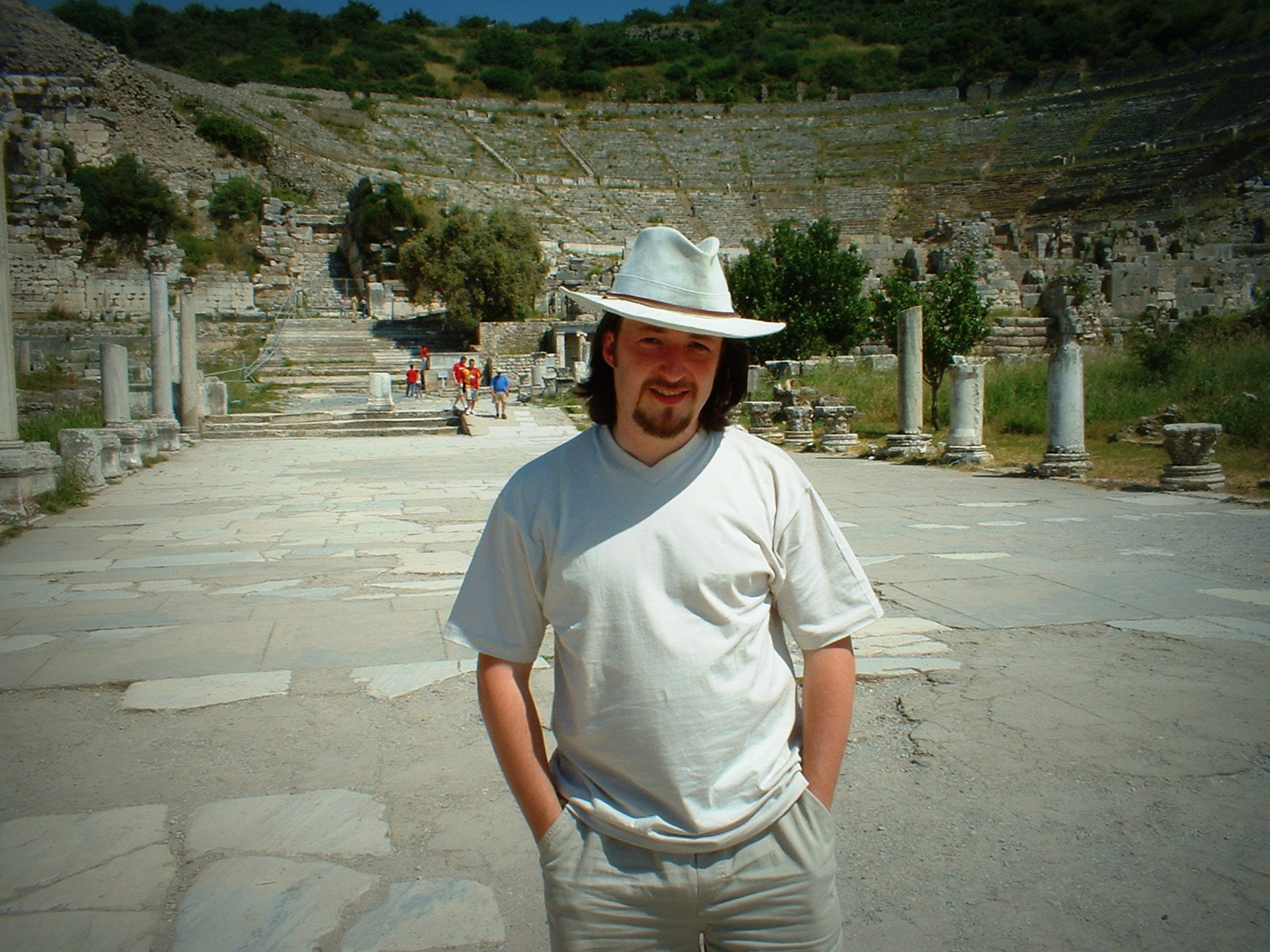
Simon Peter Sutherland at Ephesus
© 2013 Simon Peter Sutherland
From my own research into the Gospels, I have found them to date no later than this era, even as early as AD 30’s for Matthew and as late as AD 60 for Luke. The problem is that modern scholars claim that Matthew could not have been written prior to the events of AD 70 and the destruction of Jerusalem, since they think it not plausible that Jesus could have prophesied the destruction of Jerusalem as He did. Thus, the Gospel of Matthew must have been written after these events. The problem then grows because people would rather believe the negative suggestion rather than think and research for themselves. People are often fooled into thinking that they are researching something when in reality all they are doing is reading other peoples opinions.
Thus, John 5: 2 is just one of many Biblical texts which leave me wondering what on earth so many of these modern scholars are thinking when they date the gospels? What are they up to? I suspect it is a legal game like those in a court of law who look for contradictions in eye witness accounts, thus if they find them, they argue the texts as void.
But I have not found contradictions in the Gospels, the only contradictions I find are the interpretations of those passages by Western thinkers. The Gospels and the entire Bible was written by Jewish people, and when it is all said and done, the critics for the most part, know very little of ancient Judaism.
But concerning John 5: 2, the problem with the academic communities dating methods for the Gospels is that they are not consistent when one understands that John was here stating the sheep gate or market was still standing at the time of his composition. But the problem is, if this text was written when these scholars claim it was then to anyone who knows what the text claims, it is impossible to believe them. The reason being that the sheep gate or market in Jerusalem was destroyed in AD 70 by prince Titus. Thus, internal evidence from John’s Gospel gives us a composition date of AD 50’s at the very latest. And examples like this can be found throughout the Gospels and the New Testament.
Thus, concerning John’s Gospel, J. C. Ryle was certainly correct and he was not afraid or fooled into believing that because scholars say so, it must be true. He had the character and strength enough to disagree with what scholars and critics of his day claimed. Ryle let the text speak for itself and then explored it, that is what makes his expository thoughts on the Gospels so good. But the problem which happens today is that scholars such as Francesca Stravrakopoulou often make wild assumptions concerning the Bible and then publishes what she thinks the text is saying and then judges it according to that thinking. But Francesca Stravrakopoulou is not original in her thinking and neither is she convincing, in fact she in a long line of scholars who often leave both myself and others baffled at their claims.
People are swift to believe the documentary hypothesis of modern scholars, yet they are not so swift to research the actual text for themselves. If they were, the world would be full of people who do not agree with the speculative claims of the academic communities.
In this, I never fail to tire at hearing them, especially when the single minded media barons give those people all the air time. not singularly as an issue of truth or the quest for truth, but something far more earthly and possessive. We are living in a time where all but the sinful depraved nature of man is uncertain. Our age lacks identity and absolutes. Scientists are single minded in presenting their ideas alongside Theology and history, as though everything should be judged scientifically. Regardless of the fact that science merely means ‘knowledge’ people think of science as some kind of test tube analysis, which when it is all said and done is not a method used to judge history.
A person cannot put a historical document in a test tube and measure it according the that method, you have to find some other way of testing things. Each method is an interpretation only and not factual.
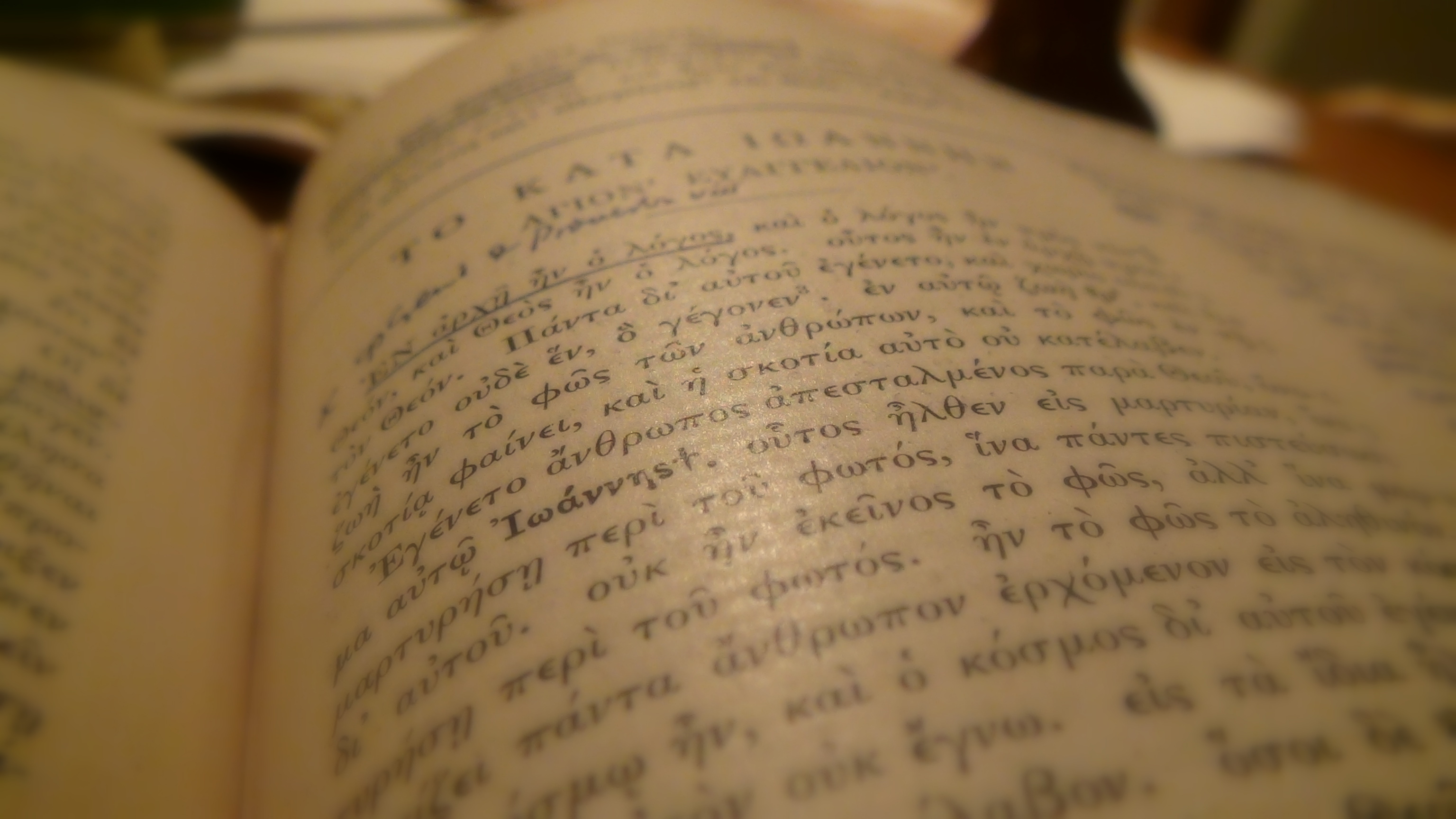
The Gospel of John in Greek
© 2014 Simon Peter Sutherland
For example, if I were to measure the Gospels, I would look at them internally and measure their claims. I would never go along with what state education claims, but would measure the claims according to what I know. For this reason, I absolutely disagree with many claims made by modern scholars who take a text, a verse, a claim, a science, a majority vote and so one and measure the texts through those eyes. Thus, whatever one makes of that, it is certainly not the method used by the early church through to the reformation and beyond, where devotion and Theological insight must first be established in order to see the text clearly. In other words, a person cannot measure a text and judge it if they have failed to understand what the text is saying.
Let us take Biblical archaeology for example; if I go to Jerusalem, I can find plenty of evidence for the Bible there, the reason being, because that is the central location for the majority of Biblical events. So if I go and search for evidence of King Solomon’s temple in Babylon, I’m not going to find very much, but if I first look at what the text says, interpret it correctly, then see where the Biblical narrative is leading me, I will find it. I suppose what I am saying is that people should first find out what the Bible is saying before they critique it.
Be aware of the Dolwyddelan Dragon
Posted by simon peter sutherland in Christianity, Science and evolution on October 7, 2013
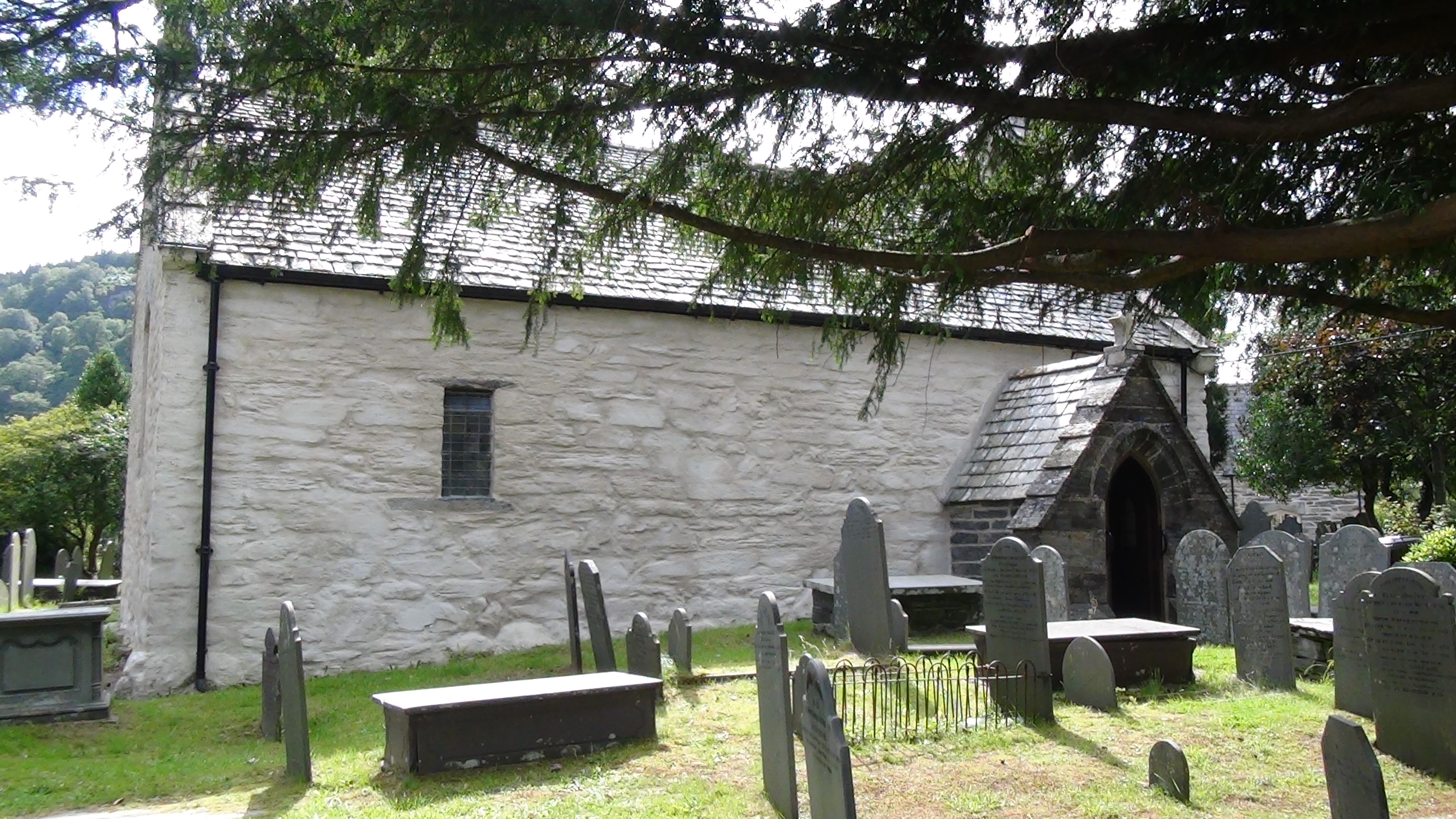
Dolwyddelan Church © 2013 Simon Peter Sutherland
In Wales recently, at the tiny and beautiful village of Dolwyddelan, Gwynedd, I, my wife and sons had been travelling through the Welsh mountains and stopped at the ancient village. This village is stunningly located in those glorious Welsh mountains and even has its own Welsh Calvinistic-Methodist Chapel and also a delightful 500 or so year old Church.While visiting this ancient building known as St Gwyddelan’s Church, I picked up an old legend about a Dragon. I love those old legends.The story goes that a Dragon came up out of the sea and made its way up the river arriving at the village of Dolwyddelan. Apparently the Dragon was so powerful that as it swooped through the valley, diving into the waters it caused a number of floods in the village.The locals knew they needed to do something about the creature but did not want to harm it and decided to lure the beast into the mountains so it could live its days out there. It did so and no harm came to the village again.
Obviously not all legends are true, but we have similar examples of stories like this where people lured Dragons into caves, even amongst the ancient writings of Marco Polo.
Strange isnt it how so many ancient stories can be found throughout the world about people coming up against Dragons and large flying creatures. Yet today, particularly amongst modern evolutionary scientists, many people appear to be under the impression that the discoveries of Dinosaurs are a modern thing, yet the writings of the ancients clearly suggest otherwise.
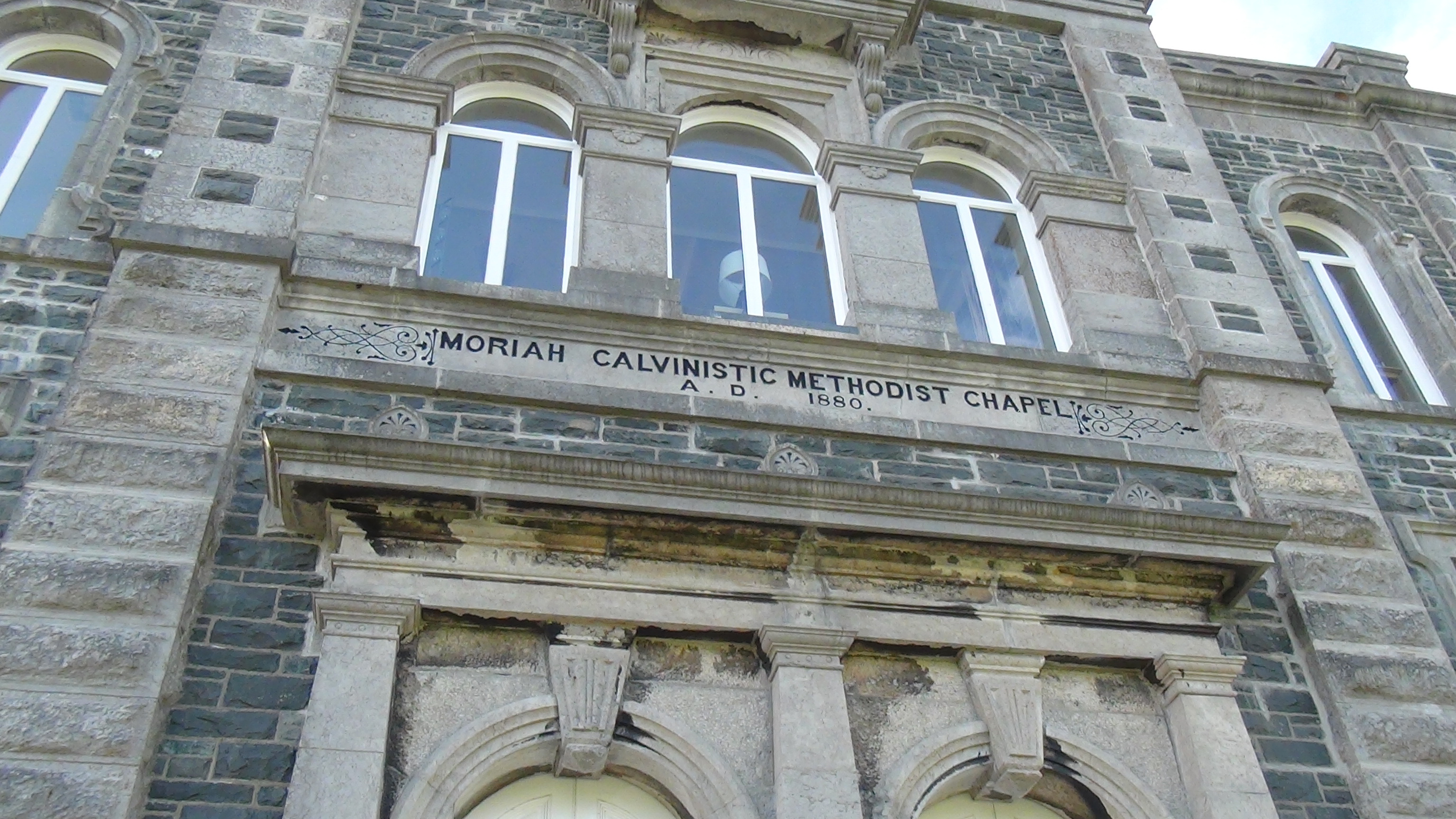
Calvinistic Methodist Chapel at Dolwyddelan © 2013 Simon Peter Sutherland
The obvious and clear problem when reviewing these ancient legends is that they never use the word ‘Dinosaur’. The answer to this is of course that the word ‘Dinosaur’ had not been invented at the time of the event and the compositions. The word ‘Dinosaur’ or “Dinosauria” was not used to describe the creatures until 1842 when the Lancaster born Sir Richard Owen formally named them. People prior to this time referred to ‘Dinosaurs’ as Dragons, Winged Serpents, Reptiles and so forth. Which is all the word Dinosauria means, terrible reptile or lizzard.We find clear examples of Dinosaurs (Dragons) in ancient writings ranging from the likes of Josephus, the Romans, the Apostle John, Marco Polo and even the likes of ancient myths such as ‘George and the Dragon’.
There is even an ancient tomb in Carlisle Cathedral with the image of a Dinosaur (Dragon) on there.
Strange is it not that so many people today think that the discoveries of Dinosaurs is a modern thing, as though modern evolutionary scientists own ‘Dinosaurs’.
Clearly the ancients would not agree, but would ask them, ‘what took you so long, we knew about these creatures thousands of years ago’.
The Welsh Bible and a forgotten preacher
Posted by simon peter sutherland in Christianity on September 3, 2013

19th century Welsh Bible from Anglesey © 2013 Simon Peter Sutherland
I was recently in a second hand, part antique, part book shop in North Wales. An old Welsh Bible with crumbling binding and unbound leaves was amongst the books. I took the Bible, purchased it and looked for points of interest within it.
The Bible dates from 1857, so it is not that ancient. It was published, as most 19th century Welsh bibles are in “Llundain”. It is likely to be a print of the 1620 revision of ‘William Morgan’s’ translation, and from the notes an inscription inside, it appears to have been owned by a 19th century preacher. His name was “John Davies”.
From the handwritten inscription written on a blank page between the Old and New Testaments, it appears that Mr Davies lived on Anglesey in the village of “Llannerchymedd” in the 19th century.
Back in those days, the village was home to a busy market, perhaps Anglesey’s most popular. The handwritten tribute in this Welsh Bible says Mr Davies was a “manufacturer” so perhaps he continued his trade in Llannerchymedd.
The handwritten notes pay tribute to Mr John Davies and says that he was from “Flintshire” in North Wales and died “the 4th day of April 1859”. This was the same year of the shipwreck of the “Royal Charter” at Moelfre, where I purchased the book.
The writer says he died “in the 73 years of his age” of which 34 years of his life had been spent a member of a Christian church and was “a local preacher with Baptists”.
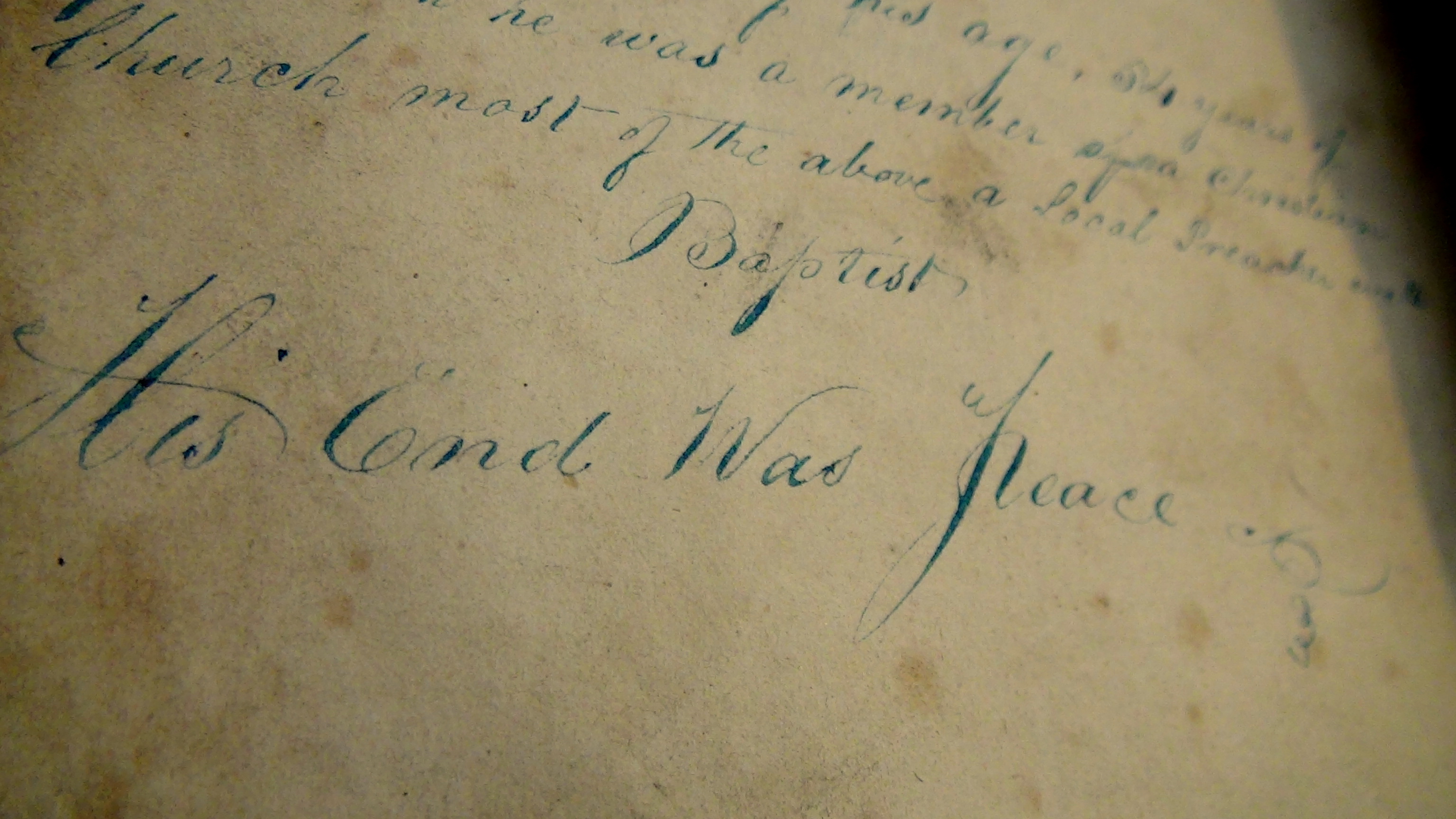 The text says “his end was peace”.
So I have written these thoughts on him and hope on my part that it offers just a tiny tribute to a man whom, like so many, time has forgotten.
I would have liked to have visited his grave this time and to have taken that Bible with me, but time forbid me such. So maybe in the future, should I return, I hope to visit his resting place and lay some mark of respect on his grave, a flower or something. It is the least I can do.
“My God how great Thou art”
Posted by simon peter sutherland in Christianity on August 14, 2013
 “The Lord is great and greatly to be praised”
1 CHRONICLES 16: 25
We often sing Hymns in Sunday services and read spiritual Psalms that can at times be of great comfort to all those who are Gods chosen people. Likewise even the average unrepentant sinner can feel a warm glowing feeling when he or she sings certain songs that glorify the majesty of God. But how many people actually know and believe what they are singing? How many Christians actually believe the doctrines contained in the hymns they sing? Though this is a question that no one can answer but the one who hears, I can only speak for myself and my love for beautiful hymns. I have little time for the popular modern and poorly written songs people often sing in the evangelical world, and when I hear them sung in the evangelical parish’s within the Church of England, my heart breaks.
I love old hymns, they are so well written and somewhat divine. Not only are the hymns extremely well composed but they contain good Theology too and they firmly express the glory and majesty of God in both His word and His creation. But I have no time for many of the modern feel good songs that pay more attention to mans emotions than to the adoration of God.
The fantastic and beautiful Hymn “How great thou art” is one of those hymns that I and many others feel cannot be sung enough. It is arguably one of the greatest hymns ever written. The hymn lines up with scripture also.
We read in Acts 16: 16-24 of where Paul and Silas and arguably Paul’s disciple Luke, were in Philippi, Macedonia spreading the good news of Gods grace. I suppose back in those days they would preach and witness to anyone who would listen to what they had to say. Some days would be good, some days would be bad, not unlike today. Acts 16: 13-15 tells us that Paul and his companions discovered that some women met for prayer by the river which was just beyond the City. So naturally they ventured to meet them and pray with them. On the Sabbath day as they went walked along the via ignatia, a young girl who was possessed by a spirit of divination found herself constantly proclaiming that “these men are servants of the most high God, who proclaim to us the way of salvation” (Acts 16: 16). Notice that the text proclaims, “the way of salvation” not the ways. Even the demons proclaim that there is only one way to Salvation, how much more then shall we proclaim that non-eccumenical truth? That Christ Jesus is the only way to God. Verse 18 of the same chapter informs us that the possessed girl proclaimed this truth for many days, and soon Paul became annoyed with the demon and commanded it to come out of her in the name of Jesus Christ.
Thus the girl was not proclaiming this truth, but the demon and the spirit came out of her that very hour and could not return if it wanted to return. This is a theme that runs all the way through the New Testament, that once a demon has been cast out of a person in the name and authority of Jesus Christ, it cannot return. Thus I hope to assure all Christians, that if a person has memories or events hanging over from the past, things which haunt and play tricks with the mind and attempt to claim that you need to deal with these things. I hope to assure you that such things are only a ploy from the enemy and they have no power whatsoever over your life. They are attempts of Satan to deny the power and authority of Christ over all things. For once you came to Christ and accepted His forgiveness, all your past sins and mistakes in life have been washed away. There is no curse, no demon, no past sin or mistakes, or previous link to the occult or any false religion that can harm you in any way once the Lord Jesus Christ has His hand upon you. Thus if any chose to differ with me on this truth, I must state that you do not differ with me alone.
Scripture says, “Who shall separate us from the love of Christ?…I am persuaded that neither death nor life, nor angels nor principalities nor powers, nor things present nor things to come, nor height nor depth, nor any other created thing, shall be able to separate us from the love of God which is in Christ Jesus our Lord”. Romans 8: 35, 38-39.
When people read and understand the text of Holy Scripture we witness the power of God over all living things. We do as Paul did by proclaiming the truth that commands the demons to flee. The girl who was in Philippi was unsaved and she paid her way by prophesying falsely and yet still “ he (the demon) came out that very hour” Acts 16: 18. Note the demon did not leave after hours of prayer or many exorcisms but within the hour. This is a theme that runs throughout the New Testament and is a proclamation of the glory and sovereignty of Christ over all things. I am convinced that the victory and glory of Christ is over all things that move and breathe. Let us not wait for the future millennial reign that most theologians constantly proclaim, but look to what the scripture says about who really is working things.
Thus we come back to my point relating to the text contained in Acts 16. We read of the slave girls owners being very angry against Paul and Silas at their loss of profit through the slave girls prophesying and thus dragged Paul and Silas into the market place and they were beaten with rods and thrown into prison and placed in the inner prison where their feet were fastened in stocks (16: 19-24). Once more we witness the worlds hatred of truth and it hatred towards those who proclaim that truth.
The apostle Luke reports in verse 25 that the two witnesses were singing hymns to God and those around them were listening to them. Soon after we read in verse 26 that there was a great earthquake and the foundations of the prison were shook, the doors of the prison were opened and Paul and Silas’s chains were loosed. We further read in verses 27-31 that the prison guard was about to kill himself through fear and quickly repented before Paul and Silas, and asked them what he must do to be saved. They quickly informed him to “Believe on the Lord Jesus Christ, and you will be saved, you and your household” Acts 16: 31. Thus we do not hear much in relation to whole families being saved anymore due to the repentance of the man of the home do we? But thank God we do hear this truth proclaimed in the scriptures, that whole families will be saved through the real repentance of one man.
Therefore my point is this, when we are in the pit sing hymns unto God and praise Him only.
-
You are currently browsing the archives for the Christianity category.
Simon Peter Sutherland
-

 Simon Peter Sutherland