Archive for category Biblical archaeology
70 ancient Messianic books found in Jordan
Posted by simon peter sutherland in Biblical archaeology, Christianity, The Bible on December 13, 2011
Earlier this year we read about one of the most important finds since the Dead Sea Scrolls and in Christian history, this find is said to have been discovered in Israel. 70 ancient Christian books written on metal and bound with wire are said to contain some outstanding writings and images concerning Jesus Christ, The Messiah, including an image of may be the earliest image of Christ, and of a T shaped cross, and an empty tomb and a crucifixion which took place outside the city walls of ancient Jerusalem.
If these books are authentic, then we are looking at what may well be the earliest works from the time of the apostles.
We are still awaiting updates for this account, but let us see what 2012 brings?
Click the link to find out more:
The truth of the oldest New Testament fragment
Posted by simon peter sutherland in Biblical archaeology, The Bible on November 11, 2011
In John Rylands Library, Manchester, houses the oldest fragment of the New Testament to date. During this present age of critical modern scholarship and its heavy critique of Biblical texts, we have a great testimony in direct contrast to many critical claims of modern textual scholars.
Many claim that the New Testament accounts were written much later than they actually were, and when I see this fragment as I do on a regular basis, its surviving words never cease to amaze me. They are a pure testimony to the reality of the absolute identity of Jesus Christ, son of God, who was and is, and is to come, “The Truth”. Not ‘a’ truth, but ‘The’ Truth.
The Greek fragment, of John 18: 31-33, on the recto reads as follows, ,
“the Jews, “For us it is not permitted to kill
anyone,” so that the word of Jesus might be fulfilled, which he
spoke signifying what kind of death he was going to
to die. Entered therefore again into the Praeto-
rium Pilate and summoned Jesus
and he said to him, “Thou art king of the
Jews?”
The Greek fragment of John 18: 37-38, on the verso reads as follows,
“a King I am. For this I have been born
and (for this) I have come into the world so that I would
testify to the truth. Everyone who is of the truth
hears of me my voice.” Said to him
Pilate, “What is truth?” and this
having said, again he went out unto the Jews
and said to them, “I find not one
fault in him.”
Is it not amazing that the oldest fragment in the world of the New Testament, dated possibly earlier than 100 AD and no later than 150 AD, speaks of such a great testimony to the word of God? Jesus said, “Heaven and earth shall pass away, but my words shall not pass away.” Matthew 24: 35.
This is certainly true. Glory to the Lamb of God.
The Experience of Visiting Biblical Sites
Posted by simon peter sutherland in Biblical archaeology, The Bible on October 18, 2011
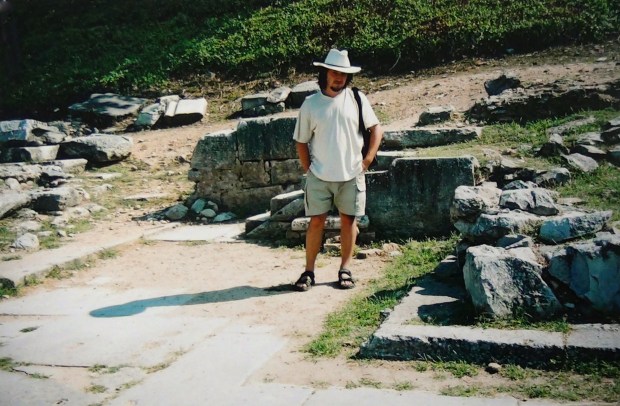
Simon Peter Sutherland at Philippi © 2003/2011
In 2003 I visited the ancient remains of Philippi in Macedonia with my wife. Travelling over from Thassos to Macedonia by ferry we landed at Neapolis (Acts 16: 11) now modern day Kavala and from there to ancient Philippi, to the Biblical sites such as the market place, as mentioned in Acts 16: 19 and the so-called prison, as mentioned in Acts 16: 24-31 and then onto the river which was just outside Philippi, where Paul baptized Lydia, as mentioned in Acts 16: 13-15.
The whole exprience astounded me and I could not but be amazed that I was actually standing in the places where the events I had read about for so many years actually took place. Places where our Sovereign Lord ordained these events to occur.
The fascination which had birthed within me when I first saw the great Arena in Ephesus on a documentary when I was a child, but I had a slight fear of flying which my wife overcame and so my ambition grew from desire to reality. The ambition within me grew and moved me so strongly that I followed our first journey to Macedonia with many more visits to sites connected with Acts of the Apostles. My wife and I would follow this journey in an adventure over the Mediterranean around Greece, and travels not only to Macedonia, Kavala and Philippi but to Ephesus and the events of Acts 19, and the ancient city to whom Paul wrote the letter of Ephesians and one of the seven Churches of Revelation. Then onto Malta to the sites where the events of Acts 27: 39 may have happened, and travels on foot to the sites where the events of Acts 28: 1-10 most likely took place. From then we journed also to Cyprus, and Kition in Larnaka, and then to Paphos and the events of Acts 13: 4-13.
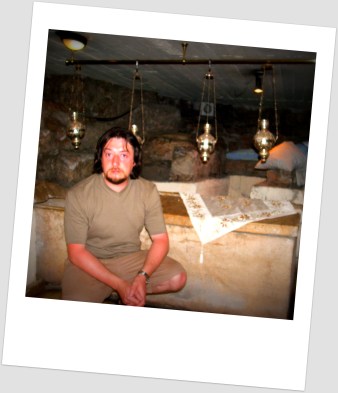
The Tomb of Lazarus, Larnaca © 2003/2011
After this glorious time my wife and I had with the Lord and His word, I became passionately drawn to the ancient reality of the original New Testament and its 1st century setting. I began to see how far Christianity had moved away from the authentic gospel and into tradition and doubted very much that Paul would be happy with modern Christianity. In 2005 my wife Jenny gave birth to our first son, Peter and in 2007 our second son Luke was born and as you can imagine, travelling became more difficult. Now that our children are growing and we can travel once more to the Biblical sites, soon we hope to begin our journeys again. This time, we hope to head to Jerusalem and more of Greece and Rome.
If you have never visited such ancient Biblical sites, then I would highly recomend it. Being amongst the ancient locations gives the believer such a more dynamic understanding of the scriptures and when you are there and reading the text, its like being within the pages.
-
You are currently browsing the archives for the Biblical archaeology category.
Simon Peter Sutherland
-

 Simon Peter Sutherland