Posts Tagged New Book
“From Obedience To Freedom” Out Now!
Posted by simon peter sutherland in Church of England, Reform, The Bible, Theology on June 12, 2025
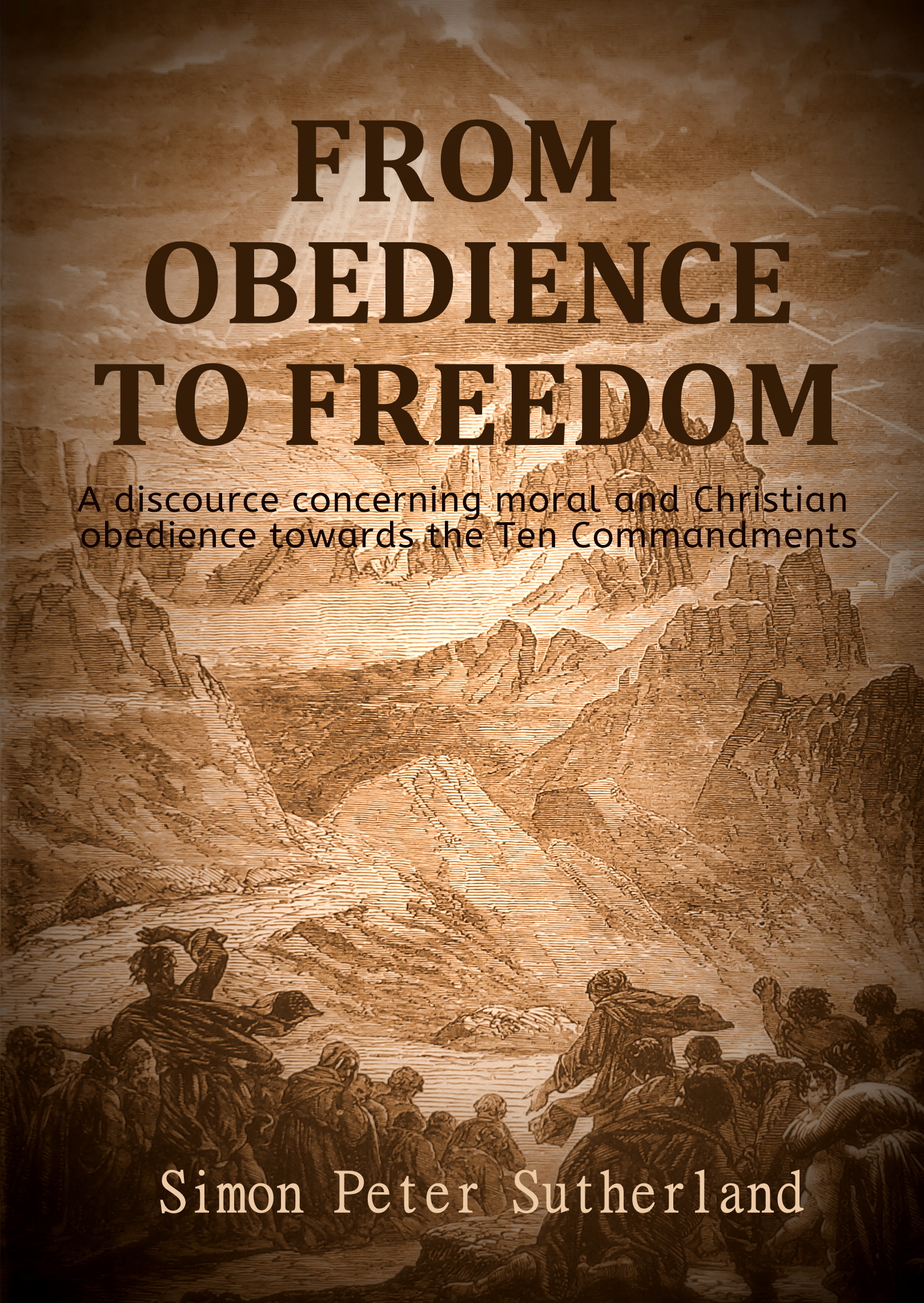
In my previous post I write about my new book on the Ten Commandments. In this book I explore the topic of the Ten Commandments from a New Testament perspective asking questions such as these: Have the Ten Commandments been abolished by the coming of Christ? Or are the two tablets mentioned in Exodus 20 the same as those found in Matthew 22: 37-40? If the answer is yes then there is no Biblical evidence to reject these commandments as irrelevant to the holy living of the Christian man.
In an original edition of this thesis, dating back to 2007, I had originally been inspired by an old Puritan book called The Ten Commandments by Thomas Watson. I loved reading the puritans back then.
Thomas Watson (1620-1686) was one of the most popular English preachers in London during the puritan era. I was certainly intrigued by this book during my earlier years of theological study. Since then however time moves on and my book has changed. It has gone through revision upon revision until I finally reached a point where I was ready to publish.
Obviously the topic is controversial on all sides. For some Christians there should be given no place whatsoever for any aspect of law in the Christian life. I disagree with that. Yet if that concept was true, then what are we left with in Christianity? Outright lawlessness or a life governed by obedience to Christ in faith. Surely there is nothing within any of the Ten Commandments to contradict what the New Testament says about holy living.
When I originally began to write this book I was much younger and I was very convicted within my soul and daily I yearned for more of Christ. My soul eagerly awaited the presence of my dear Lord and that passion can be caught within the pages of the book. However much has changed since then and I’m older. Nowadays I read Puritan books much less, however I have retained my passion for the writings of Richard Baxter. likewise the King James Bible remains my favourite translation. For this reason, I have continued to use the AV within the book and perhaps I’ll save the reasons why for some other post.
But in the meantime, I hope the Lord uses my book and that it inspires many believers to do right in the eyes of the Lord. We must love the commandments of our Lord and live them by faith in Christ. When we do this we will find inner freedom within the divine legislation.
I have experienced this freedom many times.
However, I am presently in the Church of England (in some sense) and I feel a continuous burden for the apostacy that is crippling it. Will I remain, and for how long I do not know? All I can say is that if there was ever a time for the Law of the Lord to be remembered and loved, that time is now.
Discerning Biblical truth from fiction…
Posted by simon peter sutherland in Biblical Scholarship, Theology on November 8, 2018

The term Biblical truth does not always mean what the individual person considers the term to mean. Each person has a definition of every word. What is Biblical truth to one man is heretical to another and vice versa. The Bible has a habit of contradicting many of our ideologies and theologies. But for me, when something is clearly stated in scripture and plainly referred to, the ideas and opinions of men mean little to me. Where the truth is concerned, what does it matter what men may think?
It is a fact that the many spurious gospels employed by modern secular critical scholars when dealing with the historical and spiritual life of Christ were written much later than the canonical Gospels and letters. It is not difficult to conclude that many of these writings are fictional fabrications and interpretations of real events and real people. Since many apocryphal texts are not conclusive in terms of dating due to the lack of historical reference in the texts they cannot all be deemed as truth but rather fictionalised truth.
I bring to attention the “Acts of Paul” which Tertullian claimed was a forgery by a Presbyter who wrote it out of his “love for Paul” 1. These texts, though interesting, are not as good as the biblical texts. They have very little majestic quality to them and I conclude the reason why so many were not included in the Biblical canon, is because they were not authoritative. Some of them contain stories that are so fictional, they appear unbelievable. Yet they come in useful to help us understand the minds of the ancients. If they are a record of beliefs and myths and factual traditions from the early Christians era’s, they can be useful. The problems happen when modern critical secular scholars use those texts in relation to Jesus in their attempts to disprove the New Testament. Too often they make out many of these books are modern discoveries and that the New Testament contains blatant errors. Yet scholars have been debating textual issues from the earliest days of the church. The arguments when presented today are merely part of a much larger soup of recycled argument. Re-packaged, re-marketed and re-developed for a modern audience.
EXCERPT FROM UPCOMING BOOK BY SIMON PETER SUTHERLAND
© 2018 Simon Peter Sutherland
Simon Peter Sutherland
-

 Simon Peter Sutherland