Posts Tagged faith
Does Paul say Chloe was a church leader?
Posted by simon peter sutherland in Church of England, Is Female Leadership Biblical?, The Bible on September 19, 2025

Continuing on my with my series on refuting women leadership in the church, today I’m dealing with another passage of the New Testament which advocates of female leadership misuse to promote their ideas.
Liberals and revisionists use 1 Corinthians 1: 11 to claim that a 1st century woman named Chloe was a leader of a church that met in her house.
Paul writes,
“For it has been declared to me concerning you, my brethren, by those of Chloe’s household, that there are contentions among you.” (NKJV)
That’s it! This tiny verse is used by revisionists as another pawn in their chess game to promote the tiny claims that women can be leaders and ministers in the Christian church. No such thing. This verse does not say that Chloe was in any kind of leadership. Let me show you why.
Paul is writing to the 1st century church at Corinth, this is an ancient city in Greece. Corinth was a place bustling with worldwide commerce and cultures. Religion played a huge role in that place and the church was full of problems, divisions and the difficulties of living in a pagan society. Chloe (or her family) had informed apostle Paul that things in church were not going so well. Immorality, and abuse of the Lord’s supper had been going on and people were mixing the practices of Corinthian culture with church practices. Paul sets them straight in this letter and he admonishes them and pleads that they “speak the same thing” and “that there be no divisions among” them (verse 10).
People had become proud and claimed that they were worthy of note because they were of Paul, or Apollos, or Cephas or Christ (verse 12). These claims however were not related to doctrinal distinctions, since our Lord Jesus Christ, and saints Peter, Paul and Apollos all taught the same doctrines. No, the issue here was that people were claiming that they themselves were special because they were with Jesus during His lifetime or they personally knew Peter, or Paul, or Apollos. In verse 13 Paul refutes these claims and asked them a series of questions;
“Is Christ divided?
Was Paul crucified for you?
Or were you baptised in the name of Paul?”
Note that Paul does not bring Peter or Apollos into this section where he refers to crucifixion and baptism. This is because Paul himself rarely baptised anyone even though there were exceptions.
In verse 14 he says he did baptise “Crispus” and “Gaius” and didn’t baptise the others lest any of them claim that Paul baptised in his own name. Yet in verse 17 Paul makes it clear that Christ did not call him to baptise but to preach. Then in verse 16 he refers to his baptising of those from “the household of Stephanas” so he did baptise people on occasions. This brings us to an important section of the passage. By claiming that he baptised those of “the household of Stephanas” Paul is referencing a family here. The Greek refers to a family, a home. See (G3624). This sets the passage and verse 11 in the context of a family and brings us back to the verse in question, “For it has been declared to me concerning you, my brethren, by those of Chloe’s household, that there are contentions among you.”
Here Paul is in no way referencing Chloe being a leader of any church. Paul is merely stating that either Chloe or her family have reported to him that arguments and contentions have been going on at church and Paul wants this to stop. Prideful contentions, worldly practices and divisions have no place in Christianity. The church should be a place of purity and holiness, not a place where people behave like the world and the culture around them. The people of God are supposed to be different. God in Christ has given His people righteousness and redemption, and for those who know the Scripture, we have the mind of Christ (1 Corinthians 2: 16). Because of this we do not need to conform ourselves to the culture of the day.
Once again we see another Scripture twisted and misused by preachers and pastors who manipulate the Scriptures to suit their own agendas and lead the masses away into false teaching and errors.
Please don’t listen to them, they will lead you astray.
Were Aquila and Priscilla joint church leaders?
Posted by simon peter sutherland in Christianity, Church of England, Is Female Leadership Biblical?, The Bible on September 8, 2025

Continuing on with my previous article on Priscilla, and my continued articles on Junia and Phoebe and we come to a passage of Scripture again used by liberal revisionists to usurp the unbiblical position of women leadership. This time we are looking at 1 Corinthians 16: 19.
Paul writes,
“The churches of Asia greet you. Aquila and Priscilla greet you heartily in the Lord, with the church that is in their house.” (1 Corinthians 16: 19. NKJV)
Revisionists liberals use this passage to claim that women can be leaders in the Christian church. But the passage doesn’t say very much does it. It certainly does not say that a woman can be an archbishop, rector or pastor. In fact all it says is that a 1st century Christian couple sent their greetings to other believers in Corinth.
So what is all the fuss about?
The answer is, there isn’t any fuss. The passage says nothing about joint leadership as the modern revisionist liberals claim. Paul was simply writing to an early 1st century church and says, “The churches of Asia greet you”. That is the churches that existed in the 1st century in Asia Minor, on the western shore, now modern Turkey. Paul writes, “Aquila and Priscilla greet you heartily in the Lord” by which he offers a warm greetings along with “the church that is in their house.”. This was a congregation that met in the house of this Christian couple and the apostle is being courteous to them. Paul is not writing about a state church or an institution or denomination. There were no chapels at that time. No church buildings. No cathedrals. No paid clergy. No archbishops earning a salary of £85,000 per year. These good 1st century Christians opened up their family homes for assembly’s of fellow Christians to worship together in.
Perhaps when this is considered we can understand why Paul is mentioning this Godly married couple. They were clearly wonderful Christians and perhaps that is how we should view this passage. Paul is just being very courteous to a couple who have been of great service to him in his missionary purpose.
Aquila and Priscilla were tentmakers by trade who had been expelled from Rome (Acts 18: 2) and accompanied Paul from Corinth to Ephesus (Acts 18: 18) They played a significant role in bringing Apollos to faith in Christ (Acts 18: 26) as my previous article demonstrates. In Romans 16: 3 Paul refers to them as “fellow workers”. There is no mention of preaching or teaching and certainly no hint whatsoever that any woman could be a bishop, archbishop or pastor. and the greek word translated workers does not denote ministry. Thus, I see nothing in these passages of Scripture to cause me to agree that women should be ministers in the Christian church.
Paul mentions Aquila and Priscilla (or Priscilla and Aquilla) together in six passages, and in 1 Timothy 4: 19, John Gill argues the Latin Vulgate adds “with whom also I lodge“. Thus demonstrating the generosity of the Godly couple.
Thus, if we look at 1 Corinthians 16: 19 in an open light we see there is nothing in this passage to cause any of us to believe Aquila and Priscilla were joint church leaders. Paul was simply informing his 1st century readers that a growing congregation was meeting at that time in their home and since Paul mentions Aquila first, we should assume he was the leader of this house group.
If you doubt what I am saying and have been persuaded by corrupted church leaders and revisionist liberals, ask yourself a question: wouldn’t you have the courtesy to mention the names of a married couple who let you have a house group or church meeting in their home?
If the answer is yes, then perhaps you can see why Paul mentions them.
Does Acts 18:24-26 say Priscilla was a preacher?
Posted by simon peter sutherland in Biblical archaeology, Church of England, Is Female Leadership Biblical? on September 3, 2025

In my previous articles on Phoebe (Romans 19: 9) and Junia (Romans 16: 7), I demonstrate my reasons for rejecting the modern revisionist claims that women can be leaders in the Christian church.
In this post I will be discussing another Scripture used by revisionists who argue in favour of female leadership. Revisionists like to claim that Luke in Acts mentions a woman named Priscilla as though she was a woman of Christian leadership. Yet nothing could be further from the truth. Let me show you why.
In Acts 18: 24-26 St. Luke mentions a man named Apollos who met a Christian couple in Ephesus by the names of Priscilla and Aquila and at that time Luke claims that Apollos only knew the baptism of John the baptist.
Luke writes,
“Now a certain Jew named Apollos, born at Alexandria, an eloquent man and mighty in the scriptures, came to Ephesus. This man was instructed in the way of the Lord; and being fervent in the spirit, he spoke and taught accurately the things of the Lord, though he knew only the baptism of John.
So he began to speak boldly in the synagogue. When Aquila and Priscilla heard him, they took him aside and explained to him the way of God more accurately.” (Acts 18: 24-26. NKJV)
Ancient Ephesus is no longer part of civilization, it’s a historical landmark and an archaeological site. My wife and I visited Ephesus many years ago and walked the streets where this event happened. At that time I was involved in a great deal of church work. People knew my wife and I as a Christian couple and we had many discussions with people about the Bible and what it all means. Often times we would have discussions with believers who were not seeing Scripture rightly and engaging conversations would happen to show Christ more clearly. Yet neither of us believe in women leadership.
That is what I see going on here in this passage. Luke communicates how the man named Apollos was in Ephesus and he was very knowledgeable but didn’t yet know all he needed to know about Christ. Apollos only knew the baptism of John the baptist and had been teaching in the synagogue at Ephesus. The very fact that Luke states he taught in the synagogues and only knew the baptism of John sets this whole passage in its proper context. This is what happened.
When Aquila and Priscilla heard about him and how he was Jewish man who didn’t know about Christ, they delivered the truth to him about the Messiah. Some years earlier Apollos had likely returned to Alexandria after receiving the baptism of John and never fully knew that Jesus had fully come and had been crucified, risen and ascended. So the Christian couple explained what had happened and Apollos believed and received this truth.
Luke is communicating that Aquila and Priscilla evangelised to Apollos which they did in the ancient city of Ephesus. Please do not let modern revisionists distort the meaning of this two thousand year old text. Luke does not say that Priscilla was in any kind of church leadership, he merely communicates that the godly couple witnessed about Christ in the context of evangelism.
In short, all that happened in this passage of Scripture is that a married Christian couple witnessed Jesus Christ to a Jewish man from Alexandria. That’s all.
Does Romans 16: 7 say Junia was an apostle?
Posted by simon peter sutherland in Church of England, Is Female Leadership Biblical?, The Bible, Theology on August 28, 2025
In my previous article I mention why Phoebe of Romans 16: 9 was not a deacon of the church in the sense of being a minister or preacher. Phoebe delivered a letter of Paul, and was a servant, and nothing more should be made of that.
In this article however I am continuing to explore the claims of revisionists who argue in favour of female leadership and I will show that Scripture does not affirm female leadership in the Christian church.
On Sunday I attended a CofE church and it was very unbalanced, women were leading the whole service, and there was hardly a male leader in sight. This is very unscriptural and leaves nothing for men who seek a male minister to talk to. Not only are there female reverends but female bishops too and there is not a single Scripture to support this. However, revisionists like to use Romans 16: 7 to claim that Junia (a woman mentioned by Paul) was an apostle.
Paul writes,
“Greet Andronicus and Junia, my countrymen and my fellow prisoners, who are of note among the apostles, who also were in Christ before me.” (Romans 16: 7)
In order to understand the Scripture we need to get behind the text and understand it from a contextual viewpoint. Here it is important to acknowledge that as with Paul’s reference to Phoebe (verse 1) the apostle is writing to a house church in Rome. We know this because in verse 5 Paul references the congregation that met in the house of Priscilla and Aquila. Interestingly enough Paul speaks about the congregation not the place they assembled in, and since Paul previously mentions “Priscilla and Aquila” who were a married couple, it is probable that “Andronicus and Junia”were a married couple also. Ancient Christians recognised that Junia was a woman, however very little else is known about her. However modern revisionists like to boldly claim that Junia was an apostle yet there is not a scrap of evidence to re-enforce that claim. In all probability Junia was simply the wife of Andronicus and the both of them were known by the apostles.
When Paul wrote about “Andronicus and Junia” he used the term “my countrymen” or kinsmen. Paul uses this term elsewhere in Romans 9: 3 and this is within the context of fellow Jew’s so it is likely that Junia was Jewish or even a relative of the apostle. This is where the rubber hits the road, there is no way any Jewish woman could be regarded as an apostle in the 1st century.
When Paul writes Andronicus and Junia “are of note among the apostles” he is merely saying they were known by the apostles. Paul’s proceeding words affirm this when he says “who also were in Christ before me.” Here Paul is saying that they had been Christians longer than he had, and in order for a person to have been an apostle that person had to have known Christ and witnessed His resurrection (Acts 1: 21, 22, Luke 24: 48) and we have no record whatsoever of Junia witnessing that.
Commenting on this passage Albert Barns writes,
“it by no means implies that they were apostles All that the expression fairly implies is, that they were known to the other apostles; that they were regarded by them as worthy of their affection and confidence; that they had been known by them, as Paul immediately adds, before “he” was himself converted. They had been converted “before” he was, and were distinguished in Jerusalem among the early Christians, and honored with the friendship of the other apostles.”
This view is entirely consistent with Scripture and is contrary to the false claims of revisionists who claim Junia was an apostle.
Once again, there is no evidence for female church leadership in the Bible.
Does Romans 16: 1-2 say Phoebe was a minister?
Posted by simon peter sutherland in Biblical Scholarship, Church of England, Is Female Leadership Biblical? on August 23, 2025

Throughout Christianity today we see many Christian’s believing that women can be leaders in the church. Although a number of Scriptures are used to argue that point, some don’t even want to discuss the subject. They say female leadership is now established and it’s a secondary issue. We need to lay aside our differences and work together for the cause of the gospel.
But I can’t do that. I do not believe the idea of women in leadership is Biblical or a secondary issue. The New Testament is clear on the matter and I have not been persuaded to believe otherwise. In the Bible God always chose men to be religious leaders. Noah, Abraham, Moses, Samuel, Elijah, Peter, James, John, Paul, Barnabus, Timothy and Titus were all men chosen by God. In order for a woman to be a minister, she too would have to be chosen by God and we do not find that in Scripture.
Yet today many leaders claim the church has been wrong for 2000 years and they seem to pull New Testament passages out of thin air to support their weak claim of women leadership.
Now before I continue, I want to clarify that I am not writing against women leaders in a secular sense, neither am I supporting misogyny I am talking purely about church leadership, ministry and preaching within the complimentarian perspective. The opposite viewpoint does not agree with the Bible so it seeks to revise it to make the church fit in with a changing world. The Church of England is one such establishment. Revisionists make claim upon claim and hardly any of them are legitimate.
One such claim primarily begins with a 1st century woman by the name of Phoebe, who revisionists claim was a deacon in office in the early apostolic church. Yet very little is known about her and the singular reference does not provide enough certainty to make such a significant claim. All we have are two verses.
St. Paul writes,
“I commend to you Phoebe our sister, who is a servant of the church in Cenchrea, that you may receive her in the Lord in a manner worthy of the saints, and assist her in whatever business she has need of you; for indeed she has been a helper of many and myself also.” (Romans 16: 1-2. NKJV)
According to some, Phoebe is described by Paul as a deaconess and in a regular order which implies she held the office of leadership in the church at Cenchrea. This I argue is a false claim and unsupported by Scripture. Let me show you why.
Firstly, in the Epistle to the Romans the apostle was not speaking to a modern 21st century church, neither was he writing to the church where Phoebe was from, he was writing to a congregation in Rome (Romans 1: 7). This congregation probably met in a Roman house church and Paul “commends” Phoebe to them. This act of commending someone is significant and should not be overlooked. In 2 Corinthians 3: 11 Paul uses the same custom of commendation, but if Phoebe was already known for being in office as a deacon Paul would not need to commend her. The very fact that Paul commended her implies that she was not acquainted with the congregation at Rome, or she would have already be assumed a deacon by them. This implies that Paul’s request to make her welcome was that the Roman Christian’s would receive her, why? Why would he need to make such a request if she was already a known preacher and teacher?
Paul follows this important point by using the word “servant” “diakonos” which does mean deacon and can also mean “to run on errands” (G1249 Strongs) This word is used in a variety of places in the New Testament and is used in around thirty contexts, including John 2: 5 where Mary (the mother of Jesus) calls for the servants. The greek word used in John 2: 5 is also “diakonos” yet the servants mentioned in this passage were not leaders in the church, they were simply servants. John also uses this word in 2: 9.
Likewise, we also find “diakonos” in Matthew 22: 13, which does not imply a position of leadership. This means that New Testament Greek has a limited vocabulary that uses words in a broad spectrum.
When Paul refers to deacons in office he does not always use ‘diakonos‘ but rather“diakoneo” (G1247 Strongs) which means a minister, or teacher or a deacon in office. When Paul uses “diakonos” he places deacons and bishops in the same sentence (Philippians 1: 1) and makes it very clear that deacons are to be the husbands of one wife (Timothy 3: 12) thus, if he was affirming that Phoebe was a deacon in office he would be totally contradicting himself. There is no way that Phoebe could be the husband of one wife.
When Paul uses diakonos in Romans 16: 1-2 he is simply presenting a position compatible with a ‘complimentarian view’ teaching that some women in the apostolic church were appointed to visit the sick, mainly women, and to help out. Paul is not implying that women were to teach or have the pastoral office of a deacon. He is merely using a general word to communicate a servant of the church.
John Wesley in his commentary on this passage wrote this,
“In the apostolic age, some grave and pious women were appointed deaconesses in every church. It was their office, not to teach publicly, but to visit the sick, the women in particular, and to minister to them both in their temporal and spiritual necessities.”
Obviously modern churches can and do disagree with a correct understanding of Paul’s use of diakonos but people should also consider that if Scripture interprets Scripture Acts 6: 3 affirms how the apostles gave instruction for seven men to be chosen as deacons, not seven women. The Biblical criteria is very clear and although many are now persuaded against this, the institution of women leaders in the church is just one of many signs of national apostasy and these revisions have caused the very foundations of church leadership to be weakened.
In Romans 19: 2 Paul affirms that the people of Rome should “assist her (Phoebe) in whatever business she has need of you”. The Greek word translated “business” (G4229) is used 11 times in the New Testament and does not mean preaching or teaching, it only means a task or a legal process. In fact Paul mentions nothing about Phoebe teaching or preaching but rather that she has helped many people including himself. This is within the context of a servant to run on errands or have some kind of business to attend to rather than an ordained ministry of preaching and teaching. If Phoebe were to be here today she would be a clerical worker in the church.
Thus, to claim Romans 16: 1-2 proves Phoebe was an acting deacon in office is a far fetched claim and makes the Bible out to be self contradictory. The Bible does not support the idea that Phoebe was a deacon in office, and if Scripture interprets Scripture Phoebe was merely a servant, and possibly the widow of a deacon. She helped many people and Paul out and delivered his letter, that’s all. There is no mention of preaching or teaching and certainly no hint whatsoever that any woman could be a bishop, archbishop or pastor.
I will address the other Scriptures in due course as time moves on.
Will the next Archbishop of Canterbury be a woman?
Posted by simon peter sutherland in Church of England, Is Female Leadership Biblical?, Reform, Theology on July 25, 2025

It has been six years now since I returned to the Church of England and during that time I have witnessed a very controversial era within the history of Anglicanism.
In February 2023 a majority of the synod chose to pass the unorthodox motions of the liberal revisionist bishops concerning the blessings of ‘same-sex unions’.
Since then the CofE has remained divided.
Personally I have been through great turmoil being in this denomination. Being very fond of the history of the Church of England, the early English Bibles, the Book of Common Prayer, the great hymns and the lives of the 16th century reformers who were ministers within the Church of England, there is no doubt to me that the present CofE (on the whole) is no longer the same church. After years and years of revisionist liberalism, scandals and corruption, each moment has slowly demolished the denomination brick by brick, and it seems likely that we yet again face another bigger problem that will not go away.
For the first time in history, the next archbishop of Canterbury could be a woman. With very few conservative evangelicals disagreeing with women leadership, it appears that many could embrace this choice and few will oppose it.
This could be an even bigger problem than upholding a Biblical view of marriage.
The reason I say this is because the Biblical view of marriage is plain and obvious. All religions generally agree that marriage is a union between one man and one woman. However when it comes to the issue of women leadership, even the conservative evangelicals have gone astray and many have played the hypocrite by embracing woman bishops who agree with traditional marriage, to their own advantage.
I say this because conservative evangelicals (within the CofE) speak against the liberal bishops and the synod for going against Scripture concerning ‘same-sex marriage’ and ‘the blessing of same-sex unions’ yet they themselves go against Scripture when they embrace and promote female leaders.
Yet the Bible does not support female leadership and in the New Testament there are no female leaders in the Christian church. Yet revisionists pull out text after text and radically re-interpret them and the CofE embraces their claims because fewer and fewer men are putting themselves forward for ministry. So they play a legal game and use the Scriptures to create loopholes that allow for women to become curates, vicars and bishops. Pheobe was a Deacon they say, Priscilla was a co-leader, they say and apparently Junia was an apostle. It’s absolute nonsense.
The reality is that Pheobe (Romans 16: 1) was just a servant of the church who delivered a letter and judging by the context Pheobe was probably the widow of a deacon. Priscilla was simply the wife of Aquilla they had a church in their house (1 Corinthians 16: 19) so that doesn’t prove she was a leader, and Junia was known by the apostles, (Romans 16: 7) and there is nothing in Paul’s text to say that Junia was an apostle. Thus, despite the revisionists claims, these verses do not affirm woman leadership at all and in reality if Paul did affirm female leadership he would be totally contradicting himself.
On the contrary, Paul does not contradict himself and a majority of the Bible is crystal clear that leadership in the Christian church is reserved for men. If you don’t believe me ask yourself why Jesus chose twelve men to be His disciples and then read Paul’s letters to Timothy and Titus. Read them for yourselves and let the Bible speak. Don’t turn to revisionist teachers who promote their agendas and use you as tools for their rhetoric. Paul is very clear to Timothy that the reason men alone are to be leaders in the Church is because man was formed first then Eve and Adam was not deceived but the woman was deceived and fell into transgression (1 Timothy 2: 13-14)
It is clear from 2 Corinthians 11: 3 that Paul was afraid that as the devil deceived Eve so also the Christians in Corinth would also be led astray by the same cunningness. Now imagine what St. Paul would say if he was writing to the Church of England today. They would probably reject his initial application for ministry and try and indoctrinate him with a series of sermons led by woman curates and liberal vicars and then hope and pray that he changes his mind when they’ve finished.
In Colossians 1: 18 Paul explicitly states that Christ is the head of the church and as far as I am concerned if Christ is not the head of this church then the body does not belong to Him.
Since the CofE has been attempting to liberalise practically every Biblical viewpoint in history and distance itself from the great reformers of the past, it has been anything but stable and I think their decision to make woman leaders will eventually be their ultimate downfall. Whether the decision to make the Archbishop of Canterbury a woman comes into effect this year or the next time around, it is only a matter of time before we witness yet again another great apostasy within the CofE.
Martyr George Marsh 510th anniversary 2025
Posted by simon peter sutherland in Christianity, Martyr George Marsh, Reformation 2017 on June 26, 2025

2025 marks the 510th anniversary of the birth of Martyr George Marsh.
Marsh was born in Bolton, in 1515 into a family of farmers. He attended Deane Church and had a great zeal for Biblical faith and following the tragic death of his wife he became a curate in the Church of England. Serving under the reign of Edward V1 his ministry was grounded to a holt when the boy king died and Mary Tudor ascended to the throne.
Christians and leaders were hunted down and executed and on April 24th 1555 Marsh was burned alive in Boughton, Chester and his ashes were collected and laid to rest in a nearby leper colony.
His story was collected by John Foxe and included in the Foxe’s Book of Martyrs and his martyrdom became widely known for many centuries.
His story remains of significant importance since it continually reminds us of the evils of bad religion and extremism. Yet Christian’s are still persecuted around the world so mankind hasn’t properly learned the lesson yet. It is for this reason that we must never forget our own history and we must always be aware that religion in the wrong hands can be very dangerous, especially when people get hurt.
George Marsh was a good man, and the Church of England failed to protect and preserve him. They should have embraced his zeal and passion for the truth instead of falling headlong into the bondage of the Roman Catholic Church.
Contrary to popular beliefs Britain has gained an enormous benefit from the cause of the reformation, and I have covered these points in a previous article.
So let us remember George Marsh and the martyrs who gave their lives in the cause of truth.
Today a number of dedicated memorials can be found in his memory in Deane Church grounds, Smithills Hall, St John’s Cathedral and at the site of his execution in Boughton, Chester.
May the memory and legacy of Martyr George Marsh live long.
“From Obedience To Freedom” Out Now!
Posted by simon peter sutherland in Church of England, Reform, The Bible, Theology on June 12, 2025
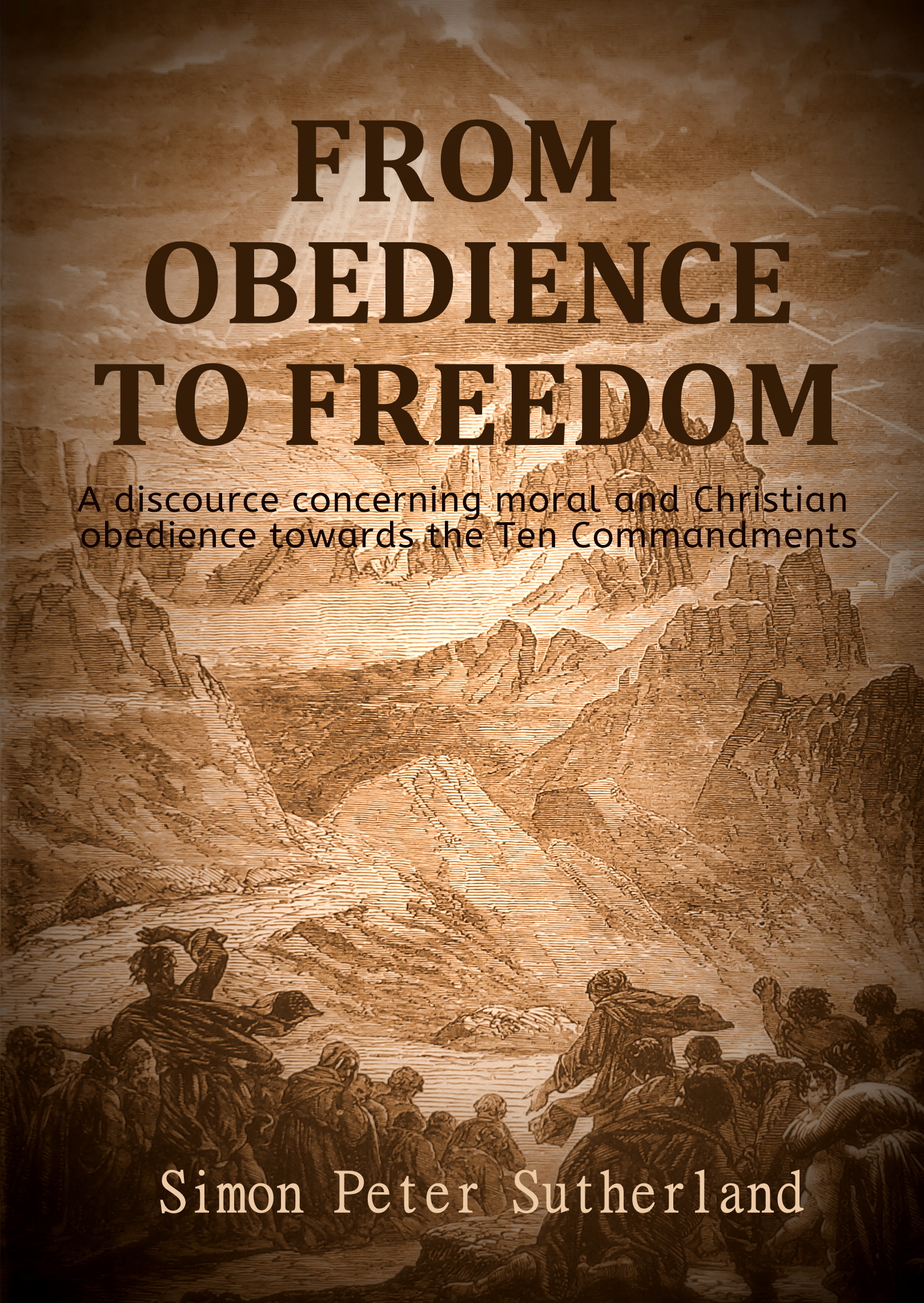
In my previous post I write about my new book on the Ten Commandments. In this book I explore the topic of the Ten Commandments from a New Testament perspective asking questions such as these: Have the Ten Commandments been abolished by the coming of Christ? Or are the two tablets mentioned in Exodus 20 the same as those found in Matthew 22: 37-40? If the answer is yes then there is no Biblical evidence to reject these commandments as irrelevant to the holy living of the Christian man.
In an original edition of this thesis, dating back to 2007, I had originally been inspired by an old Puritan book called The Ten Commandments by Thomas Watson. I loved reading the puritans back then.
Thomas Watson (1620-1686) was one of the most popular English preachers in London during the puritan era. I was certainly intrigued by this book during my earlier years of theological study. Since then however time moves on and my book has changed. It has gone through revision upon revision until I finally reached a point where I was ready to publish.
Obviously the topic is controversial on all sides. For some Christians there should be given no place whatsoever for any aspect of law in the Christian life. I disagree with that. Yet if that concept was true, then what are we left with in Christianity? Outright lawlessness or a life governed by obedience to Christ in faith. Surely there is nothing within any of the Ten Commandments to contradict what the New Testament says about holy living.
When I originally began to write this book I was much younger and I was very convicted within my soul and daily I yearned for more of Christ. My soul eagerly awaited the presence of my dear Lord and that passion can be caught within the pages of the book. However much has changed since then and I’m older. Nowadays I read Puritan books much less, however I have retained my passion for the writings of Richard Baxter. likewise the King James Bible remains my favourite translation. For this reason, I have continued to use the AV within the book and perhaps I’ll save the reasons why for some other post.
But in the meantime, I hope the Lord uses my book and that it inspires many believers to do right in the eyes of the Lord. We must love the commandments of our Lord and live them by faith in Christ. When we do this we will find inner freedom within the divine legislation.
I have experienced this freedom many times.
However, I am presently in the Church of England (in some sense) and I feel a continuous burden for the apostacy that is crippling it. Will I remain, and for how long I do not know? All I can say is that if there was ever a time for the Law of the Lord to be remembered and loved, that time is now.
Calvinistic Determinism Refuted
Posted by simon peter sutherland in "Calvinism", Theology on April 29, 2025
There is a doctrine gaining popularity today, known as ‘Calvinistic determinism’ or ‘theological determinism’. This concept claims that every event in the universe is predetermined by a divine will, suggesting that human actions and decisions are ultimately guided by God’s divine plan. It is often cloaked or hidden within the beliefs of many famous reformed preachers, who may emphasize God’s sovereignty and control over the universe without explicitly acknowledging the implications of their doctrine. At other times, it is plainly stated, leading to profound discussions among theologians and laypeople alike about free will, predestination, and the nature of divine foreknowledge, which raises questions about human responsibility and moral accountability in a world governed by such determinism.
In short, for those who do not know, determinism is a doctrine that claims that all human acts, both good and evil are pre-determined by God before the world began. God’s will is always done. Everything people do, be it good or bad, is all pre-determined and predestined by God before He made the world. It’s not a belief that says God knows everything you do, it’s a belief that says God determines, decrees and wills everything you do. In other words, He writes them.
It’s crazy!
But where did this doctrine come from and why are people so eager to believe it?
Well, basically, people do not always like the truth and some people are gullible and others are skilled at indoctrinating them. Some people are easily influenced by people they follow. They listen to their favourite preachers and their skilled rhetoric causes listeners to feed their views into the Bible. People assume that because a preacher strongly believes something, it makes it true. As a result, people assume the preachers beliefs are very Biblical, when in actual fact they are the exact opposite.
But are these deterministic ideas Biblical?
Well, the answer is yes and no. Yes in the sense that some Biblical events were determined by God, no in the sense that the events of Jeremiah 7: 31, 19: 5: 32: 35 and Isaiah 30: 1 and Galatians 5: 7-8 were not determined or decreed, or willed by God. In fact, in Jeremiah 18: 10 God reconsidered the good He intended to do, because Israel did not obey Him.
In order for God to determine everything that happens in this world He must decree, will and determine apostasy, the persecution and murder of Christians in Africa, false teaching, and some of the most evil acts of mankind can do, (evil acts I do not even want to mention) and then judge people for doing things that He has already determined them to do. If Calvinistic determinism were true God would be self contradictory. He would be determining people to break the commandments He has commanded them not to break.
But where do these ideas come from?
The answer is early examples originate in Augustine of Hippo, John Calvin and Jonathan Edwards. Augustine introduced theological determinism into Christianity in 412 AD and Calvin re-introduced them in the 16th century. Before that time determinism was a Gnostic and Stoic concept originated by Greek philosophers in the 7th and 6th century BC. Early Christian writers did not teach theological determinism. However, when Calvin re-introduced determinism into western Christianity (and adopted his ideas from St Augustine), his influence spread to puritans in the 17th century and Jonathan Edwards took this concept to another level, and when Banner of Truth republished a lot of old puritan books, preachers in America re-introduced their love of Jonathan Edwards and puritans to a new audience, and the so-called ‘reformed’ preachers in America began to influence a whole new generation of eager restless and reformed Christians.
Obviously not all Calvinists believe this level of determinism, but the original source is St Augustine and Calvin quotes Augustine more than any other theologian.
The reality is, it’s that same old thing again, influence. As Calvin adopted his deterministic logic from the writings of St Augustine, preachers today adopt their logic from the works of Calvin, Jonathan Edwards and their favourite preachers via podcasts, books, YouTube videos and so on.
But let us take a step further, if Calvinistic determinism were true God would not only determine everything that happens, He would have to decree and will everything that happens including these winds of doctrine. God would not only have to determine every good and evil act of mankind, but He would have to determine the podcasts and the books.
Preachers who oppose abortion would need to be opposing God because in reality God would not only be the one who wills and decrees the deaths of unborn babies who die in the womb and in infancy but He would be the one who determines them.
Do yourselves a favour and search up how many murders happen in America every year. In order for determinism to be true, God would need to have decreed, determined, and willed those horrific acts to take place down to the very number.
The Bible however does not affirm these repulsive beliefs.
In Jeremiah 32: 35 the abominations men did didn’t even enter God’s mind, so how could He determine them?
In 1 Corinthians 14: 33 Paul states that God is not the author of confusion so how could God determine and decree and will everything that happens? God would not only be the determiner of every human act but He would be the author of confusion, which is contrary to what the apostle claims.
Does that make sense?
In short, I am not even remotely interested in debating or discussing these forgone conclusions with theologians, pastors or preachers who advocate these repugnant doctrines. They are making the God I serve and love to be the author of evil and the determiner of the most disgusting and evil acts this world has ever known.
In short, I want to reach out to you, the general public, average Christians who find themselves confused and influenced by these preachers and do not know what to make of these filthy claims.
I want you to know that the God of the Bible has nothing whatsoever to do with the evil acts that men do. He gave His Ten Commandments and the commandments of Christ for people to obey not disobey. He gave us Christ to save us from our sins not determine them. He cares for you and He serves you in your times of great strife and upset and wants you to know that we live in a fallen world and in the midst of that fallen world God has given us His spirit to minister to the souls of men. Therefore, comfort each other with these words.
If you are influenced by these confused preachers who repeatedly contradict themselves and don’t know what they are talking about, do yourselves a favour, switch off from them and go and read your Bible.
The 500th Anniversary of the Tyndale New Testament
Posted by simon peter sutherland in Church of England, The Bible on March 10, 2025

2025 marks the 500th Anniversary of the very first Tyndale New Testament to have ever been published.
In 1524 William Tyndale had been self exiled from England where he headed for Germany and began translating his New Testament into English. It was there where Peter Quentell published his groundbreaking and monumental New Testament.
For those who may not know, William Tyndale (c 1494-1536) was an English priest and scholar and the very first person to translate the New Testament into English from the original Greek. Tyndale was educated at Oxford and Cambridge and became a chaplain in Little Sudbury. There he ran into conflict with a Roman Catholic priest and Tyndale left for London and eventually for Europe and Cologne. His aim of translating the New Testament into English was fulfilled in 1525 and 1526, and his greatest revision was accomplished in 1534. In 1536 he was executed for his faith in Vilvoorde. But his work did not end there. His translation became the bedrock of all English Bibles from the 16th century and even to the present day.
The Tyndale New Testament would impact, influence and formulate the English language more than any works of English literature apart from Shakespeare.
It is still quoted even today, and for many Christians around the world his work can be appreciated through his undeniable influence in the pages of the King James Bible. A staggering 93 per cent of the New Testament (in the KJV) is the work of Tyndale. The Old Testament is about 85 per cent.
Melvyn Bragg writes, “Shakespeare quotes from the Bible about 1,350 times. These quotations are from the Bibles he heard and read – the Great Bible, the Matthew Bible and probably the Geneva Bible – all of which were Tyndale in disguise.” (William Tyndale A very brief history. Melvyn Bragg. P. 89).
In 2017 I had the pleasure of meeting Melvyn Bragg and as he handed me a copy of his biography on William Tyndale I thanked him for his documentary on “The Most Dangerous Man in Tudor England”. This was an excellent film and the BBC would do well to broadcast it again this year for the anniversary.
Likewise churches up and down the country would do well to remember Tyndale this year and start using either his New Testament or the King James Version once again.
I am not a King James onlyist but I believe the Church of England made a big mistake when it removed the King James Version from all services. It makes no sense to me that such a great and monumental translation should be abandoned and replaced with the extremely inferior NIV translation. I believe the King James Version should be regularly used, even if for special occasions or seasons. And where has the abandonment of old English translations got the Church? It has fallen into disrepair and apostasy and utter chaos, and her identity is lost. No wonder, it is because they removed the great translation.
But let us ask, what version has translated Genesis 1: 1 better than Tyndale? Read for yourselves his opening lines,
“In the beginning God created the heaven and the earth. The world was void and empty; and darkness was upon the deep and the spirit of God moved upon the water.”
And who can forget the beauty of the Lords Prayer.
Simon Peter Sutherland
-

 Simon Peter Sutherland