Archive for category Biblical Scholarship
The Arch of Titus and Biblical Prophecy
Posted by simon peter sutherland in Biblical archaeology, Biblical Scholarship on May 30, 2015
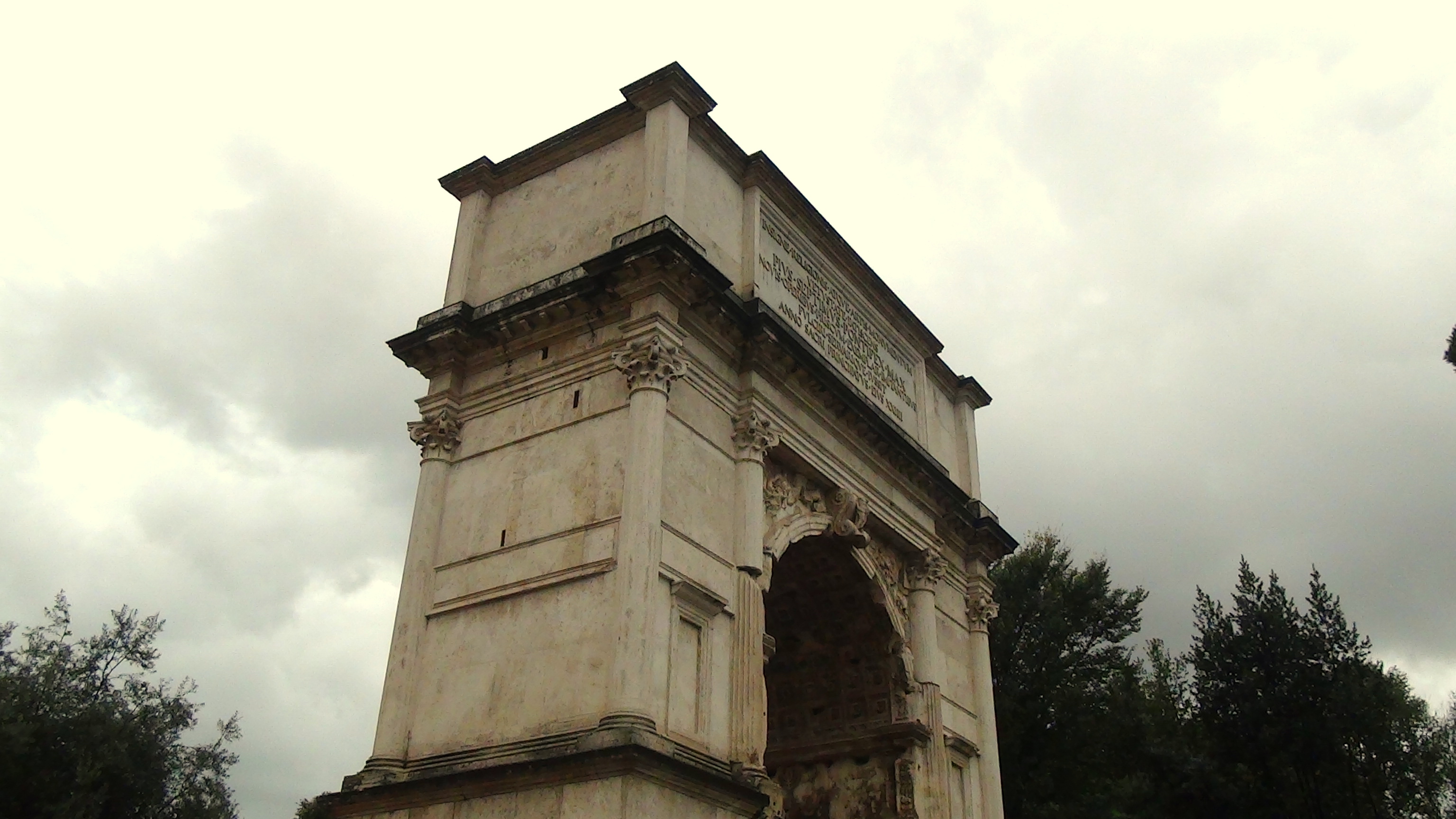
The Arch of Titus, Rome © 2015 Simon Peter Sutherland
In Rome there stands the Arch of Titus. This arch stands on the Via Sacra and was built c 82 AD to commemorate the Roman victory over Jerusalem and the Jewish people.
I had read about the Arch of Titus for many years, and during my visit to Rome it was quite a monumental moment for me to look directly at this treasure of the Biblical era.

The Arch of Titus, Rome and the Jerusalem Temple © 2015 Simon Peter Sutherland
The actual arch contains some of the few secular and historical images of the artefacts from the Herodian Temple and the siege of Jerusalem. The arch contains an image of the Menorah which was the very same Menorah that was standing in the Temple in Jerusalem when Jesus was on earth. The Arch also contains excellent representations of the gold Trumpets and the Table of Show bread as written about in the Bible.
It is claimed that the images were once coloured in gold and the background blue.
The inscription on the arch reads like so;
SENATVS
POPVLVSQVE.ROMANVS
DIVO.TITO.DIVI-VESPASIANI.F
VESPASIANO.AVGUSTO
A literal translation into English, would read something like this;
Senate
people Roman Titus divine
Vespasian son Augustus
With some emphasis on translation, it could read like this;
(The) Roman Senate and (the) people to (the) Divine Titus Vespasian son (of) Augustus.

The Arch of Titus, Rome © 2015 Simon Peter Sutherland
On another note, the situation I so often find myself in is at variance with so many modern claims of secular scholarship. I find it hard to respect certain branches of modern critical scholarship when certain claims are made against the Bible, arguing the narratives are not factual history, but merely religious fiction. These claims are at variance with me continuously, especially when I see facts such as the Arch of Titus standing before my very eyes.
The Arch of Titus strengthens the case to claim that the Synoptic Gospels of Matthew, Mark and Luke were all written well before AD 70, likewise the book of Revelation.
The following verses are affirmed by the Arch of Titus;
Matthew 24: 2
Mark 13: 2
Luke 21: 6
The thing is many modern scholars must claim the Gospels were written after AD 70 and not by eye witnesses or the truth of Biblical prophecy will be clearly seen. The Gospels claim that Jesus, during His incarnation, prophesied the destruction of the Jerusalem Temple around 40 years or more prior to the events themselves. The problem is that many modern critical scholars do not believe in prophecy and therefore approach the texts with that persuasion. Thus, if a person looks at the Biblical narrative through certain spectacles and in denial of the supernatural, that person will only see a natural explanation. Thus, the conclusion will be made that the Gospel narratives were written after the events they prophesied and not by eye witnesses.
As controversial a statement as it may seem these days, there is no actual evidence that the Gospels themselves were written after AD 70. On the contrary, the evidence of the Arch of Titus affirms the New Testament step by step and the Old Testament also.
This claim is not any new argument or contrary to Ecclesiastical history or historical Theology.
DSS: 7Q5, Marks Gospel and the Resurrected Christ
Posted by simon peter sutherland in Biblical Scholarship, Christianity, The Bible on April 20, 2014

Ancient handwriting
© 2014 Simon Peter Sutherland
Those who are familiar with me know how I repeatedly disagree with the many popular claims made by so-called modern ‘Bible Scholars’. All too often I find the opinions of these people and their dating methods concerning Biblical history, the New Testament Gospels and epistles, inconsistent with the information that is available. Since the existing data contradicts them, I often regard their claims as either misinformation or out right lies.
However, what some people fail to acknowledge concerning me, I, is that I never make such claims without rigorous research and proofs.
In this post, I am writing yet again concerning another often overlooked and deliberately disregarded proof text which contradicts the claims of modern critical scholars. This further information I am presenting relates to DSS fragment 7Q5 and its connection to the Gospel of Mark, which if true, is undeniable proof that the Synoptic Gospel of Mark was written well before AD 66 or 68.
The facts are the following.
Between 1946-47 shepherds in Qumran, Israel, discovered a number of ancient manuscripts in a series of Caves about a mile inland from the Dead Sea. These scrolls (known as DSS) are of highly significant in Biblical research and were written in the languages of Hebrew, Aramaic and Greek and provide valuable information relating to some Religious practices and beliefs during the 2nd Temple Biblical era.
This discovery is arguably one of the greatest finds of the last century.
In cave 7 among some of the Qumran scrolls was discovered a fragment known as 7Q5. This Papyrus fragment clearly appears to be a New Testament papyri containing a section of Marks Gospel chapter 6 and verses 52-53.
This section in Greek reads like so;
ου γαρ
συνηκαν επι τοις αρτοις,
αλλ ην αυτων η καρδια πεπωρω-
μενη. και διαπερασαντες [επι την γην]
ηλθον εις γεννησαρετ και
προσωρμισθησαν. και εξελ-
θοντων αυτων εκ του πλοιου ευθυς
επιγνοντες αυτον.
In the King James Version, the passage reads as following;
“For they considered not the miracle of the loaves: for their heart was hardened.
And when they had passed over, they came into the land of Gen-nes-aret, and drew
to the shore”
It is quite clear that this Greek passage is part of Marks Gospel. Which, presents a huge problem for modern scholars since this cave was closed in AD 68 and never reopened again until 1946-48.
The problem is that those leading scholars whom society make their leading thinker, are the very ones who deny them. Yet the Markan narrative in its original context shows that some people back in the time of Christ could not see the Truth, their hearts were hardened by God Himself.
In his book ‘The Complete Dead Sea Scrolls in English’ Geza Vermes ignores the claim that 7Q5 contains Mark 6: 52-53 and dismisses it as a “clearly unprovable hypothesis” (Appendix. P 441) yet he appears to offer no satisfactory explanation why? Neither does he include the actual text in his book. This begs the question; ‘just how complete is his version?’
The significance concerning this fragment and Marks Gospel is very high and should not be played down by scholars. Since the caves in which the DSS scrolls were discovered were large quantities of scrolls which are of the highest importance. Today the DSS sit in the Shrine of the Book, in Jerusalem of which the Israel Museum has over one million visitors per year.
It is a very real claim to say there are a lot of disinformation agents in the West today who are trying to bring down Christianity and her mother Religion, Judaism. And any evidences that rise up, either by archaeology, vault discovery or textual analysis, each day they are ready to pounce upon them and discredit the information in relation to the Bible.
The Truth is that the some of these modern scholars continuously play down the authority of the Synoptic Gospels and the Gospel of John because they know the implications and the power of eye witness testimony of this grand scale. The Gospel of Christ “turned the world upside down” (Acts 17: 6) and these scholars and authorities and political spin doctors know that. So in order to control the masses of people and play down Christianity, they must attack it from within. What better place to start than attack the Bible itself.
The problem is that they know all too well that the Bible is not just another religious text. If Jesus had been presented as some kind of guru, philosopher or crucified man, He would be just another martyr, but no, He rose from the dead and proved He was the Christ. But if He was just a great teacher or one of many ways to God, then people would not revolt against Him. But knowing the implications of the things He said, He Himself makes the path of Truth a very singular journey. Thus, in order for the enemies of Truth to bring down this road to pave the way for another they look for contradictions like a lawyers in a court of law in an attempt to make the testimonies themselves appear unreliable. But clear research and Theological insights and exegesis of the Biblical narratives clearly demonstrate that the Gospels do not contract each other and people like myself are willing to appear unlearned and silly sometimes in making claims that are contrary to what is often seen as the majority opinion.
But just because something is believed by a majority, does not make it true. The fact remains the Theological community regularly reviews these apparent contradictions and by careful analysis of the text, know the claims are in error. The problem is, that we know the Word of God and its Theological meaning, they don’t. They are attacking things they do not understand. They win over the unsaved majority and even some believers who sit on the fence and then claim their victories. But even a majority vote does not make something true, sometimes people are just plain wrong.
What we need to do, each and every one of us, is rise up and defend the Truth. It is the promise of eternal life which those scholars are robbing people of. It is they who are destroying peoples faith in the Bible as the Word of God. And it is the Word of God which is Gods chosen way for Him to reveal who He is. But if people close their minds to the Truth, how will they find it?
The time is upon us and we are seeing more than enough proofs of this each day, that a very large organization is set out to utterly abolish Christianity from face of the earth. And if it cannot do that, it seeks to destroy peoples faith in Christianity’s measuring line by reducing it to mere literature. But they will not succeed so long as the Truth is presented and that fellow Christians, is our job.
Do it now while it is still day, for the night comes when no man can work.
Post-modernism, Church corruption and why proof-texting is an offence to liberal Theology?
Posted by simon peter sutherland in Biblical Scholarship on February 24, 2014
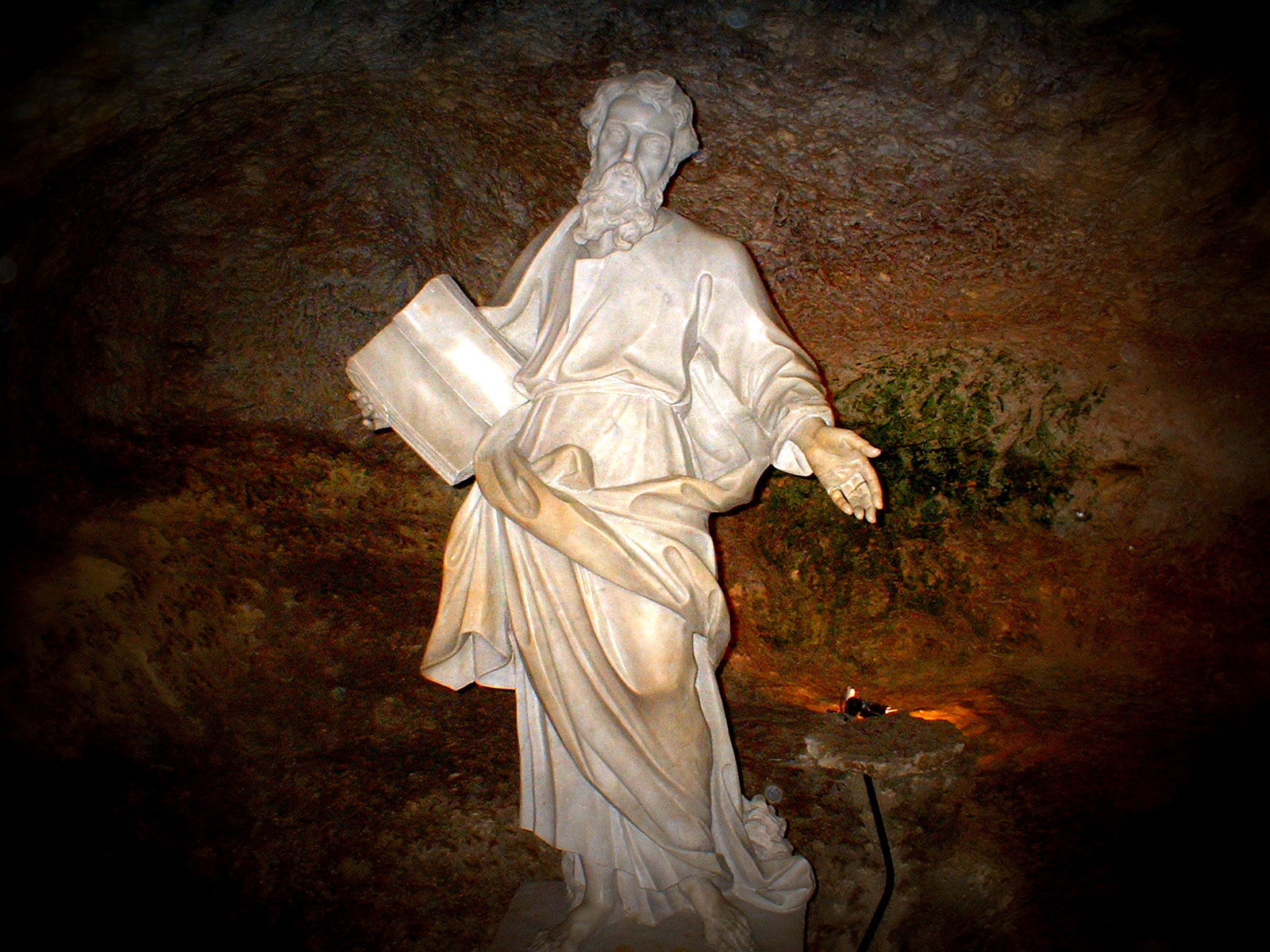
St Paul’s Grotto, Rabat, Malta
© 2005/2014 Simon Peter Sutherland
In many ways I admire certain aspects of Liberal Theology and the attitudes of some of those who subscribe to it.
The aspects of the system I admire is the attitude it creates, where, people form a habit of practicing a less judgmental and harshly condemning set of practices.
I admire it when people develop the ability to disagree on a reasonable level without verbally attacking people and condemning people as a heretic who think differently.
However, that does not always happen.
There are some liberals who are more fundamental and harshly condemning of others in defense of their systems than the many average fundamentalist Protestants or even Roman Catholics.
It is that persuasion which I am now writing against.
Many of these liberal Theologians and ministers dislike forthright statements about God. Especially when the statements themselves are founded upon Biblical proof-texts. Yet the many foundations and well established creeds and catechisms within Christian history contain forthright statements concerning the Attributes of God.
These Creeds and so forth are what has given the world the Christianity as it can be found today. Christianity is founded upon fundamentalism and what many label ‘fanaticism’.
These days, the word ‘fundamentalism’ has become a naughty word to many hardcore liberals within the Church. Yet without ‘fundamentalism’ there would be no Christian church. It was during the days of fundamentalism that the Christian church flourished and although the Church of England today is being corrupted by liberalism, the very foundations and establishment of the Church of England is rooted in fundamentalism.
I would add that I consider hardcore liberalism just another way of defying a plain reading of the Biblical text. And despite the fact that the devout liberal often fails to make distinctions concerning that word ‘fundamentalism’ he or she rarely gives credit to the fact that the Christian Church is founded upon a fundamental reading of the Word of God. That the person of Jesus Christ, as revealed in Scripture is the only true source for our understanding of Him.
Today, the claim that the Scriptures are the only true sources for identifying the true nature and Person of Jesus Christ has been downplayed by many branches of modern scholarship. And yet, Truth is eternal. Not subject at all to matter or humans. But today, many believe that the only way to Truth is through matter. Yet they fail to establish why ‘Truth’ is so important if ‘Truth’ itself is not defined.
During the passion of Jesus, He was asked by Pontius Pilate “What is Truth” (John 18: 38) We do not have a reliable record of Jesus’ answer to that question. John did not record anything for us, which implies that the answer to the question itself, did not lay in the answer. Truth in itself is a quality of being true, a state, a condition. This is why Jesus said, “I am the way, the Truth, and the life” (John 4: 6)
He also said, “no man comes to the Father but by Me” (Ibid) These statements defy the claims of world religions that there are many ways to heaven. But in liberal Theology, this statement is inclusive. That Jesus may be drawing all people from many religions into Himself. True in the sense that Jesus draws people from whatever background or condition, but untrue in the sense that He leaves them there.
The problem with the liberal claim is one of consistency, that is concerning the continued statements and texts of that same Gospel. Jesus said “When I be lifted up, I will draw all men unto Me” (John 12: 32)
This can also be found in post-modernism, and although I am not certain that post-modernism denies Truth as a concept or reality, it certainly denies any claim concerning the Bible being absolute truth. They claim the understanding of Biblical In-errancy collapses on itself. They claim that examinations of the Biblical texts reveal inconsistencies and that the oldest Biblical manuscripts differ to the English Bible and established Greek New Testaments. Yet rarely do they make this same claim concerning the Old Testament manuscripts.
The problem is that to the mind that reads the Bible without Christ, it will contain inconsistencies and errors. But they are not really the ones to judge it, for their words, lives and claims contain more inconsistencies than any translated Bible could ever contain. And to the Christian minds that have been corrupted by this scholarship, only the Holy Spirit can draw them back.
This whole matter is a clash of world views and one is guilty of dishonesty. The contrast I see between the Bible and post modernism is that, in post modernism life is all about ‘me, me, me’. Life, for the post-modernist worldview is centralized upon what the individual can get out of it and if contrasts someone else, so what? I am important, I am for me, the most important. This type of mind set according to the Bible is a chasing after the wind (Ecclesiastes 1: 14). To the post-modern mind, freedom is the goal, yet when that concept is examined, that freedom is selfish. Yet, freedom according to the Biblical account is one where the Truth itself sets a man free (John 8: 32) That Truth is a person and that person is Christ. And this freedom cannot be found in doing as you wish, but having trust in the Saviour and being set free from yourself in the serving of Him and the needy. Jesus is the Truth, therefore only in Him can true freedom be attained.
But concerning the modernist scholarly claims and their attempts to demolish the true reading of the Bible, they, for the most part, use the Codex Sinaiticus to defend their position. Yet, that claim in itself is inconsistent since any claim to the superiority of one manuscript over the 5,000 + Greek New Testament manuscripts is an error. There are thousands more Greek New Testament manuscripts in existence than any other ancient writing, why then should one manuscript be embraced higher than any other? 99.5% of the 5,000 + New Testament manuscripts are consistent.
But our media barons and critics continue to propagate this disinformation based upon a single manuscript that was found in the ancient Monastery at the base the false location of Mount Sinai. Not that the manuscript is unimportant, it is important, but it is not the earliest manuscript for that is yet to be found, however, we have the earliest fragment, P52, I see it regularly at Rylands and it matches the familiar account of John perfectly.
The claim today that the Bible is inherent and ultimate Truth is seen as a somewhat outdated and radical thing to say. For many, the moment it is said, the media and modern scholarship influenced brain switches off and regards the claimant as either a Christian ‘fundamentalist’ fanatic or uneducated. Yet, the most important person in history, that is Jesus Christ, affirmed Himself, the Inherrancy of Scripture and to have Faith is to Trust in Him.
Jesus Himself was a Jew and lived by every word of the Old Testament (Matthew 5: 18). St Paul affirmed the inherrancy of Scripture (2 Timothy 3: 16) and St Peter affirmed the inherrancy of St Paul’s writing (2 Peter 3: 16) It is no coincidence that both these verses and John 3: 16 have ‘3: 16’ attached to them.
Yet many modernist thinkers appear to consider what they lay claim to is, something that the people of whom they talk about, were ignorant of. That they think Jesus didn’t know the Jewish Scriptures contained inconstancies? Yet we know that “every word of God is tested” (Proverbs 30: 5) and that “The words of the Lord are pure words, as silver tried in a furnace on the earth, refined seven times” (Psalm 12: 6)
The facts remain that the Bible itself contains 1,200 promises and 8,000 verses containing predictions of the future. No other religion has this. The texts of the Qur’an, the writings of Confucianism, Hinduism, Buddhism and the texts of other leading religions do not contain prophecy. It is unique to the Judaic/Christian scriptures. This means the underlying author, who is the Spirit of God, knew the future.
Yet the modernists think that their speculative and theoretical claims can take dominance over what is already established? That the absolute can be replaced with uncertainties?
I want to challenge those claims and mindsets. For the Biblical text says, “The Scripture cannot be broken” (John 10: 35)
I want to suggest that underneath the claims that modern scholarship makes, is a bigger flat picture. Not merely a suggestion that says ‘the devil wants to destroy the word of God’ but one that claims that there are two opposing world views. One is human, the other is Spiritual. Yet, for the single track mind, in order for one world view to take dominance over the other, the very foundations of the opposing proof text must be diminished. That, I might add, is a method of war, which in this case is applied to a verbal or written war of words.
In conclusion, I would like to add that the reason I think that liberal Theologians and ministers dislike proof-texting is because they know that the Bible refutes the claims they make. That unless they apply heavy reliance upon Theological and liberal argument, the Bible they want to continue holding on to, is the very book that speaks against them.
It is not easy to swim against the tide. It is easier to go along with the ‘status quo’.
So, I say to my readers; take up the challenge. Don’t take any mans word for it or agree to a claim because a man or woman has the academic accreditation behind him or her. See for yourself. And what I am claiming is consistent with history and with what is established. That the Bible is reliable and trustworthy. However, I cannot prove that to you, for such a claim contrasts many different world views. I can only say for you to read the Bible for yourself, study it, learn Hebrew and Greek, read the text. Don’t just learn about the Bible, live it. I do not say for you to read this man’s book, or this scholars book or that. I say, read the Bible for yourself, openly. Don’t just read books by critical scholars and trust their claims, for in doing that you would be guilty of doing that which you may critique others for. The reader would be guilty of embracing ‘blind faith’. Find out for yourself and then you may see why the liberals and modern’s deny the authority of the Bible and do not like proof texts. They do not like them because they contradict their claims and if they are proven wrong, their careers will suffer. They know that the word of God is powerful, it gets into the DNA of a man, it discerns the thoughts, it is in the soul and spirit. It is in the blood. As the text affirms;
“For the word of God is quick, and powerful, and sharper than any two edged sword, piercing even to the dividing asunder of soul and spirit, and of the joints and marrow, and is a discerner of the thoughts and intents of the heart.” (Hebrews 4: 12)
Revelation TV. Predestination debate: James White & Michael Brown
Posted by simon peter sutherland in Biblical Scholarship on January 24, 2014
On Friday 24th January from 9pm, Revelation TV, Dr James White and Dr Michael Brown will be in debate concerning the most excellent topic of Predestination.
This debate has raged primarily since the 16th century through the interpretation of predestination by John Calvin and still continues to this day. However, in any debate it is important for the listener, reader, or viewer to understand the doctrine first and to listen carefully to both sides of the argument.
I am presently writing a book on this very subject, so I am very interested in the subject.
It may be helpful firstly to recognize some points before joining the debate;
- The doctrine of ‘Predestination’ is an interpretation of Biblical texts which claims that God has predetermined the salvation of particular people whom He has revealed to be His elect. That through the cross of Christ, God has chosen and effectively redeemed a people for Himself. A people of whom their effectual salvation does not depend upon the ‘free choice’ of man, but the elective purposes of God. In other words, the elect are not elect because they believe, they believe because they are elect.
- The Bible communicates ‘Predestination’ as something predetermined by God.
- The early Church fathers (1st -3rd centuries) upheld the freedom of human choice.
- St Augustine (354-430 AD) was probably one of the earliest Theologians to deny the doctrine of ‘Free Will’.
- During the 16th century reformation, most reformers denied the doctrine of ‘Free Will’. This was affirmed by Martin Luther and also the ’39 articles’ of the Church of England.
- The Calvinistic interpretation of ‘Predestination’ is generally associated with the Theological position and scriptural interpretation of John Calvin (1509-1564).
- The Arminian interpretation of ‘Predestination’ is generally associated with the Theological position and scriptural interpretation of Jacobus Arminius (1560-1609).
- If the Calvinistic doctrine of ‘Predestination’ is true, the doctrine of ‘Free Will’ must be seen as untrue or denied.
- If the Arminian doctrine of ‘Predestination’ is true, the doctrine of ‘Free Will’ or ‘Free Choice’ must be upheld.
I personally regard John Calvin as one of the finest Theologians known to church history. I also find Jacobus Arminus’s works of great worth. However, I also recognize that people are only human and the Bible is like a piece of wax, it can be interpreted or molded this way or that.
The question remains; are these positions true or important? If they are true, then surely they are most important. If they are wrong, then surely it is important to show why. What do you think?
Were the four Gospels eye witness testimony?
Posted by simon peter sutherland in Biblical archaeology, Biblical Scholarship, The Bible on January 13, 2014
Ancient handwriting
© 2014 Simon Peter Sutherland
One common notion people are presented with today is the claim that scholars now know the four Gospels of the New Testament were not written by eye witnesses or people who actually knew Jesus of Nazareth.
This type of claim is quite a common place today. We read it in books, hear it on the BBC radio, see and hear it on television and in countless documentaries. Likewise within the world of scholarship I continuously run into a head on collision with this argument by people who, when it is all said and done, know more about this argument than the narratives themselves.
One problem I see is that many of the people who make these claims do not make them off their own back, neither did they originate them. The claims themselves go back quite a while to the dawn of modern scholarship and one can easily find the early church disputing who wrote the Gospels.
In the 19th century, a fine Biblical commentator and Anglican Bishop of Liverpool J. C. Ryle wrote concerning this issue in his exposition of John 5: 2 and said the following;
“These words, it is thought, show that Jerusalem was yet standing, and not taken and destroyed by the Romans, when John wrote his Gospel. Otherwise, it is argued, he would have said, “There was at Jerusalem.”. J. C. Ryle. (Expository Thoughts on the Gospels. Volume 3. P 269)
At the time when Ryle wrote this there was no evidence for the exact location of this pool, but it was discovered in the 19th century and now sits within the Muslim Quarter of Jerusalem. Thus, demonstrating that although evidence for this pool had not been found until around nineteen hundred years or so after the text was written, the Bible was correct all along. And today it is widely recognised and visitors to Jerusalem can visit the site.
The text of John 5: 2 reads like so; “Now there is at Jerusalem by the sheep market (or pool) a pool, which is called in the Hebrew tongue Beth-es-da, having five porches”.
In this text John is clearly communicating that, not only was John writing for Gentiles and not Jews, which confirms the position of Eusebius in his ecclesiastical history that John wrote this Gospel from Ephesus to expand on things not previously written by Matthew and Mark, but that he wrote in the way that is communicating that Jerusalem was still standing at the time.
There is ample evidence that John had already read Matthew, Mark and Luke by the time he was to write his Gospel and noticed that there was other points concerning Jesus’ life that the Synoptic writers did not mention. For this reason, John wrote concerning the final year of Jesus’ ministry. This is just one of many reasons to claim historically and textually that the Gospels were written by eye witnesses and based upon eye witness testimonies.
Eusebius claimed Irenaeus wrote in Against Heresies, 111.1.2 that Matthew published his Gospel first in the Hebrew tongue and Mark recorded the words of Peter from his preaching. He connects Luke’s Gospel to Paul, which could be confirmed by Luke’s opening passage in his Gospel. (Eusubius. The History of the Church. 8)
Thus, if Eusebius was correct, then this places the date of authorship for Matthew and Mark to well before AD 50’s and not anywhere the proposed dates that modern academic communities claim.
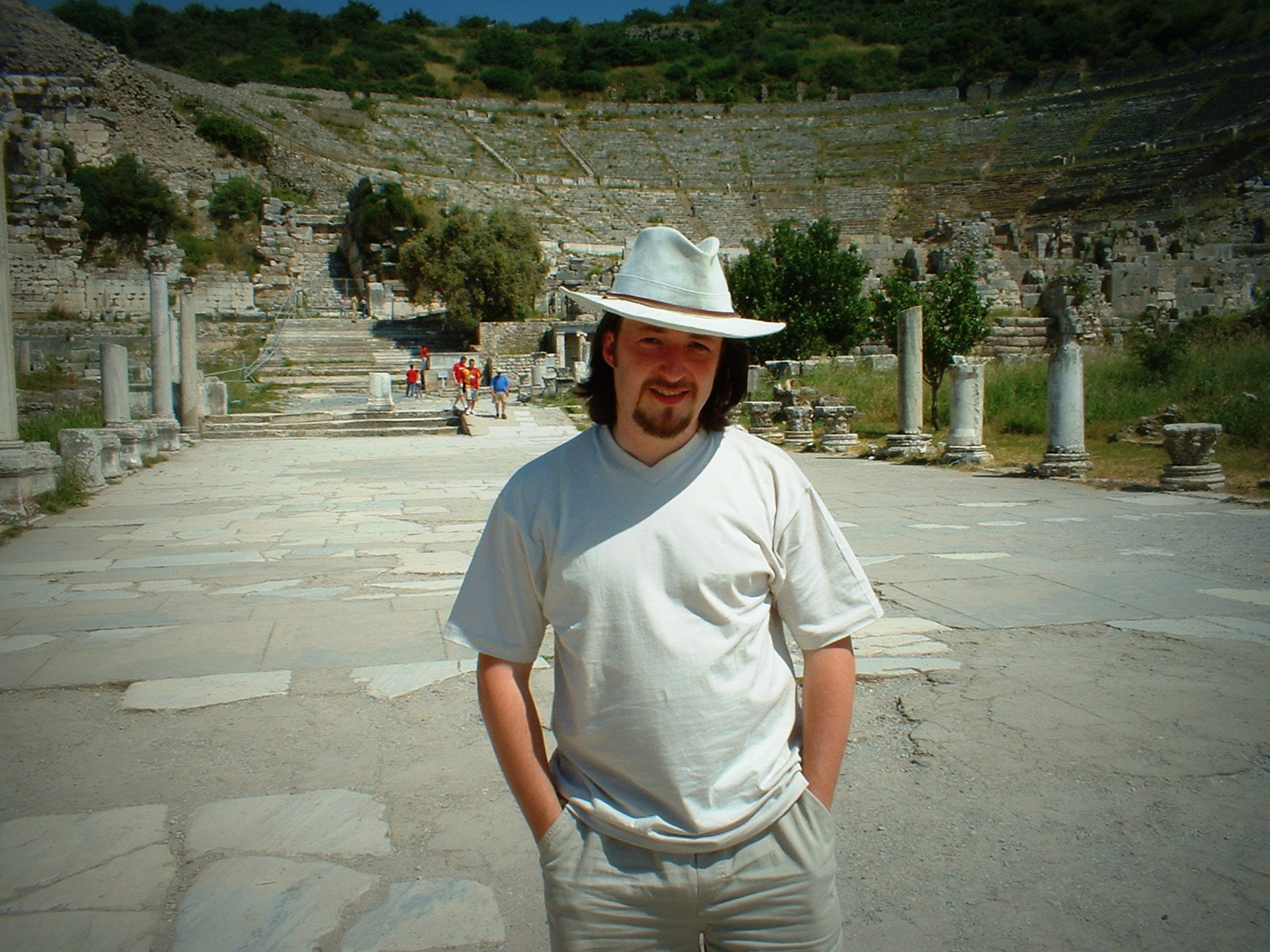
Simon Peter Sutherland at Ephesus
© 2013 Simon Peter Sutherland
From my own research into the Gospels, I have found them to date no later than this era, even as early as AD 30’s for Matthew and as late as AD 60 for Luke. The problem is that modern scholars claim that Matthew could not have been written prior to the events of AD 70 and the destruction of Jerusalem, since they think it not plausible that Jesus could have prophesied the destruction of Jerusalem as He did. Thus, the Gospel of Matthew must have been written after these events. The problem then grows because people would rather believe the negative suggestion rather than think and research for themselves. People are often fooled into thinking that they are researching something when in reality all they are doing is reading other peoples opinions.
Thus, John 5: 2 is just one of many Biblical texts which leave me wondering what on earth so many of these modern scholars are thinking when they date the gospels? What are they up to? I suspect it is a legal game like those in a court of law who look for contradictions in eye witness accounts, thus if they find them, they argue the texts as void.
But I have not found contradictions in the Gospels, the only contradictions I find are the interpretations of those passages by Western thinkers. The Gospels and the entire Bible was written by Jewish people, and when it is all said and done, the critics for the most part, know very little of ancient Judaism.
But concerning John 5: 2, the problem with the academic communities dating methods for the Gospels is that they are not consistent when one understands that John was here stating the sheep gate or market was still standing at the time of his composition. But the problem is, if this text was written when these scholars claim it was then to anyone who knows what the text claims, it is impossible to believe them. The reason being that the sheep gate or market in Jerusalem was destroyed in AD 70 by prince Titus. Thus, internal evidence from John’s Gospel gives us a composition date of AD 50’s at the very latest. And examples like this can be found throughout the Gospels and the New Testament.
Thus, concerning John’s Gospel, J. C. Ryle was certainly correct and he was not afraid or fooled into believing that because scholars say so, it must be true. He had the character and strength enough to disagree with what scholars and critics of his day claimed. Ryle let the text speak for itself and then explored it, that is what makes his expository thoughts on the Gospels so good. But the problem which happens today is that scholars such as Francesca Stravrakopoulou often make wild assumptions concerning the Bible and then publishes what she thinks the text is saying and then judges it according to that thinking. But Francesca Stravrakopoulou is not original in her thinking and neither is she convincing, in fact she in a long line of scholars who often leave both myself and others baffled at their claims.
People are swift to believe the documentary hypothesis of modern scholars, yet they are not so swift to research the actual text for themselves. If they were, the world would be full of people who do not agree with the speculative claims of the academic communities.
In this, I never fail to tire at hearing them, especially when the single minded media barons give those people all the air time. not singularly as an issue of truth or the quest for truth, but something far more earthly and possessive. We are living in a time where all but the sinful depraved nature of man is uncertain. Our age lacks identity and absolutes. Scientists are single minded in presenting their ideas alongside Theology and history, as though everything should be judged scientifically. Regardless of the fact that science merely means ‘knowledge’ people think of science as some kind of test tube analysis, which when it is all said and done is not a method used to judge history.
A person cannot put a historical document in a test tube and measure it according the that method, you have to find some other way of testing things. Each method is an interpretation only and not factual.
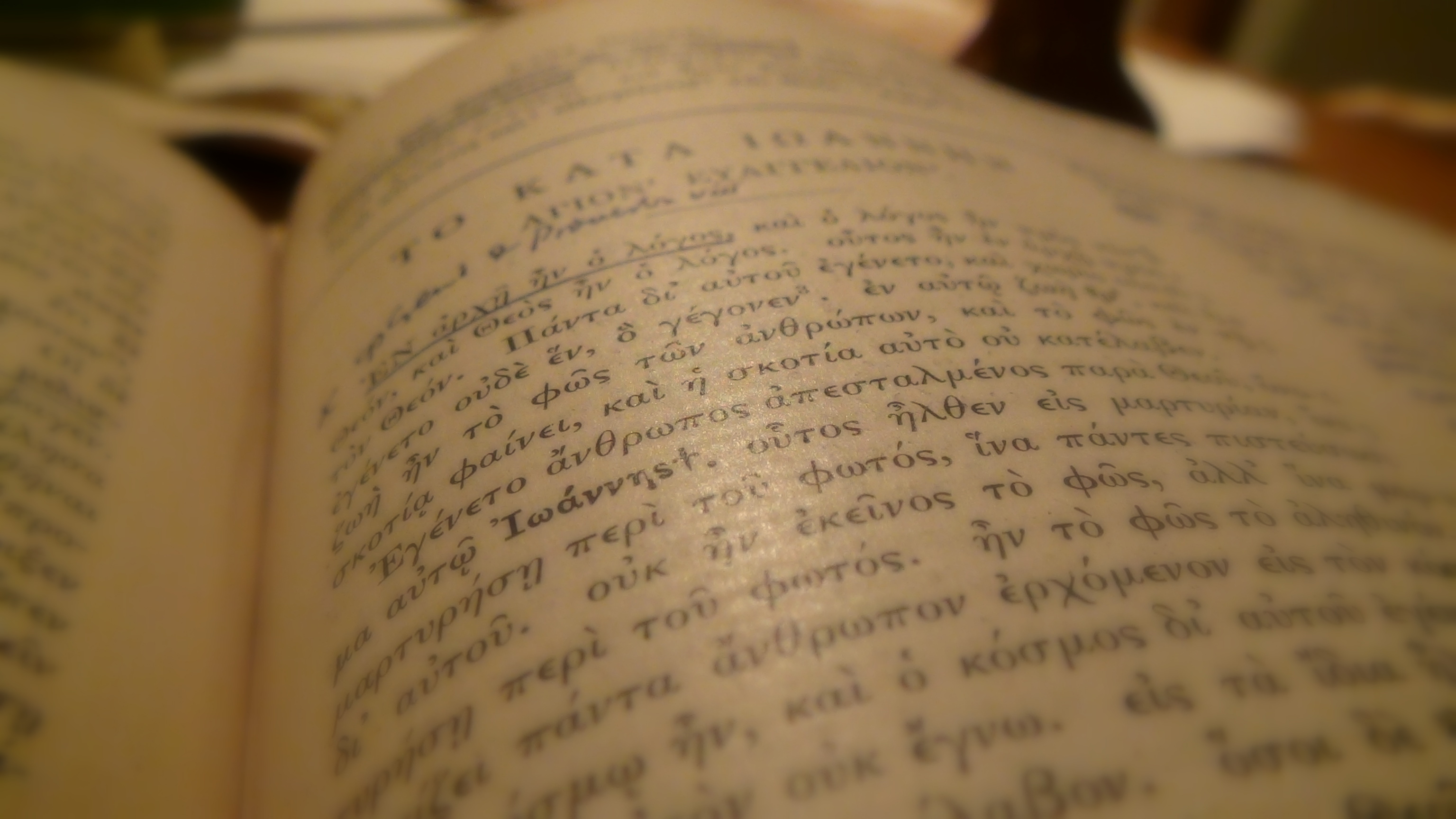
The Gospel of John in Greek
© 2014 Simon Peter Sutherland
For example, if I were to measure the Gospels, I would look at them internally and measure their claims. I would never go along with what state education claims, but would measure the claims according to what I know. For this reason, I absolutely disagree with many claims made by modern scholars who take a text, a verse, a claim, a science, a majority vote and so one and measure the texts through those eyes. Thus, whatever one makes of that, it is certainly not the method used by the early church through to the reformation and beyond, where devotion and Theological insight must first be established in order to see the text clearly. In other words, a person cannot measure a text and judge it if they have failed to understand what the text is saying.
Let us take Biblical archaeology for example; if I go to Jerusalem, I can find plenty of evidence for the Bible there, the reason being, because that is the central location for the majority of Biblical events. So if I go and search for evidence of King Solomon’s temple in Babylon, I’m not going to find very much, but if I first look at what the text says, interpret it correctly, then see where the Biblical narrative is leading me, I will find it. I suppose what I am saying is that people should first find out what the Bible is saying before they critique it.
-
You are currently browsing the archives for the Biblical Scholarship category.
Simon Peter Sutherland
-


