Posts Tagged Christmas
The real Virgin Mary was the Lord’s servant
Posted by simon peter sutherland in Census of Luke, Christmas, Christmas or Nisan, Theology on December 16, 2025

In J C. Ryle’s readings for advent, he chooses Luke 1: 34-38 for todays text. This text is about how the Virgin Mary received news that she would conceive by the Holy Spirit and give birth to a Son, the Lord Jesus Christ. Mary responded to the angel, “Let it be to me according to your word.” (Luke 1: 38)
We see from this text that the Virgin Mary was a real servant of God and even though she knew what controversy would face her once news of her conception came about she obeyed the word of the Lord perfectly.
Ryle writes how this act did “present no small danger to Mary’s reputation and no small trial to Mary’s faith.” And when you consider the danger she would have to potentially face, it’s not difficult to understand why. Mary could have been stoned to death for conceiving outside of marriage. But we know, because of Scripture that Mary was indeed innocent and had not conceived outside of wedlock (Luke 1: 34). Mary was a Virgin and betrothed to Joseph who only knew her intimately after Jesus was born.
It is here in these passages where we see the true Virgin Mary, not the false version worshipped by the Roman Catholic Church as mediator. Mary points us to Christ she does not replace Him or cause us to pray to her in order to get to Jesus. Mary is no mediator. There is only one mediator between God and men, the Man Christ Jesus (1 Timothy 2: 5)
A number of years ago a scholar claimed that the nativity account in Luke’s gospel contains feminine uses of Greek. This implies that the words contained in these few verses in Luke are the actual eyewitness testimony of Mary herself, incorporated into the gospel by Luke. This little known observation can inspire us all to know that Scripture is reliable and trustworthy.
Our society seeks to play down Scripture and inspire people to doubt what is written, but no one need let this happen. The Bible is true and historically accurate and the more people believe by faith, the stronger your belief will be.
Please don’t be fooled by Roman Catholicism or her prophets and proponents. If you want to find the true Mary don’t pray to her, read Scripture and her own words.
Believe the Bible this day and trust in Jesus Christ till the end of your life and He will never leave you or forsake you. Amen.
Is Jeremiah 10: 1-10 about the Christmas tree?
Posted by simon peter sutherland in Christmas, Christmas or Nisan on November 27, 2025

A number of years ago I wrote an article about Martin Luther and the Christmas tree. In this post I mention how some believers have claimed that the prophet Jeremiah wrote against the use of Christmas trees in Jeremiah 10: 1-10. I wrote “I doubt that the text is speaking of anything like that, for the context of Jeremiah’s passage speaks more against the idol worship that then existed and cannot rightly be connected to a mere celebration of Christmas which did not begin until many centuries later.”
In this post I would like to share a little more information on that claim.
Jeremiah’s ministry took place between 627 B.C. until the fall of Jerusalem in 586 B.C. He is my favourite Old Testament prophet. I see Christ in him. He was accused wrongly, as was Christ, he was tried, persecuted and imprisoned because of the things he said. Like Christ he also foretold the destruction of Jerusalem and the temple (Jeremiah 22: 5-7, Matthew 23: 37-39) and was rejected by his own people.
The book of Jeremiah was essentially written about 605 B.C. and chapter 1 describes his call, chapter 2 describes his call for Israel to repent, chapter describes their unfaithfulness, in chapter 4 he calls Israel to return to God, in chapter 5 the sins of Jerusalem and Judah are exposed, while chapter 6 speaks about the siege of Jerusalem and in chapter 7 Jeremiah preaches. You can at times hear his voice and his sorrow. As Jerusalem cries out for help (chapter 9) and in chapter 10: 1 Jeremiah calls on ancient Israel to “Hear the word which the Lord speaketh unto you” meaning them, his original audience.
I am struck by some words in the footnotes of my dad’s Thompsons Chain Reference Study Bible relating to “Palm-trees” and “Idol Making“. My dad used to preach from this Bible. In it Jeremiah speaks against people cutting down a tree in a forest and then they deck it with silver and gold, fastening it with nails so that it won’t move (Jeremiah 10: 3-4) But then in verse 5 we read about these palm trees. The prophet writes the “customs of the people are vain” meaning they are founded upon nonsense, idolatry and folly. Jeremiah ridicules them. The people must have been nailing these trees to a pedestal or a pillar. All the while Jeremiah is speaking from the living God but these people were making dumb idols out of palm trees and fastening them up like pillars.
Calvin comments “We now see what the Prophet meant to teach us, – that the wisdom of the Chaldeans, and also of the Egyptians, was celebrated throughout the world, and also so blinded the Jews, or so enraptured them...” (Calvin’s Commentaries on Jeremiah, Chap. X. 4, 5)
Here we do not see Jeremiah speaking against Christmas trees put up to remember Jesus Christ, the light of the world, we see ancient Israel following the ways of the Egyptians from whom GOD had delivered them from in the Exodus. But never the less, they are returning to the ways of the world and not continuing on in the ways of the Lord.
It is true that people can make gods of anything, be it wood or stone. But for people to remember and honour the birth of Christ by placing up a work of art in the form of a Christmas tree is in no way spoken against by Jeremiah.
If you in your heart are honouring Christ and remembering His birth then your Christmas tree is very right and proper, and in no way spoken against by the prophet Jeremiah. Remember that when Jesus was hailed as king the people honoured Him with palm trees (John 12: 13). This was a symbolic act and the gospels do not speak against that. So again, if you are honouring Christ and are not bowing down to a Christmas tree or worshipping it as a god, then you are doing nothing wrong.
Jeremiah 10: 1-10 is nothing to do with the Christmas tree.
The Promise of God for all mankind
Posted by simon peter sutherland in Census of Luke, Christmas, Christmas or Nisan, Documentaries, Eschatology, Theology on December 18, 2024

Many years ago, when I was a boy, I was asked what my favourite New Testament Gospel was, and I replied “Luke’s Gospel”. For me, I think that claim still stands. The Gospel According to St. Luke is still my favourite of the four Gospels.
Luke’s Gospel gives us the greatest account of Christ’s birth. I say this because I believe chapters 1 & 2 contain the actual words of Mary herself given to St Luke. Luke’s Gospel gives us the reference to the census of Quirinus. I have discussed this census in a previous article showing that it may have been referenced in the Mausoleum of Augustus on the funerary Res Gestae Divi Augusti in Rome.
Luke was a very reliable historian as my documentaries have shown. In Kos and the Gospel According to St. Luke I demonstrate elements of his accuracy by visiting the Greek island of Kos and discuss how he interviewed surviving witnesses to the life of Jesus Christ. Luke references his accuracy himself in Luke 1: 1-4 and Luke’s desire was for the Roman official (Theophilus) “to “know the certainty of those things in which you were instructed.”
Luke follows up his Gospel with part two (Acts of the Apostles) and those who know it are assured of the certainty of the events that happened.
As previously mentioned “I believe chapters 1 & 2” of Luke’s Gospel “contain the actual words of Mary herself given to Luke.” The nativity account contains elements of feminine Greek and in Mary’s account of the angelic announcement of Christ’s birth the angel says to Mary “behold you will conceive in your womb and bring forth a Son, and shall call His name Jesus. He shall be great, and will be called the Son of the Highest; and the Lord God will give Him the throne of His father David. And He will reign over the house of Jacob forever, and of His kingdom there will be no end.” (Luke 1: 31-32. NKJV)
This statement concerning the kingdom of Christ and Him being given the throne of David was not some reference to a futuristic kingdom that Jesus sets up when He returns to earth at the second coming. Luke tells us that this kingdom was established during the life, death, resurrection and ascension of Jesus Christ and was revealed to the people of Judea and Jerusalem by St Peter in his sermon contained in Acts 2: 14-39.
In Acts 2: 30-31 Peter says “Therefore, being a prophet, and knowing that God had sword with an oath to him that of the fruit of his body, according to the flesh, He would raise up the Christ to sit on his throne, he forseeing this, spoke concerning the resurrection of the Christ, that His soul was not left in Hades, nor did His flesh see corruption” and in verse 32 Peter states that the things which they saw when the Holy Spirit came on the Day of Pentecost (Acts 2: 1) is what they “now see and hear.”
The important point to note here is that the promise made to Mary in Luke 1: 32-33 has been fulfilled for all mankind. God in Christ Jesus has set up His kingdom and it has no end and as Peter stated to the people in Judea and Jerusalem, “the promise is to you and to your children, and to all who are afar off, as many as the Lord our God will call.” (Acts 2: 39)
This Christmas remember what Christ has done for us and for all mankind. Let us turn our backs upon the things of this world and whatever you do keep your eyes upon Christ, and know that He is our Saviour, and our God, if we believe in Him and receive forgiveness for our sins and make Him Lord of our lives.
Jesus out of focus and Christmas with Christ
Posted by simon peter sutherland in Christianity, Issues with Christianity in England today on December 23, 2014

Cross out of focus © 2014 Simon Peter Sutherland
I greatly admire Christmas and it is at this season of the rolling year that I have a few traditions of my own. One such tradition I have is my reading of ‘A Christmas Carol’ by Charles Dickens.
First published in 1843 after a visit to Manchester, Dickens clearly wrote the book with the aim of reforming the festival that was starting to fade. I think he did a good job of it. His term “humbug” was a masterly description. The problem is, Scrooge was in fact correct, Christmas was a “humbug”. A 19th century definition means ‘fraud’.
In the 21st century, Christmas is in fact a time for paying bills, acquiring heavy debts and a time where people indulge in constant spending, socialising, gluttony and alcoholism in an industrious commercial institution that focuses upon materialism and not the person of Jesus Christ. In that context Scrooge was correct; ‘Christmas sir is a humbug’.
But for me and many Christians, Christmas is not merely a time for gaining material or spending, and I certainly do not drink alcohol or indulge in gluttony. Christmas for me, is a time for remembering the birth of the Lord Jesus Christ and in that, Christmas is with me 365 days a year.
However, despite the fact that a secular Christmas has little to do with Jesus Christ, there is little doubt in my mind that many people today, Religious and none Religious would seek to abolish Christmas, and replace it with something else or nothing. In many ways, secularist culture has done just that, it has abolished the true historical meaning of Christmas.
Likewise, the use of the abbreviation “X” rather than “Christ” can be argued that the secularists have used a historic meaning. The letter “X” is from the Greek “Χριστός” which means Christ. The problem is that the majority of people, especially the secularists or average soul, has little or no knowledge of the Greek language, so “X” to them is just a letter.
Secularism has turned Christmas away from a festival where people celebrate and remember the birth of Jesus and turned it into a time of worldliness and sin and selfish gain. People are celebrating the sins that Jesus came to set us free from.

St Paul Outside the walls, Rome, Out of Focus © 2014 Simon Peter Sutherland
In the year 1647, the Puritan government in England banned Christmas and regarded it as little more than a snare of “Antichrist” and “Popery”. But today in the 21st century it is difficult to connect Christmas with the Roman Catholic Church or even as a Religious festival. We all know that for many people in the West, particularly in Britain, Christmas has little to do with the Lord Jesus Christ.
But for me as a Christian, the season is very much related to our Lord Jesus. He is everything! And even though we do not know the exact date or year when Jesus was born, we do know that the early Church made the decision to celebrate His birth at this time of year.
Because of a 4th century reference to Christmas in the calendar of 354 AD, we know that early Christians at Rome regarded the Nativity to have taken place on 25th December. However, Christians in the East celebrated the Messiahs birth on January 6th.
Moving forward in history toward the Protestant Reformation, I would think that no accurate case can be established to claim the 16th century Reformers denied Christmas. It is true that governmental 17th century English Puritans banned Christmas, but such was not the case with the 16th century Reformers. The facts remain that 16th century Lutheran, and Church of England Reformers continued to celebrate Christmas: that point is clear from history and the Book of Common Prayer.
Christmas reminds me in many ways of the Jewish season of Hanukkah, recorded by Jewish historian Josephus as “The festival of lights” (Antiquities X11) In this festival the Jewish people commemorate the establishing or rededication of the Holy Temple, and is an eight day holiday which starts on the 25th day of kislev. This can occur from late November to late December. Concluding for many on what we call ‘Christmas eve’.
It is clear to me that the things which Jewish people celebrate in Hanukkah were fulfilled in the life, death, burial and resurrection of Jesus Christ. I see that in and through Jesus, Judaism is made whole. Without Him I see little conclusion or fulfilment of the Torah and the Prophets. Not only is Jesus the “Light of the world” and not only has did He fulfil the prophecies but He has rededicated the Temple and purified it in His people. And if one desires to see Jesus in this, a good place to start would be throughout the Gospel of John, where Jesus is at the Feast of dedication during winter (John 10: 22-23) and also the book of Hebrews.
I think Christmas has been hijacked by secular culture and I think that unless peoples hearts and minds are won over to the Truth, there is little that can be done about that. Christmas for secularists merely implies faith, hope and gluttony:
- Faith in “Evolution”.
- Hope in “Science”.
- Indulgence in the flesh.
A person cannot honestly take Christ out of Christmas and continue to celebrate the festival as though He never was who He said He was, it is intellectually dishonest. And as for the mess that the world makes of Christmas, should we really expect anything else? The world would turn every celebration into a hotchpotch of drunkenness and fleshly pursuits, and entertainment. So what more can we expect? It is up to each one of us to be different, because we are different. We are not of this world, if we belong to Christ. Thus, it is up to us to know and understand what we believe and it is up to us to show the people of the world the historic Truth behind the Christmas many know and love.
Many Christians are speaking out for the Truth, but far too many Christians in Britain desperately need to start speaking out!
Martin Luther and the Christmas tree
Posted by simon peter sutherland in Christianity, Christmas on December 13, 2011

Christmas tree light © 2016 Simon Peter Sutherland
Christians are divided over issues concerning the Christmas tree. Many regard the tree as part of a pagan celebration and not Christian.
Some Christians also claim that Jeremiah 10: 1-10 speaks against the Christmas tree? But I doubt that the text is speaking of anything like that, for the context of Jeremiah’s passage speaks more against the idol worship that then existed and cannot rightly be connected to a mere celebration of Christmas which did not begin until many centuries later.
There is a 16th or a 17th century claim made by the early Lutheran church that the Protestant reformer Martin Luther was the first one to come up with the idea of having a Christmas tree in the home.
The story goes like this; Luther was one day in the woods and he saw the trees amongst the snow and thought it would be a good idea to cut down a tree and put candles on it to remind people of Christ’s birth?
The story itself has no actual historical evidence to support it, but really, I don’t see what evidence a person can find for such a claim. What would it matter anyway?
I think what I personally see from the Christmas tree is a reminder of Christ, who is the light of the world, crucified on a tree (1 Peter 2: 24) and that all His people who are crucified with Him and have died to self and are the light of the world (Matthew 5: 14)
That is what I see when I look at the Christmas tree, just a simple reminder of what Christians should be and a simple reminder of Christ who died for us.
The star of Bethlehem: The Star and the glory
Posted by simon peter sutherland in Christianity, The Bible, Theology on November 26, 2011
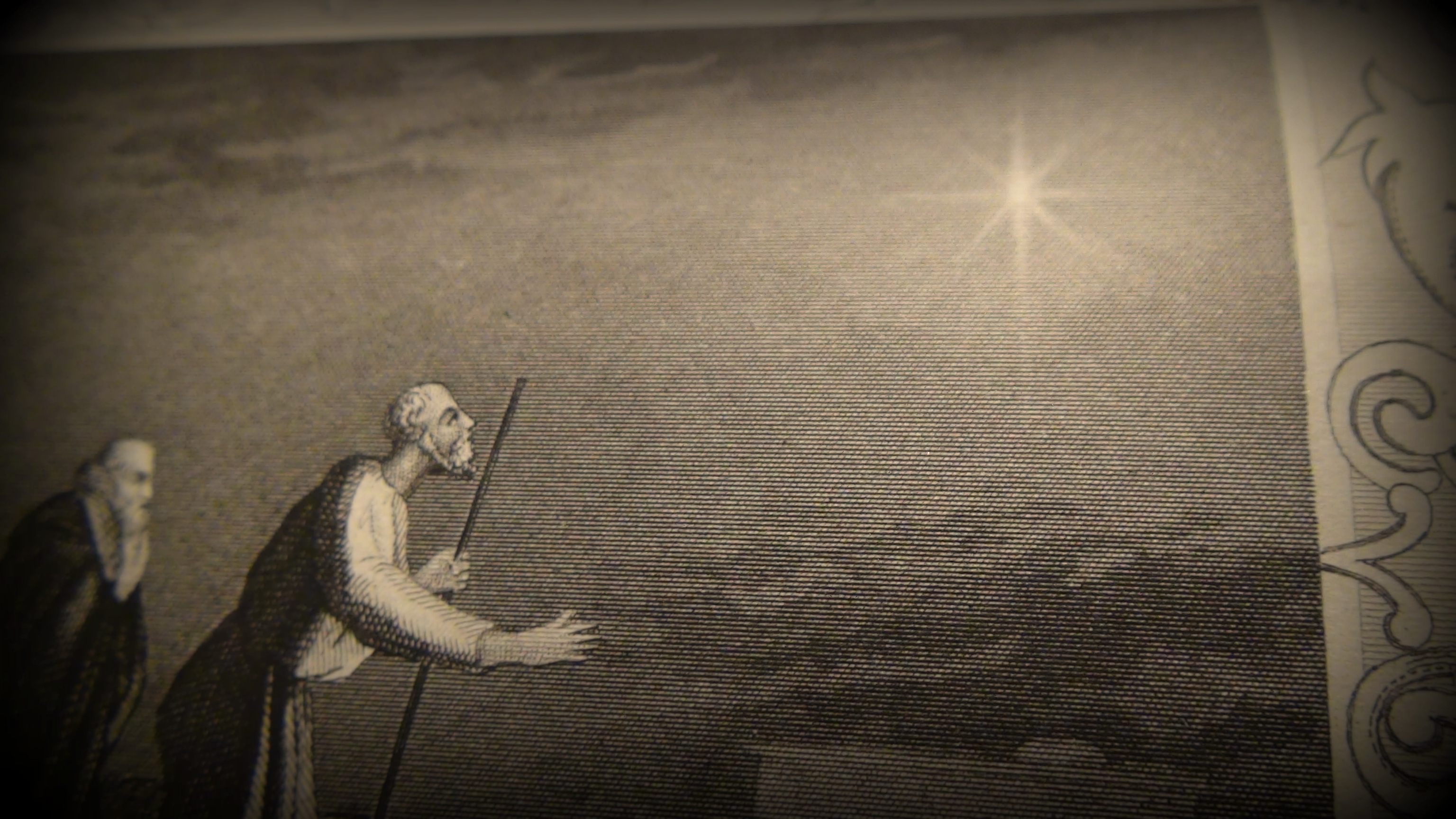
The wise men and the star over Bethlehem © 2016 Simon Peter Sutherland
“The people who walked in darkness have seen a great light” Isaiah 9: 2
One thing that strikes me about what is commonly called, ‘the Nativity story’ is how much of it is so often only recalled or referred to at Christmas time. Yet the above text demonstrates that the coming of Jesus and His incarnate birth is the light and life of all Christians for all seasons and times of the year. That charity towards man and the celebration of the birth of the incarnate Jesus should continue throughout the life of the Christian, not only at Christmas.
In the classic 1951 Alistair Sim version of ‘A Christmas Carol’ the so-called spirit of Christmas present when referring to the child born in Bethlehem makes a profound statement that, “He (Jesus) does not live in men’s hearts only one day of the year, but in all the days of the year”. Clearly this cannot be said of those outside of Christ but of those who are In Christ, the body whom is the Church. But this great light would as soon be put out by worldly hands as swiftly as it were revealed by heavenly hands. This is stated in the gospels. Herod when he gave out the command to slaughter all the children in Bethlehem (Matthew 2: 16) sought to put out the great light because he was not of the light. And many more would continue to do the same thing and put out the light of the gospel and let the darkness rule.
The given Isaiah text states that those “who walked in darkness have seen a great light”. Jesus being the light of the world cannot be denied as to whom the text is referring. Jesus is the light that shines in the darkness and those whom the Lord chooses to reveal His light to, can see the light. Those whom He chooses not to acknowledge, cannot see the light.
The familiar text states that ‘the wise men’ who came from the East saw a star in the East and came to Judea because they knew the meaning of the prophetic scriptures that would have included Micah 5: 2 (Matthew 2: 6) and maybe other texts that are no longer available to us? They knew that once this sign of the star appeared in the heavens, then the Messiah was soon to be born.
ASTROLOGERS OR PRIESTS?
Many believe the wise men to have been ‘Magi’ which could mean ‘astrologers’, but such views only present one side of the coin, for, astrology is not the only meaning being the word ‘Magi’ but the word is also an ancient word for ‘wisdom’. In other words the term ‘wise men’ literally means ‘they were wise’ and clearly this wisdom came from God. The translators are correct when they translate the Greek ‘Magi’ as ‘Wise men’. Solomon was a wise man, and full of Godly wisdom. Thus, it could have been that the wise men were indeed ‘Wise men’ in other words ‘Priests’ who knew the Word of God and the correct interpretation of His word. Thus, they clearly knew the Lord and must have been drawn to Christ by the father, for Jesus said, “No one can come to me unless the father draws him” this was the case with the Magi, who were drawn by the father and guided by His light unto the baby Christ.
But, what actually was this light? Was it a star? A sign? An angel? Was it the glory of the Lord? Or was it more than one?
Well, before I get to my points, permit me to make a few distinctions first. Now then, if we were to review the scriptures through un-regenerate eyes, we would not be able to believe in the Virgin Birth or the miracles that surrounded Jesus’ birth. This is why so many deny and reject the virgin birth, because they do not know Christ, and have a false god in their heads who is not capable of doing such a thing and therefore has no Glory. But we who have seen the light believe it and know how wonderful and powerful the Lord really is. It is a mere plaything for Him to create the world in the beginning and to re-create the world at the incarnation of Christ, and if there was no virgin birth then the truth is erased and Christ is not Christ and the glory of God is removed. But we know that such is not possible, and yet sadly all too often we the church are often guilty of removing the glory of God and replacing it with our own sad opinions and objective arguments. The star of Bethlehem is such an example of how Christendom does not give glory to God and is not very well understood by modern scholars and ministers and Christians alike. Many merely look at the star of Bethlehem as an actual star and although there is evidence for an actual star over in the East around 7BC, the actual reality of Matthews narrative has become somewhat shrouded in myth and Christmas card images.
Now then, since the rise of the modern scholarship movement in the 17th century we have read and heard many claims in relation to the truth of scripture and many denials of plain Biblical truth due to over emphasis on intellectual reasoning by many who clearly do not have Christ within them but have more imagination than Godliness? Many modern scholars over emphasise intellectual explaination of certain Biblical statements when they search through astrology and the history of the stars of 2000 years ago, when they need not search the sky if only they were permitted to see the glory of the Lord and interpret certain passages correctly, which is not often the case. But, since many may not be permitted to see His glory, the problem sits within the lap of the church when ministers and commentators embrace the views and opinions of the unregenerate regarding matters of Biblical truth. The fact that historical commentators within Christendom have always believed that the star of Bethlehem was not an actual star, but rather an angel or
the Glory of the Lord is clear evidence of how modern scholarship has crept into the church and the ideas of the reprobate have been embraced by too many Christians.
It is only since the rise and influence of the modern scholarship movement that many have embraced the view that the Old Testament prophecies and the synoptic nativity texts are communicating an actual star appeared over Bethlehem, and many do not even question these claims?
TWO OBJECTIONS
Now, evidence contrary the many claims of modern scholarship regarding the star of Bethlehem can be found within the text of the New Testament and the Old Testament. And speaking within the context of the Synoptic gospels there are far too many details given to us by Matthew that do not match up with the idea that the light over Bethlehem at the birth of Jesus was an actual star in the heavens.
The following contains some points and objections to the star theory:
1. An actual star is much too large to direct anyone to a house and then rest over that place as described to us in Matthew 2: 9.
2. Why did the star that the wise men saw in the East suddenly seem to re-appear in Israel? (Matthew 2: 9)
Regarding objection 2 many think the star followed the Wise men from the East, but it did not. It only re-appeared when the wise men set off from Herod’s palace unto Bethlehem. Thus, the light they saw when heading from Jerusalem to Bethlehem was only in appearance like that of which they saw in the East, but in actual fact both of them may have been the same light, but it could be that the light they saw in the East was a star, but what they saw in Judea was not a star but rather an angel arrayed with the Glory of the Lord.
Regarding objection 1, permit me to state that a star does not go before people as a guide which could guide them to a house. A star is much too large to do that, and would merely stay in the night sky and appear to be over a massive area and not a tiny town such as ancient Bethlehem. However, there is a clear and more Biblical understanding and one that fits the context and the meaning with more clarity and truth. This understanding is to be found in an angelic appearance which was arrayed with the glory of the Lord. This is a far more Biblically accurate statement that angels arrayed with the glory of the Lord do guide the Lords people throughout the scriptures. Remember when the Children of Israel were guided out of Egypt into the promise land. That was Christ, who guided them. Remember when Paul met with a great light on the road to Damascus, well that light was Christ (Acts 9: 1-7).
Thus, it is more accurate to suggest that the light that guided the Magi to the baby Christ was like that of the light which went before the children of Israel to guide them out of slavery and into the promise land (Exodus 13: 21) But do I say this without Biblical evidence? No, for the entire life of Moses speaks wonders of typological referrences to the life of Christ.
TEN CHRISTOLOGICAL TYPES IN THE LIFE OF MOSES
The following Biblical evidence demonstrates the life of Moses as a type of the life of Christ, far too distinct to deny, unless you are a hyper critical sceptic? Here are 10 interesting types for the life of Christ being seen as typology within the life of Moses.
1. Moses was born an Israelite. Christ was born an Israelite.
2. The King of Egypt felt his kingdom threatened by the large number of Israelites and so ordered all new-born male children to be killed. (Exodus 1: 8-22). Moses’ however was not killed but was hidden in Egypt in an ark in the river. (Exodus 2: 1-3). King Herod also felt his kingdom threatened by the birth of the messiah, and so ordered all the new-born male children to be slaughtered. Christ however was not killed but was hidden in Egypt. (Matthew 2: 1-18).
3. Moses had a mother but no mention of an earthly father, he was adopted by Pharaohs daughter. (Exodus 2: 10). Christ had a mother but no earthly father, He was adopted by Joseph. (Matthew 1: 19-21).
4. Scripture tells us very little about the childhood of Moses. Scripture tells us very little about the childhood of Christ.
5. The Israelites were in slavery to the labour of Pharaoh and Moses delivered them out of the hand of slavery. The children of God were in slavery to sin and death, Christ delivered them out of the hand of both.
Pharaoh sought to kill Moses. (Exodus 2: 15). The Jewish priests sought to kill Christ.
6. Moses walked with the Israelites through the waters of the Red sea to get to the promise land. Christ walked with the nations through the waters of baptism to get to the promised land of salvation.
7. Moses was appointed to die before his people arrived at the promise land. (Deuteronomy 34: 5). Christ was appointed to die before His people arrived at the promised salvation.
8. Michael the archangel disputed with Satan over the body of Moses. (Jude verse 9). Joseph of Arimathea disputed with Pilate over the body of Jesus. (John 19: 38).
9. The body of Moses was buried and no one has ever found his body for he was buried by God. (Deuteronomy 34: 5-6). The body of Jesus was laid in a tomb and no one has ever found His body for He ascended into heaven.
10. Moses appeared alive again after his death on the mount of transfiguration with Christ. Christ appeared alive again after his death and resurrection with His disciples.
Thus it is clear that the life of Moses testifies to the very life of Christ, and that of His incarnate birth. So we can connect the two events and say that what the wise men saw was not a planet but the Lord Himself who is the light of the world, guiding them into the promise land of salvation. For, “The people who walked in darkness have seen a great light” Isaiah 9: 2. Thus, we could claim that the light was in fact an angel of the Lord or the light was the Lord Himself.
It is clear either way that what the text is attempting to communicate is that the star was a great light that merely stood way up in the sky over the area where the house was, and since even the lowest appearance of a star would cover a wide area and not a single house, let us not claim that the scriptures present unreal tales of fantasy and not reality. The actual reality of the text cannot be presenting a case for a literal astrological star over the sky of Bethlehem, but an angelic manifestation arrayed with the glory of the Lord.
I repeat my objection once again when I point out that what the wise men saw in the east suddenly vanished and then re-appeared in Judea when the wise men were nearing Bethlehem and this fact is made clear in Matthew 2: 9,
“And behold the star that they had seen in the east went before them”
In other words if they had seen the star guiding them from the moment they first saw the light in the east until their journey was completed by their arrival in Judea, why then does Matthew employ the term “And behold”? The text implies that they had seen His star in the East, but have not seen it again until it re-appeared in Judea when the neared Bethlehem. Thus, if the star was a literal star in the heavens which remained in clear view, then why did Herod or other people not see it and come to the place where Christ was, for such a supernova would be visible to all of Judea. A proper reading of Matthew 2: 2 reveals this truth so clearly.
BUT WHAT DOES IT SAY IN THE GREEK?
No doubt many will add the question: “What does it say in the Greek?” or “Of what importance is this to us is it anyway, if it was a star then so be it, but if not, what matter is it? When what really matters is that Christ was born” Well yes that is true, but we are missing something that is vital and important and that is the ‘Glory of God’. For it is clear that what really appeared was the Glory of the Lord, that “shone round about them” (Luke 2: 9) Thus, in order to get to the glory, let us look further into this and see what we can find within Greek text of the gospel of Matthew.
Firstly the Greek ‘Aster’ translated star can be taken literally or figuratively and means a strown over the sky. It need not be taken as a literal star but as a Christ type light of the world. Christ said, “I am the light of the world and he who follows me shall not walk in darkness, but have the light of life” (John 8: 12) and if you compare this to Matthew 2: 9 and Isaiah 9: 2 the similarities can be staggering. It is clear that the light is of Christ and He has made Himself known to His people. In Revelation 22: 16 Christ is referred to as “the bright and morning star”. Thus, Christ is not a literal star and the prophetic text “a star shall come out of Jacob” Numbers 24: 17 confirms the connection, since the Hebrew of this text can be used figuratively of a prince or a blazing light and in this light we can connect it absolutely to Christ for in Isaiah 9: 6 He is referred to as “Prince of peace“. Thus, the true meaning of the star or light over Bethlehem is nothing to do with star gazing or astrology but is all about either an angel of Christ guiding the Lords people to the promise salvation being arrayed with the glory of Christ or the text is communicating that the light was the Lord Himself? We cannot be sure, but what we can be sure of is that the light was the light of the Lords glory which was shinning like the sun and full of power and beauty and spendour. Just as it was with the shepherds when “The glory of the Lord shone round about them“ Luke 2: 9 so it was when the Magi were guided by the Lord to the baby Jesus, the glory of the Lord shone in the heavens. How wonderful is that?
CONCLUSION
So then, in conclusion to this I would like to add that this article is not written for controversy or to argue that I am right and so many are wrong, it is not anything like that, I have written this article for the glory of God. For, if we do not give the Lord glory and deny His glory a place in our understandings and ideas, then we are wrong. For we are His people and we seek His glory. And if we embrace the ideas and views of those who are scholars of the Bible yet have not the Holy Spirit living within them, then we lose the Glory of Christ and miss the whole point of this given text. Sure, His creation speaks of His glory and the stars in the heavens are part of that, but I am certain that this is not what the text is communicating. The text is all about the glory of Christ.
So then, In conclusion I would like to add the following word that, you who belong to Christ are the light of the world. You are His people, so “let your light shine before men, so that they may see your good works and glorify your father in heaven” (Matthew 5: 16) for, all the children of God, are truly the light of the world, as Jesus said, “You are the light of the world” (Matthew 5: 14).
Thus, in closing I would like to add with the warmest of love for the Lords people, a word of advice: Seek the Lord and follow His light. If you walk, follow His light. If you travel, follow His light. If you read scripture and desire to teach souls from His word, search for His glory and His light and spirit will guide you and then you will know His true peace and good will. As it is written, “Glory to God in the highest, and on earth peace, good will toward men.” Luke 2: 14
May the light of the Lord be with you always!
Simon Peter Sutherland
-

 Simon Peter Sutherland