“Kos and the Gospel according to St.Luke” now on YouTube
Posted by simon peter sutherland in Documentaries, The Bible on March 27, 2016
“Risen” movie review
Posted by simon peter sutherland in The influence of film on March 25, 2016
This week I went to see “Risen” at a cinema.
I am not an overt cinema goer, but I’m always interested in Biblical movies. For me, seeing visual depictions of the Bible on screen is often exciting and inspiring.
Recent so-called ‘Biblically inspired’ releases such as “Noah” and “Exodus: Gods and Kings” have not even made it into my collection, but “Risen” certainly will. After all, the Bible contains the greatest stories ever written and the Biblical landscapes always look fantastic on film when the Bible is portrayed in a proper way.
For those who may not know, “Risen” is a new fictional movie inspired by the events surrounding the historic death and ‘resurrection of Christ’. It features a character named “Clavius” who is a Roman official, tired from battle, and summoned by Pontius Pilate in Jerusalem to break the legs of the newly crucified Jesus and dispose of His body. By the time Clavius arrives at Golgotha, the crucified Jesus is already dead and Clavius instructs a Roman solder to thrust the spear in His side. The body of Jesus is taken by Nicodemus, as Scriptures tell, and a Roman seal is put upon His tomb and under the watch of Roman guards.
When rumours surface of a resurrection, Clavius is sent to take care of the situation and find His body and settle the matter before Caesar arrives in Jerusalem.
When the ‘body of Jesus’ cannot be found the investigation begins but things do not work out as both Pilate and Clavius had planned. What follows is a Biblically respectful film and one that, on the whole, is consistent with what the Gospels record.
Joseph Fiennes, who plays Clavius is a great actor of modern times. His portrayal of Martin Luther in the 2003 film “Luther” was excellent and fresh. Likewise, his portrayal of Clavius was also well played.
In my opinion, “Risen” is a good film, Biblically consistent and respectful. The film had a positive and distinct absence of mere entertainment based dramatics and over acting, and seemed to deliver a film based upon dialogue and confronting personalities within the narrative of the greatest story ever told. Clavius is human, the disciples are fun. Pilate is concerned and Mary Magdalene is “free”.
For me, I felt the overall direction of the film was not heavy, the sets were excellent and the costumes fitting. The soundtrack was appropriate and occasionally the script contained a sense of the type of things New Testament people might have said in everyday life.
In my opinion, “Risen” remained respectful to Scripture and the centrality of the resurrection story. It was careful to not over interpret the narrative. I enjoyed watching the whole film. I wasn’t overly impressed by some of the accents or the portrayal of Jesus, but I suspect the film makers chose to present Jesus in a more ‘regular’ sense than many other films, however, he maintained a distinct middle Eastern appeal.
I think all Christians and none Christians should go and see “Risen” and for believers, I would like to say this; please don’t be put off by the recent past releases of “Noah” and “Exodus: Gods and Kings”. Forget about them, “Risen” is not in the same league. And although “Risen” may not be one of the greatest Biblical movies ever made, it is still ten thousand times better than “Noah” movie and “Exodus: Gods and Kings” combined. And the sooner Hollywood learns from this and realizes that the Bible contains the greatest stories and narratives ever written, the sooner Hollywood can stop wasting its time producing mock Biblical films and the more Christians can cease from wasting their money on going to see them.
“Kos and the Gospel according to St.Luke” trailer 2
Posted by simon peter sutherland in Documentaries, The Bible on March 17, 2016
“Transgender Jesus play”staged @ St. Chrysostom’s C of E
Posted by simon peter sutherland in England issues, Issues with Christianity in England today on February 17, 2016
Cultural secularists in 21st century Britain have implemented radical changes upon the people of this nation.
More often than not, certain political and social reforms reflect the views of ‘the powers that be’ rather than the traditions and beliefs of the people of Britain.
More often than not we find that anyone who publicly speaks against certain winds of change and presents views that differ to the cultural mainstream are labelled “uneducated” fanatical” “fundamentalist” being victims of ‘ad hominen’ attacks, branded with the hot irons of the powers that be and the penetrating growth of media mind seeds.
The contradiction must be that ‘freedom of speech’ appears to have more flexibility in Britain with those who agree with cultural secularism than those who don’t.
Shamefully, the people of 21st century Britain are seeing more and more of this prejudice directed toward them. People are being emotionally blackmailed into keeping their opinions and beliefs silent, lest they cause offence. Even many within the state Church are falling into these deceptive political snares. Many ‘Anglican Churches’ are failing to reflect the beliefs and traditions of the Christian community or the Bible on the whole, presenting a more politically correct form of Christianity rather than an authentic position.
Many’ ‘Anglican’ churches fail to represent authentic Christianity in favor of religious and cultural liberalism. This decline has been forming for many years and we regularly hear ‘Anglican’ Bishops presenting positions and beliefs contrary to authentic Christianity.
 This certainly the case with one of the current affronts to the Christian faith. On Sunday 14th February 2016, St Chrysostom’s church in Manchester, presented a play featuring a “transgender Jesus”. This play is called “The Gospel according to Jesus, Queen of heaven”.
Despite the fact that this play is “blasphemous” and inconsistent with Christianity and “repugnant” to the Word of God and the 39 articles and Cannon Law, St Chrysostom’s had decided to re-interpret the cannon, and stage the play.
However, I’m not going to overstate the play and insult them, that’s just what they want. On the contrary, it is they who are attacking Jesus Christ and they would not do this with ‘Mohammad’. Thus, they pick on Christians knowing they can get away with it in this life. Yet insults to the Christian faith are nothing new and fallen Churches are nothing new. People have been insulting Jesus since He first came to earth and they will do so until He returns to judge them. Likewise, St Chrysostom’s Church is ‘liberal, inclusive and anglo-catholic’ so I don’t expect anything else from them however, St.Chrysostom’s claims to represent the Christian church and are part of the Anglican communion and the Parish of Manchester and have clearly broken the clear meaning of article C1X of Canon law (Constitutions and Canons Ecclesiastical) and its laws on plays being “consonant with sound doctrine”. A penalty for failing to observe canon law is the “removal from such office or membership as afore said” (Constitutions and Cannons Ecclesiastical 1X)
I am convinced this is but a glimpse into what is coming in the future. It is clear that somewhere behind the scenes, the ‘Anglican’ communion is being either forced or persuaded to bow her religious and political knees. But “there’s an East wind coming all the same”. The question is, what’s the bigger agenda?
Kos and the Gospel according to St.Luke trailer
Posted by simon peter sutherland in Documentaries, The Bible on January 8, 2016
Jesus the “Son of David” and heir to the throne of Israel
Posted by simon peter sutherland in Biblical Scholarship, Theology on December 11, 2015
 Therefore the Lord Himself shall give you a sign, Behold, a virgin shall conceive, and bear a Son, and shall call His name Immanuel.” Isaiah 7: 14
The virgin birth of Jesus Christ has been controversial topic for centuries. In the 2nd century, a Greek philosopher and a critique of Christianity named Celsus, claimed that Jesus was the son of a Roman soldier named Pantera. This claim has sparked debate that Mary was the victim of a rape and that Jesus was the product of that. But the story has very little historic backbone to it.
In 1952, a Bible translation called the Revised Standard Version was published. This translation rendered “a virgin” of Isaiah 7: 14 as “young woman”.
The translation appeared to be in direct contrast to the KJV and caused considerable controversy in its day and gave zest to the King James only movement. One of the arguments presented by critics of the RSV was that the rendering of ‘a virgin’ could be traced back to the oldest translation of the Old Testament known to exist. This translation is the Septuagint (LXX) and is a Greek translation of the Old Testament dating to the 3rd century BC.
likewise, we know the early Church believed Isaiah 7: 14 meant ‘a virgin’ since the ancient Apostles creed, puts the miracle of the Virgin birth this way:
- “Jesus Christ was conceived by the Holy Ghost, and born of the Virgin Mary.”
The problem is that in the RSV, the text of Isaiah can be read to deny the virgin birth, however, Luke’s gospel according to the RSV may not appear to deny the virgin birth, since the claims are quite clear by exposition.
However, for many people today, the virgin birth is about as real as Rudolf pulling Santa’s sleigh, yet these views are nothing new. In fact, when we read the New Testament, we see Joseph and Mary wrestling a little with it too.
In Matthew 1: 20 we read that Joseph “thought about these things” and then had a dream. Clearly he was troubled by the situation and was logical, he must have thought Mary had been unfaithful to him and Matthew recorded that he planned to divorce her quietly (Matthew 1: 19). Likewise Mary’s response to the angel who told her she would give birth to a son was likewise logical and reasonable “how can this be, since I do not know a man” (Luke 1: 34. NKJV). The angel told Mary the miraculous conception would be of “the Holy Spirit” (Luke 1: 35. NKJV). Mary’s question was reasonable and shows that people can reason and ask questions concerning God and faith.
A question I often asked myself when I was a child was; why did the genealogy of Jesus in Matthew’s Gospel go to Joseph? And why do the genealogies of Matthew and Luke differ? Many years later, I learned there is a very distinct reason for the two genealogies. Matthew’s genealogy differs to Luke’s genealogy for very distinct reasons:
Matthew’s genealogy proceeds forwards from Abraham to Joseph. While Luke’s genealogy moves backwards from Jesus to Adam. Matthew’s genealogy represents the legitimate, legal, royal line unto Jesus’ legal father, as in stepfather, while the genealogy of Jesus recorded for us by Luke represents Mary’s lineage.
Matthew’s genealogy represents the legitimate, legal, royal line unto Jesus’ legal father, as in stepfather. The genealogy of Jesus recorded for us by Luke through Mary’s lineage. This connects all the way back to Adam, as needs must to connect Christ as direct decent from Adam that He in the likeness of flesh, might take upon Himself the sins of the world.
Research shows that King Jeconiah is mentioned in Matthew’s genealogy and thus reveals a very distinct reason for the virgin birth.
In Jeremiah 22: 30 the prophet wrote;
- “Thus says the Lord; Write this man down as childless, A man who shall prosper in his days; for none of his descendants shall prosper, Sitting on the throne of David, And ruling anymore in Judah.”
This is the reason why a virgin birth had to happen, because if Jesus had been the actual biological son of Joseph, then Jesus would have been part of this curse and thus could not be King of Israel.
If not for this curse, then Joseph, Jesus’ stepfather would have been the legitimate King of Israel. This is why the Angel referred to Joseph as “Joseph, thou son of David” Matthew 1: 20. The Angel did not refer to Joseph as ‘the’ Son of David, but ‘son of David’. Seventeen verses in the New Testament name Jesus as the Son of David and Matthew recorded that when Jesus rode into Jerusalem on a Donkey, the people hailed “Hosanna to the Son of David” (Matthew 20: 9) Jesus the King was clearly next in line for the throne and Paul also affirmed this claim in Romans 1: 3, 2 Timothy 2: 8.
This curse written by the prophet Jeremiah did not come upon Mary or her descendants because she was not a descendant in the lineage of Jeconiah.
The people of ancient Jerusalem and the Babylonian Kings (the wise men) knew these things and this is why they asked:
- “Where is He who is born King of the Jews”. Matthew 2: 2
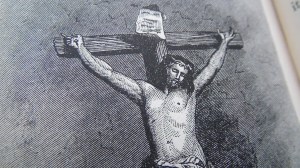
Jesus Christ crucified from a 19th century engraving © 2013/15 Simon Peter Sutherland
The claim to the throne of Jesus as the true King of Israel was known not only by the Jewish people, but by Greeks and by Romans. The Gospels record that the claim of Jesus as King was written by Pontius Pilate and placed upon Jesus’ cross.
- Matthew 27: 37 “This is Jesus the King of the Jews”
- Mark 15: 26 “The King of the Jews”
- Luke 23: 38 “This is the King of the Jews”
- John 19: 19 “Jesus of Nazareth the King of the Jews”
The claim of Jesus as King was written in “Greek, Latin and Hebrew” and in John 18: 34 Jesus questions Pilate on whether or not the claim that He Himself was King came from Pilate or from other people. “Sayest thou this thing of thyself, or did others tell it thee of me?”
That question should be asked by all of us; do we say things about Jesus because others tell us these things or do they come from ourselves? It must be a fact that since Christianity has impacted this world so strongly that every human being must at some point ask the question of who Jesus Christ truly was and is. If He was truly the Son of God, which I believe He was, then He is the most important person who has ever lived or ever will live. And if He wasn’t the Son of God then who was He and how strong a case can be assembled to make each and every individual wage eternity upon their answer?
I believe that Jesus was who He said He was and that is why I hold Him and His commands in such high royal esteem. I believe He is the only way to God and His miracles, healing’s and resurrection stand as firm proofs of that.
The question is; when He returns, will He take the throne in a literal sense?
Richard Baxter 400th anniversary 1615-2015
Posted by simon peter sutherland in Christianity, Theology on November 14, 2015
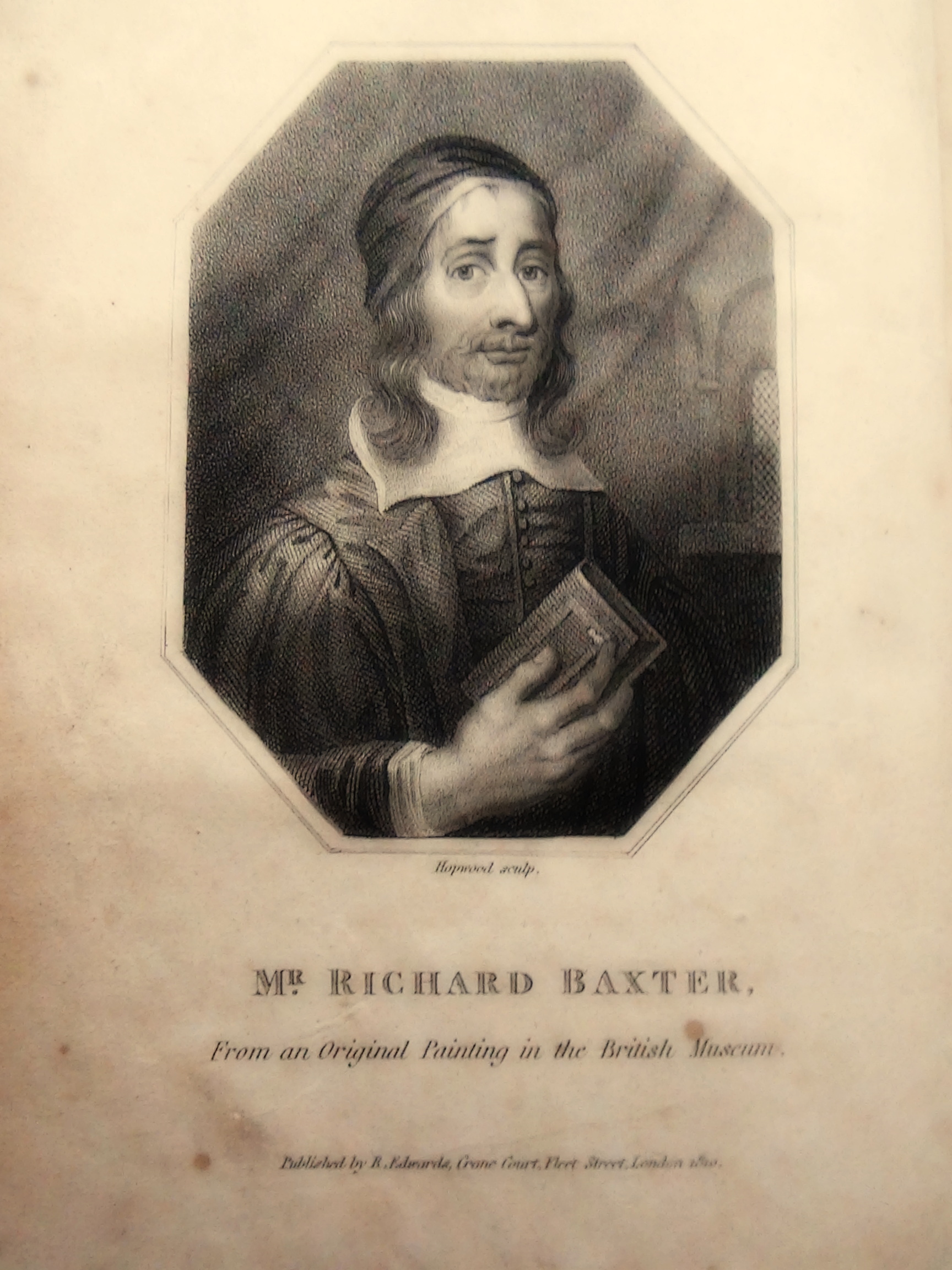
Richard Baxter © 2015 Simon Peter Sutherland
Thursday 12th November 2015 saw the 400th anniversary of 17th century Puritan Theologian, hymn writer and minister Richard Baxter.
Richard Baxter was born on 12th November 1615 and died 8th December 1691. He is famed for being minister at Kidderminster. He was a towering figure in the nonconformist movement. He lived through the English Civil war.
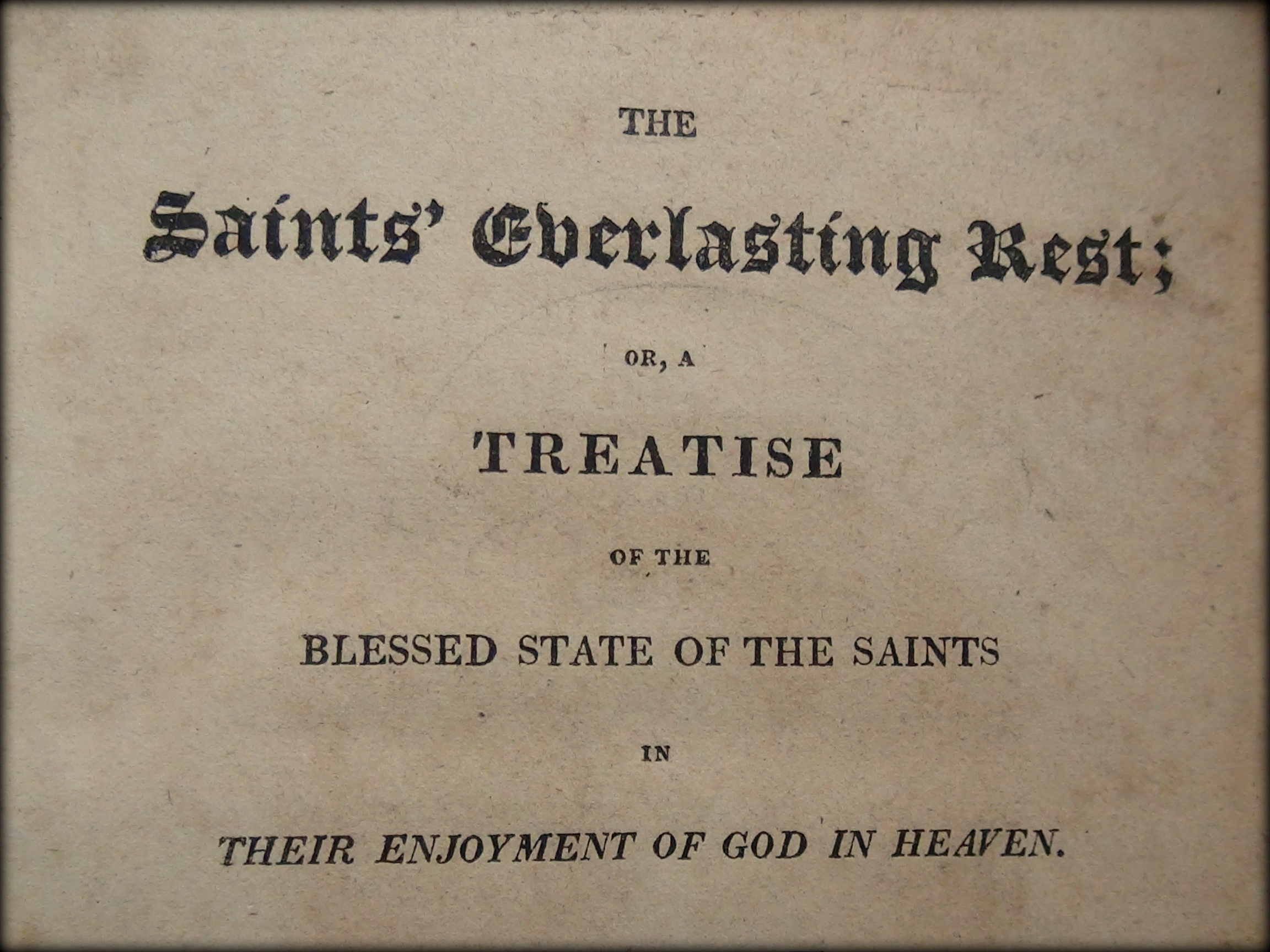
Richard Baxter Saint’s everlasting rest © 2015 Simon Peter Sutherland
He was a great Christian man and a true witness to the life of Christ. He wrote many books, which are still published even to this day and his work “the Saints everlasting rest” is one of my favoured works in all of Christianity.
Baxter interpreted Scripture that Christ died for ‘all mankind’ in the sense of Christ dying for sins, not only for the elect. The substitutionary atonement of Christ was available for all men in Adam, no one was excluded. The atonement was available for all who believe in Jesus Christ and that no man was excluded from believing in Jesus Christ as Saviour and Lord.
Baxter’s Theological position on the universal offering of salvation was not favoured by the majority Calvinists of his day and he ran into conflict with John Owen, the author of ‘the death of death in the death of Christ’. Owen believed that the sacrifice of Christ granted nothing for the none-elect and the doctrine of ‘double predestination’ was a logical conclusion to the doctrines of predestination, election and reprobation.
Baxter believed the doctrine of ‘limited atonement’ in the 5 point Calvinist sense, was inconsistent with the Bible and I agree with Baxter that Christ is available as Saviour for all mankind and I believe the Scriptures affirm this explicitly.
If I had only four books to choose from, my first would obviously be the King James Bible, then the Imitation of Christ by Thomas a Kempis, the third would be the Foxe’s Book of Martyrs and my final would be “Saints everlasting rest” by Richard Baxter. My reason for these choices is that the Bible is the absolute measuring line and rule of faith and practice for any Christian: the ‘Imitation of Christ’ helps me with humility and devotion: The ‘Foxe’s Book of Martyrs’ offers remembrance of our own Christian history, showing us where we have come from proceeding the Apostolic era to the Reformation and the ‘Saints everlasting rest” shows me quite clearly where Christians are going.
When I read ‘Saints everlasting rest’ I look forward to heaven.
I am truly thankful to men like Richard Baxter who stood up for Biblical truth and fell out of favour with many for doing so and I am thankful to God for His outpouring of love upon His people, showing us time and time again the treasures and glorious future He has stored up for those who love Him.
New documentary on Kos and the Gospel ‘coming in 2016’
Posted by simon peter sutherland in Documentaries on November 10, 2015
Kos and the Gospel documentary with Simon Peter Sutherland © 2015
Bonfire reflections
Posted by simon peter sutherland in Christianity on November 5, 2015

Prayer of thanksgiving from the Book of Common Prayer © 2015 Simon Peter Sutherland
Tonight being November 5th I attended a bonfire.
For those not familiar with English traditions; Bonfire Night is a tradition in Britain and cultural event where people gather around a large fire, eat toffee apples and treacle toffee and enjoy a display of fireworks.
Tonight I participated in this tradition at an even on the outskirts of Manchester. Walking toward the area I looked down over the bridge and the fire was lit and the people were all gathered around. Walking toward them and the fire, I looked around at everybody. People smiling, talking, drinking, eating.
When I arrived at the fire I felt myself moving toward the heat. I stood looking at the fire and I thought about the Christian martyrs from the earliest days of the Church to the Protestant Reformation. Suddenly my youngest son asked me ‘dad, is that what the fire was like when the burned George Marsh’. ‘Yes’ I replied, ‘and John Bradford’ Cranmer, Ridley, Latimer and Tyndall. And people flocked to see them burn. To some it was entertainment, others watched in terror, some with Religious zeal, others believing they were doing the will of God via the Pope.
In ancient times the execution of a man could be local entertainment. In the 16th century people sold religious items and even prayers during executions. Even in the 19th century, an execution could prove commercial. One such example can be found in the history associated with Beaumaris Gaol in Wales. Here, people often rented out highly elevated rooms and put on entertainment when a convicted man was to be put to death. It shows that man is not good, his depravity can be switched around based upon the mainstream culture of the times.
Many people back in ancient times would not consider it immoral to watch an execution and even to make a bit of money off the event. Today, it is difficult to believe that any person could do such things and yet when it is all said and done, people and their outlooks are all too often the result of culture and influence.
Today in some circles, the word ‘martyr’ has merely took on another form. It communicates ‘death cults’. But in the ancient Christian history, the meaning of the word martyr has a whole different connotation. The early Christian and Reformation martyrs did not want to die, they were merely willing to die rather than deny what they believed to be true. There is a difference.
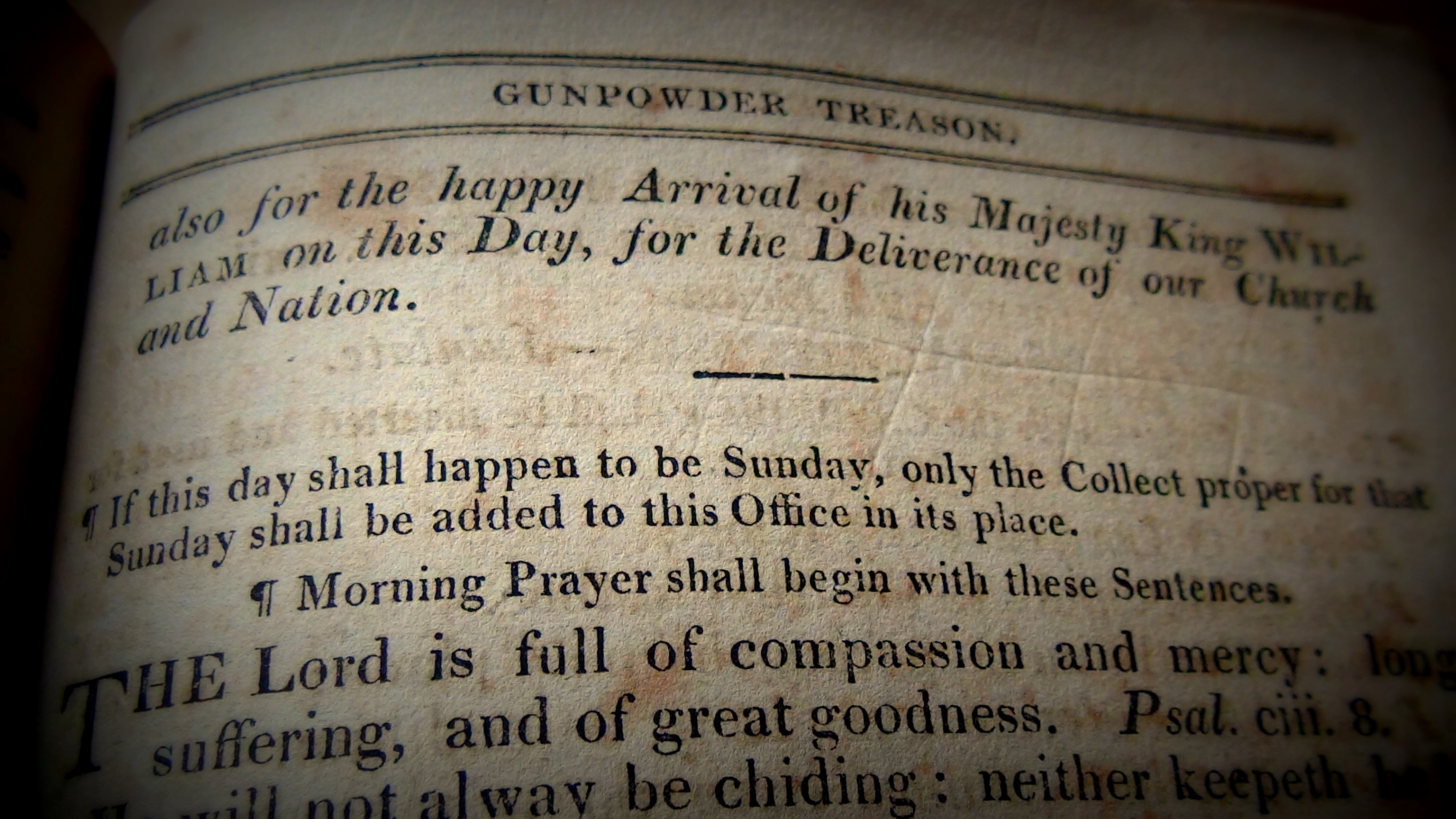
Gunpowder treason from the Book of Common Prayer © 2015 Simon Peter Sutherland
Tonight I looked around me and tried not to judge people, but I couldn’t help but reflect upon the sheer ignorance of a society that gathers around fires eating toffee apples and drinking drinks together without any discussion or meaningful understanding of what Bonfire Night means. For too many people, Bonfire Night has nothing whatsoever to do with Guy Fawkes and his failed attempt to undo the Protestant Reformation and return Britain once again to the religious bondages and totality of Roman Catholicism? On the contrary, it is merely a social event and just something people do to have a good time. Yet a sad reflection indeed is that November 5th was once a time of thanksgiving and prayer, where Christians thanked God for the deliverance of the Church and the nation from the bondage of Rome.
Britain has come a long way since the glorious days of the 16th century, and in many ways both England and Britain are founded upon the principles of the Protestant reformation. Many ideals such as democracy, tolerance and human rights are rooted in the principles of the reformation and the people of Britain should never forget that.
It is a true saying ‘remember, remember, the 5th of November’.
“Revealing the buried secrets of the Temple mount”
Posted by simon peter sutherland in Biblical archaeology on September 3, 2015
Simon Peter Sutherland
-

 Simon Peter Sutherland