simon peter sutherland

Singer-songwriter, Christian theologian and independent documentary maker. https://simonpetersutherland.com/ http://shimeon.co.uk/
Homepage: http://enjoyingtheology.wordpress.com
2017: A year of hope of renewal and Reformation!
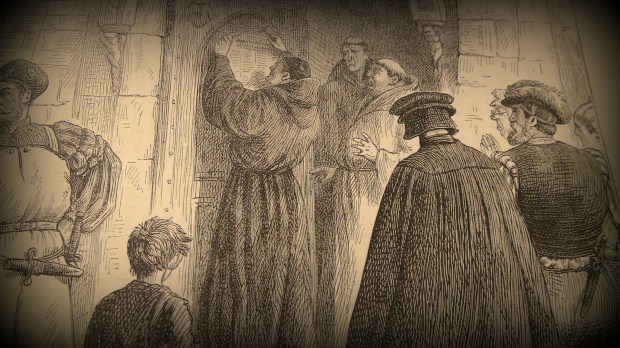
Luther nailing his Thesis to the Church door © 2017 Simon Peter Sutherland
This year, 2017, is the 500th anniversary of the Protestant Reformation.
On the 31st October 1517, Augustinian Monk, Martin Luther nailed his Ninety-Five Thesis to the Church door at Wittenberg.
The Thesis itself was centralised around his criticism of the Roman Catholic Church, the Papacy, Purgatory, and the selling of indulgences.
Today such a move would not seem all that bold, but in his day, the content of Luther’s thesis was one of the most radical criticisms of the Catholic Church that anyone had ever read. It was the dawn of such a bold and impactful move that Luther’s life between 1517-1546 would suffer a great deal of turmoil and tribulation.
In 1521 Luther stood trial at the Diet of Worms and was told to renounce all of his writings by order of Pope Leo X. Luther refused and was excommunicated by the very Church he sought to defend and reform. The Pope put a bounty on his head and Luther was given shelter by Prince Frederick the wise, at the Wartburg Castle.
 Luther had his opponents, but it is always good to have friends in high places!
At the Castle Luther spent his time translating the New Testament from Greek into German. Luther’s New Testament was published and what would follow for Luther would be a life of turmoil, religious intolerance and even war.
Luther wrote: “Be a sinner, and let your sins be strong, but let your trust in Christ be stronger.”.
Luther was no perfect man, but his reformation was a quest for perfection.
Every generation of Christians from the 16th to the 21st century have been inspired or have benefited in some way from the work that Luther began. There were even men who lived centuries prior to Luther who by the same Spirit sought to bring reform and renewal to the Church of their days.
Each quest has been a struggle. But the Word of God cannot be broken!
The Reformation is far from over.
Reform is not a thing of the past, it is an ongoing future. All of us, whether we be preachers or simply Christians have a part to play in the widespread movement of reform.
It is true that complaining is not always a popular thing. Today in our hyper positive thin world, the masses generally like a more positive, uplifting message rather than doom and gloom. But where would we be today if Luther and the Reformers kept silent and looked at the positives rather than the predominant errors of so many Churches?
The sad truth is that there is much to complain about and logic knows that a light does not come on without the negative too. When God said “Let there be light” He was not speaking about the darkness. But after the darkness came the light.
The 16th century Reformation had a saying: ‘Post Tenebrass Lux‘ It was a Latin phrase meaning ‘Light after darkness‘.
Today, the Christian Church in England is in a dark time. There really is no point in ignoring that. Where would we be today if the Reformers had never recognised that the Church was in an age of darkness because they were stooped up in a weak and crowd pleasing positive message? Where would we be if they had never criticised the errors of the Roman Catholic Church? Where would we be if they had looked at the positives of Rome and failed to judge? They would not have hoped for light.
 This year, in 2017 each one of us, wherever we are, can write our ninety-five Thesis and live in hope that the body of Christ is not done for!
Each one of us can stand against the widespread errors and deceitful doctrines of corrupt Churches. Even in the face of danger, excommunication, slander and fear based fundamentalism, each one of us can stand boldly and love our Bibles and say before God and man; ‘my conscience is captive to the Word of God, and to go against conscience is neither right nor safe. Here I stand, I can do no other God help me.‘
Clement of Alexandria on the birth of Jesus at Nisan
Posted in Christmas or Nisan, Theology on March 9, 2017
Gauffered edged Bible © 2017 Simon Peter Sutherland
“Therefore, from the birth of Christ to the death of Commodus are a total of one hundred ninety-four years, one month, and thirteen days. There are those who have calculated not only the year of our Lord’s birth, but also the day. They say that it took place in the twenty-eighth year of Augustus, on the twenty-fifth day of Pachon [May 20] … Others say that He was born on the twenty-fourth or twenty-fifth day of Pharmuthi [April 19 or 20]”
Clement of Alexandria (c. 195)
Following on from my previous post concerning the birth of Jesus and my expressive doubts that the Bible even remotely claims that Jesus was born on December 25th, I continue on with this polemical theme, and in this post, consider a historic claim made by Clement of Alexandria in the 2nd century AD.
For those readers who may never have heard or read anything of Clement of Alexandria, his life is worth looking into. With that in mind permit me to spend a few moments relaying some things concerning his life and work.
Clement of Alexandria was born c. 150 AD in Athens, Greece and is believed to have died in Jerusalem c. 215 or 220 AD. He was a Christian Theologian and is venerated as a ‘Church father’ and his writings provide us with important source material concerning the beliefs and claims of the ante-Nicene Church fathers.

Clement of Alexandria book © 2017 Simon Peter Sutherland
He wrote on such varied ethical topics as eating, drinking, laughter, filthy speaking, clothes, true beauty, ear rings, hair, Government, and behaviour in public baths. He also wrote concerning human arts, the necessity of understanding the Scriptures and Greek Philosophy. Clement wrote concerning the Septuagint and the comparison between the ancient Greeks with the Hebrews. Indeed, much of our understanding of early Christianity and the views of early Christians comes directly from the writings of the early ante-Nicene Church fathers.
A number of Clement’s works have fully survived. Here is a list of three of them.
- The Protrepticus
- The Paedagogus
- The Stromata
On embracing Christianity, Clement travelled extensively over Greece, Italy, and Jerusalem seeking instructions and teaching from “the most eminent teachers” of his day. He was recommended by Alexander, the Bishop of Jerusalem and Origen was one of his pupils. Church historian Eusebius also speaks well of him. Clement taught that Jesus Christ was the personal saviour of men and the living Word of God and he affirmed the Inspiration of the Holy Scriptures.
As part of Clement’s research and historic record of his day, the claim he made that “Others say that He (Jesus) was born on the twenty-fourth or twenty-fifth day of Pharmuthi [April 19 or 20]” may well be the earliest known reference to the actual birth date of Jesus?
It is with all this in mind that when a historic Church father of this calibre made such a historic claim that Jesus was not believed in his day to have been born on December 25th or anywhere near that date but in either April or May, I feel I must point out; it really is irrelevant whether a modern person agrees with Clement or not. He wrote what he wrote regardless!

The Gospel of Luke KJV © 2017 Simon Peter Sutherland
With this in mind it is certainly clear we need no emphasis on ‘historic revisionism’ since it may well be more historically consistent to claim Nisan as Jesus’ birth date rather than December and we can be certain that neither Matthew or Luke made any references to the birth of Jesus as taking place in winter. On the contrary, as I stated in my previous article, “it is more probable that He was born at Nisan which took place in the spring”. And it seems by all accounts that Ecclesiastical history may well affirm this too!
Nisan falls in March-April, and Clement claims Jesus’ birth date as either April 19th or 20th which is almost upon us. So, since this really is not a divisive issue, may I humbly suggest that believers and followers of Jesus Christ consider this history as we approach the coming months and the season of Nisan.
Was Christ born in December or Spring?
Posted in Christmas or Nisan, Theology on December 23, 2016
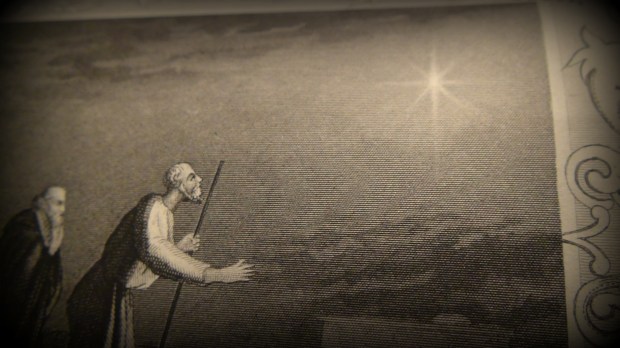
The wise men and the star over Bethlehem © 2016 Simon Peter Sutherland
Every year over the Christmas season I focus my mind distinctly upon the incarnate life of Christ as written in the Gospels. I often read Matthew and Luke’s narrative concerning the birth of Jesus at Bethlehem in the ancient Kingdom of Judah.
Many studies have been done to draw insights out from the Gospels to uncover the facts that surrounded Jesus’ birth. Questions are often asked: was Jesus really born on December 25th? Was He really born in a stable?
Over the many years of my being a Christian and desiring to know more about the incarnate life of Christ, I have approached the narratives from many perspectives and over recent years I have focused on His life from the perspective of Jesus as “the lamb of God” (John 1: 29).
From this perspective everything that Jesus did had to be a complete fulfilment of the requirements laid down by God concerning the sacrificial lambs offered up in the Temple. Lambs were to be perfect and without blemish (Exodus 12: 5, 1 Peter 1: 19) Jesus was perfect being without sin (1 John 3: 5, 2 Corinthians 5: 21, Hebrews 4: 15)
Likewise, the lambs which were reared to be offered up as Temple sacrifices were born in Bethlehem and sure enough, when they were firstborn were ‘wrapped up in swaddling cloths’ as Jesus was for a sign (Luke 2: 12). Yes, Jesus was born with the sacrificial Lambs.
Sadly for many, these points and necessities concerning the sacrificial lambs do not point to Jesus being born in December, but it is more probable that He was born at Nisan which took place in the spring.
Nisan is by far a more significant time since 14 Nisan marks the Fast of the firstborn, Jesus being the ‘firstborn among many brethren’ (Romans 8: 29, Colossians 1: 15) and 15 Nisan marks the birth of Isaac, whom demonstrates as a type or shadow of Christ. 15-21 Nisan marks the Passover when Jesus was crucified as the Passover lamb and 15 marks the Exodus from Egypt, which again was a foreshadow of Christ who delivered His people from the bondage of sin.
Obviously none of this proves that Jesus Christ wasn’t born in December, however if indeed He was born in Nisan it would be far more fitting with Scripture to consider it, since it is also on 17 Nisan that the ark of Noah came to rest upon the mountains of Ararat, which again speaks of Christ who is our eternal rest.

Christmas tree light © 2016 Simon Peter Sutherland
I like and enjoy Christmas and I too have my own traditions. These traditions include reading a fresh the nativity story from the Gospels, putting up the Christmas tree early while watching a Christmas movie and also reading ‘A Christmas Carol’ by Charles Dickens.
Yet even though I like tradition, I refuse to let it override Scripture.
‘All Hallows’and ‘Reformation day’ in Oxford
Posted in Christianity, Reform on November 3, 2016
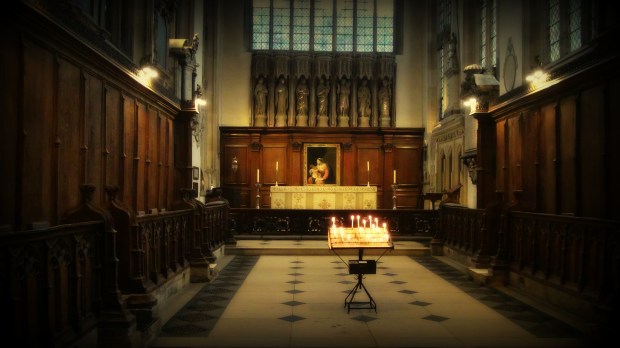
St Mary’s Oxford © 2016 Simon Peter Sutherland
This year my wife and I and our sons spent ‘all hallows’ and ‘Reformation day’ in Oxford remembering the true meaning of the so-called ‘Halloweeen’. Visiting the ancient sites associated with historic Christians such as John Wycliffe, William Tyndale, Hugh Latimer, Nicolas Ridley, Thomas Cranmer and Welsh Bible translator William Salesbury.
Oxford is one of those cities where history and the present meet together on every street. If one looks closely, stories and histories can be told on every street corner.
One of those stories which stood out to me on this trip was that of the trial of Hugh Latimer. A great reformer of the 16th century.
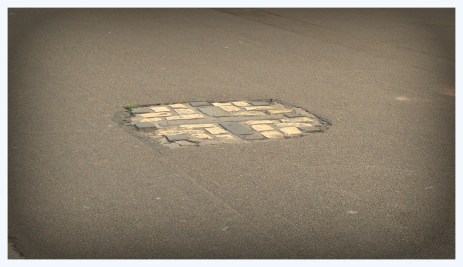
The exact spot where the Oxford Martyrs were burned © 2016 Simon Peter Sutherland
Latimer had studied at Cambridge and became a Bishop in the Church of England and for a time served as Chaplain to King Edward V1. However on the Coronation of bloody Mary to the throne, Latimer was brought to trial for his Biblical teachings and would eventually be condemned and burned at the stake with Nicolas Ridley, outside the city walls and Balliol College, on Broad Street where John Wycliffe had been Master.
During our time in Oxford we visited St Mary’s Church where the trial took place. As I stood in the centre of that room Latimer’s words echoed through my mind. Upon being questioned concerning his denial of Transubstantiation, Latimer declared that his memory had “plain gone” and that his teachings were true to Scripture and agreed with the Church fathers, when the Church fathers agreed with Scripture.
Concerning the Eucharist, Latimer was presented with a series of articles of which article 1 said “In the sacrament of the alter, by the virtue of God’s word pronounced by the priest, there is really present the natural body of Christ, conceived of the Virgin Mary, under the kinds of appearance of bread and wine; in like manner His blood.”
To this doctrine, Latimer replied;
“I answer that for the right celebration of the Lord’s Supper, there is none other presence of Christ required than a spiritual presence; and this presence is sufficient for a Christian man, as the presence by which we abide in Christ, and Christ abideth in us, to the obtaining of eternal life, if we persevere therein.”
Note that Latimer held to the very Biblical position that faith in Jesus Christ is ‘past, present, continuous‘ and ‘if’ we abide in Christ, Christ abides in us and by this abiding faith, we obtain eternal life, “if we persevere therein”.
For many Christians, these truth’s are nothing less than exactly what Scripture teaches. But concerning the case of Latimer, the enemies of Biblical truth were the Roman Catholic Priests and the Anabaptists. Of whom he goes on further to say; “And this I here rehearse lest some sycophant or scorner should suppose me, with the Anabaptists, to make nothing else of the sacrament but a bare and naked sign.”
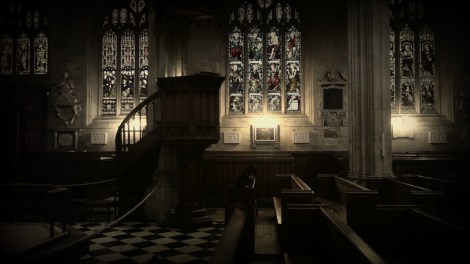
The location in St Mary’s where Cranmer stood trial © 2016 Simon Peter Sutherland
As I stood in the exact location in the Chapel where Latimer stood and the location where Cranmer made his defence, I was reminded of the cost of following Christ and being true to His Word. I know that from my own trials over the years within the Christian Church, my loyalty to Scripture has cost me the pulpit more than once.
Being loyal to Scripture is a battle from start to finish, and the Church is often the one that prevents the Christian loyalty to the Biblical text. So often it is a historic fact that the so-called Christian Church has been one of the major opponents of true Christianity. But in all this I count it all as part of the cost of knowing Christ. We lose in this life, but Christ wins. Even amidst persecution, Christ wins. After all, was it not the so-called Christian Church which persecuted the reformers? Was it not the official legal priests who insulted and accused my Lord Jesus Christ? Was it not the priests who murdered the Old Testament prophets and the New Testament Apostles? How much more then will the hypocrites continue to accuse those who obey Scripture rather than the whims, fictions and fairy tales of men.
Christians, be encouraged, stand with Latimer in the Truth and know that if you believe in the Lord Jesus Christ and abide in Him, you will never perish.
On that note Christians, I leave you with the echoing words and memory of Hugh Latimer, who, proceeding his trial, on his way to being burned at the stake, declared his salvation to men, saying thus;
“Play the man, Master Ridley; we shall this day light such a candle, by God’s grace, in England, as I trust shall never be put out.”.
“The love of money”a 19th century poem against money preachers
Posted in Christianity, Reform on October 21, 2016

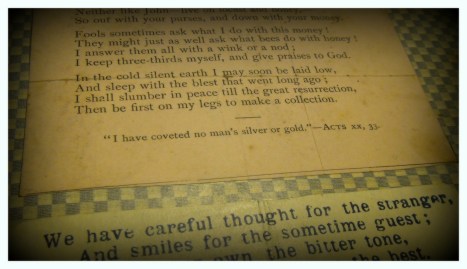
The Love of Money © 2016 Simon Peter Sutherland
Recently I acquired a 19th century scrapbook.
The scrapbook contains a lot of truly interesting things. Newspaper articles, letters, pictures, concert advertisements, and toward the front there is a poem. This poem is called “The Love of Money” and speaks against money preachers and ministers of the 19th century. It begins with a quote from 1 Timothy 6: 10 “For the love of money is the root of all evil: which while some coveted after, they have erred from the faith, and have pierced themselves through with many sorrows”.
In that text, Paul was stating that many had been led away from Truth and walked away from Christ and lost what they had and in doing so fell into a life of misery.
The poem is an insightful warning and one that is even still so relevant to our day, where so many people fall away from Truth and into error out of their love of money, and the pursuit of acceptance. As Bob Dylan once wrote; “money doesn’t talk, it swears“.
The old poem reads like so;
“MONEY ! oh money ! thy praises I sing,
Thou art my Savior, my God, and my King;
Tis for thee that I preach, and for thee that I pray, And make a collection twice each sabbath day.
I have candles, and all sorts of dresses to buy,
For I wish you know that my church is called high-
I don’t mean in structure of steeple or wall,
But so high that the Lord cannot reach it at all.
I have poor in my parish who need some relief –
I preach to their poverty, pray for their grief;
I send my box round to them, morning and night,
And hope they’ll remember “the poor widow’s mite.”
I gather my knowledge from wisdom’s great tree,
And the whole of my Trinity is £,s, and d ;
Yes, pounds, shillings, and pence, are all that I crave.
From my first step on earth to the brink of the grave.
When I’m laid low, and my body at rest,
Place a box on my grave, – ’tis my latest request,
That friends may all see who come for reflection,
I can’t rest in peace without a collection.
Money’s my creed, I’ll not pray without it,
My heaven is closed ‘gainst all those who doubt it;
For this is the essence of parson’s religion-
Come regular to church and be plucked like a pigeon.
My pay may be hundreds or thousands a year-
Double it, treble it, still I’ll be here
With my box or my bags, collecting your brass,
For I can’t do as Jesus did -ride on an ass.
I’ll have carriage and horses, and servants, and hall, –
I am not going to foot it, like Peter and Paul;
Neither like John – live on locust and honey, –
So out with your purses, and down with your money.
Fools sometimes ask what I do with this money !
They might just as well ask what bees do with honey !
I answer them all with a wink or a nod;
I keep three-birds myself, and give praises to God.
In the cold silent earth I may soon be laid low,
And sleep with the blest that went long ago;
I shall slumber in peace till the great resurrection,
Then be first to my legs to make a collection.”
The Love of Money © 2016 Simon Peter Sutherland
A mysterious torn image of William Tyndale
Posted in Bible translation, Christianity on September 10, 2016

Diwygwyr, Merthyron, A Chyffeswy. Eglwys Loegr, Ynghyd A’R Prif DDIWYGWYR YN Scotland, A GWLEDYDD TRAMOR. Gan T. Jones. 1813
Earlier this year I found an old Welsh book in Wales on Christian martyrs dating to 1813. The book itself covers the lives of William Tyndale, Martin Luther, George Marsh, John Bradford, Nicolas Ridley, and so forth and the pages appear in good condition for the age. However, a page that stood out to me contained an image of William Tyndale. The 16th century martyr and translator of the New Testament into English. The reason the print stood out is because Tyndale’s image had been ripped out.
Tyndale was a good Christian man and dedicated his life to the delivering of the Word of God to all English speaking people. The Church of his day rejected him, but his translation work laid the foundations of the Coverdale Bible, Bishops Bible, Geneva Bible and the King James Bible of 1611 and all significant English translations from 1535 to this day. 80-90% of the New Testament in the King James Bible has been shown to be the translation work of Tyndale.
The torn image seems to be deliberate? I say this because the book appears to have no damage elsewhere. However, even if the tare is coincidental, it still begs me to think upon how torn apart true Christians can be at times. Men like Tyndale held fast to the Bible and would not deny the text even in the face of danger, excommunication, imprisonment and execution. And how often has it taken place since his day that men and women who stand firm upon the text of the Bible are either rejected by the Church or ridiculed, mocked, insulted, and maligned by the world.
How true is that of our day.
Researching Titus 1: 5 on Crete
Posted in Biblical archaeology, Documentaries on June 17, 2016
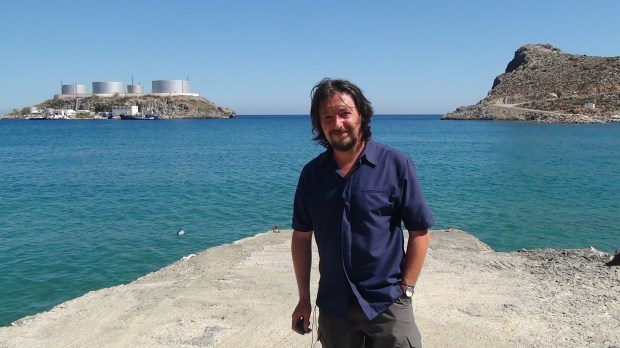
Kaloi Limenes, Crete © 2016 Simon Peter Sutherland
I have recently returned to England from my visit to the Greek island of Crete.
Travelling thousands of miles across Biblical landscape is always insightful and my primary goal on Crete was to seek out the historic locations written about in Acts 27 and Paul’s letter to Titus. My desire was to gain a more historic understanding of Titus 3: 5;
“for this reason I left you in Crete, that you should set in order the things that are wanting”.
2000 years ago Paul gave commission to Titus to appoint elders in every city on Crete. My aim in visiting Crete was to discover those ancient cities and gain an historic understanding of the work Titus did on Crete. Along the way standing face to face with the ancient law code of Gortyna, the mysteries of the Phaistos disc, ancient Minoan culture, and in some cases frustration at the sheer amount of unexcavated sites, leading to a general lack of information.

Kaloi Limenes ‘Fair Havens’ Crete © 2016 Simon Peter Sutherland
However, travelling over 100 miles across the island, visiting the ancient cities of Heraklion, Gortyna, Lasea and the spectacular mountains to port of ‘Kalio Limenes’ (fair havens) proved insightful to the Biblical narrative yet left many unanswered questions.
Part of the reason for this is that much of the history of ancient Crete has little connection to the New Testament era. Ancient cities such as Knossos have connections but they were long gone by the 1st century AD. But Gortyna and Kalio Limenes are key locations.

The Church of St. Titus, Gortyna © 2016 Simon Peter Sutherland
“Kos and the Gospel according to St.Luke” now on YouTube
Posted in Documentaries, The Bible on March 27, 2016
“Risen” movie review
Posted in The influence of film on March 25, 2016
This week I went to see “Risen” at a cinema.
I am not an overt cinema goer, but I’m always interested in Biblical movies. For me, seeing visual depictions of the Bible on screen is often exciting and inspiring.
Recent so-called ‘Biblically inspired’ releases such as “Noah” and “Exodus: Gods and Kings” have not even made it into my collection, but “Risen” certainly will. After all, the Bible contains the greatest stories ever written and the Biblical landscapes always look fantastic on film when the Bible is portrayed in a proper way.
For those who may not know, “Risen” is a new fictional movie inspired by the events surrounding the historic death and ‘resurrection of Christ’. It features a character named “Clavius” who is a Roman official, tired from battle, and summoned by Pontius Pilate in Jerusalem to break the legs of the newly crucified Jesus and dispose of His body. By the time Clavius arrives at Golgotha, the crucified Jesus is already dead and Clavius instructs a Roman solder to thrust the spear in His side. The body of Jesus is taken by Nicodemus, as Scriptures tell, and a Roman seal is put upon His tomb and under the watch of Roman guards.
When rumours surface of a resurrection, Clavius is sent to take care of the situation and find His body and settle the matter before Caesar arrives in Jerusalem.
When the ‘body of Jesus’ cannot be found the investigation begins but things do not work out as both Pilate and Clavius had planned. What follows is a Biblically respectful film and one that, on the whole, is consistent with what the Gospels record.
Joseph Fiennes, who plays Clavius is a great actor of modern times. His portrayal of Martin Luther in the 2003 film “Luther” was excellent and fresh. Likewise, his portrayal of Clavius was also well played.
In my opinion, “Risen” is a good film, Biblically consistent and respectful. The film had a positive and distinct absence of mere entertainment based dramatics and over acting, and seemed to deliver a film based upon dialogue and confronting personalities within the narrative of the greatest story ever told. Clavius is human, the disciples are fun. Pilate is concerned and Mary Magdalene is “free”.
For me, I felt the overall direction of the film was not heavy, the sets were excellent and the costumes fitting. The soundtrack was appropriate and occasionally the script contained a sense of the type of things New Testament people might have said in everyday life.
In my opinion, “Risen” remained respectful to Scripture and the centrality of the resurrection story. It was careful to not over interpret the narrative. I enjoyed watching the whole film. I wasn’t overly impressed by some of the accents or the portrayal of Jesus, but I suspect the film makers chose to present Jesus in a more ‘regular’ sense than many other films, however, he maintained a distinct middle Eastern appeal.
I think all Christians and none Christians should go and see “Risen” and for believers, I would like to say this; please don’t be put off by the recent past releases of “Noah” and “Exodus: Gods and Kings”. Forget about them, “Risen” is not in the same league. And although “Risen” may not be one of the greatest Biblical movies ever made, it is still ten thousand times better than “Noah” movie and “Exodus: Gods and Kings” combined. And the sooner Hollywood learns from this and realizes that the Bible contains the greatest stories and narratives ever written, the sooner Hollywood can stop wasting its time producing mock Biblical films and the more Christians can cease from wasting their money on going to see them.
“Kos and the Gospel according to St.Luke” trailer 2
Posted in Documentaries, The Bible on March 17, 2016
Simon Peter Sutherland
-

 Simon Peter Sutherland